
สมบัติทางความร้อนและทางกายภาพของฉนวนกันความร้อน จากเส้นใยกาบกล้วยผสมน้ำยางพารา
Article Sidebar
Main Article Content
บทคัดย่อ
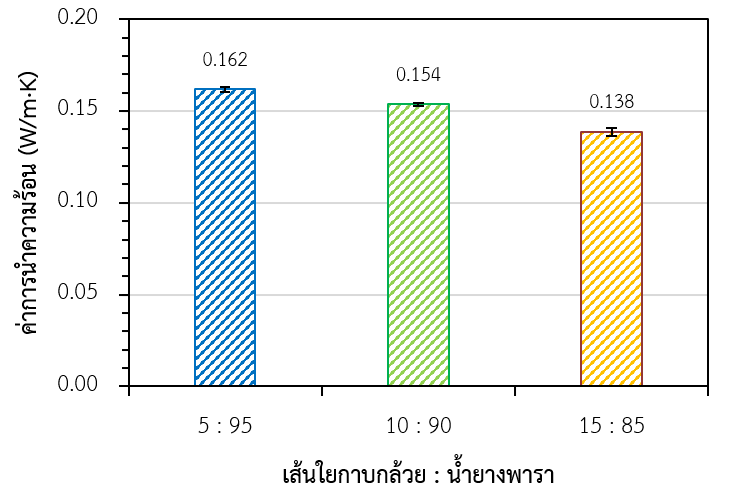
งานวิจัยนี้มีวัตถุประสงค์เพื่อพัฒนาและศึกษาคุณสมบัติของวัสดุฉนวนกันความร้อนจากวัสดุเหลือทิ้งทางการเกษตรที่ย่อยสลายได้ทางชีวภาพและปลอดภัยต่อสุขภาพมนุษย์ โดยใช้วัสดุหลักคือ เส้นใยกาบกล้วยและน้ำยางพารา งานวิจัยได้สำรวจอัตราส่วนผสมของเส้นใยกาบกล้วยต่อน้ำยางพาราโดยมวลที่แตกต่างกัน ได้แก่ 5:95, 10:90, และ 15:85 เพื่อหาอัตราส่วนที่เหมาะสมที่สุดในการผลิตฉนวน คุณสมบัติที่ทำการศึกษาประกอบด้วย ค่าการนำความร้อน ค่าความร้อนจำเพาะ อัตราการลามไฟ ความหนาแน่น และการดูดซับน้ำ ผลการศึกษาพบว่า ฉนวนกันความร้อนจากเส้นใยกาบกล้วยผสมน้ำยางพาราในอัตราส่วน 15:85 โดยมวล ให้คุณสมบัติที่ดีที่สุด โดยมีค่าการนำความร้อน ค่าความจุความร้อนจำเพาะ อัตราการลามไฟ และความหนาแน่นต่ำที่สุดคือ 0.138 W/m·K 1.140 MJ/m³·K 0.011 cm/s และ 489 kg/m³ ตามลำดับ อย่างไรก็ตาม การดูดซับน้ำมีแนวโน้มเพิ่มขึ้นตามปริมาณเส้นใยที่เพิ่มขึ้น จากผลการทดลองทั้งหมดแสดงให้เห็นว่าฉนวนกันความร้อนจากเส้นใยกาบกล้วยผสมน้ำยางพารามีคุณสมบัติการนำความร้อนและคุณสมบัติทางกายภาพใกล้เคียงกับฉนวนใยธรรมชาติชนิดอื่น งานวิจัยนี้จึงเป็นแนวทางสำคัญในการเพิ่มมูลค่าวัสดุเหลือทิ้งทางการเกษตร และพัฒนาไปสู่การเป็นวัสดุทางเลือกที่เป็นมิตรต่อสิ่งแวดล้อมสำหรับการก่อสร้าง
Article Details

อนุญาตภายใต้เงื่อนไข Creative Commons Attribution-NonCommercial-NoDerivatives 4.0 International License.
เอกสารอ้างอิง
กนกวรรณ มหารัชมงคล. (2558). การดัดแปลงพื้นผิวเส้นใยเซลลูโลสจากฟางข้าวด้วยไซเลนเพื่อใช้เป็นสารเสริมแรงในอีพอกซีเรซิน. (วิทยานิพนธ์ ปริญญามหาบัณฑิต, มหาวิทยาลัยศิลปากร). http://ithesisir.su.ac.th/dspace/handle/123456789/177
บุญญารัตน์ พิมพรม, ปีย์วรา แดงนา และปานใจ สื่อประเสริฐสิทธิ. (2560). การพัฒนาฉนวนกันความร้อนจากฟางข้าว. ใน: เอกสารประกอบการประชุมวิชาการ มหาวิทยาลัยมหาสารคามวิจัย ครั้งที่ 13, มหาวิทยาลัยมหาสารคาม. มหาสารคาม. 358-367.
ปานใจ สื่อประเสริฐสิทธิ์, ชิตชเนตร บุญเฉลียว และสุธาทิพย์ จันทร์ศิริ. (2563). ความเป็นไปได้ทางเทคนิคสำหรับการผลิตแผ่นฉนวนกันความร้อนจากเปลือกทุเรียน. วารสารวิทยาศาสตร์และเทคโนโลยี มหาวิทยาลัยมหาสารคาม, 39(6). 664-671.
โรสลีนา จาราแว. (2559). การพัฒนาฉนวนกันความร้อนจากพืชในเขตท้องถิ่น (รายงานวิจัย). มหาวิทยาลัยราชภัฏยะลา.
วิศิษฎ์ โล้เจริญรัตน์. (2548). การผลิตฉนวนความร้อนจากเส้นใยฟางข้าวและน้ำยางธรรมชาติ. วิศวกรรมสาร มก, 19, 32-45.
สิทธิชัย โพธิ์ถนอม. (2564). การพัฒนาแผ่นประกอบที่ผลิตจากใบยางพาราผสมน้ำยางพาราธรรมชาติสำหรับการประยุกต์ใช้ในงานอาคาร (วิทยานิพนธ ปริญญามหาบัณฑิต, มหาวิทยาลัยธรรมศาสตร์). https://ethesisarchive.library.tu.ac.th/thesis/2021/TU_2021_6316030219_15139_22083.pdf
อามีนา ตําหิ. (2560). การผลิตฉนวนความร้อนจากเสนใยใบเตยปะหนันและน้ำยางธรรมชาติ (วิทยานิพนธ์ ปริญญามหาบัณฑิต, มหาวิทยาลัยบูรพา). https://buuir.buu.ac.th/jspui/handle/1234567890/6605?mode=full
Asdrubali, F., D'Alessandro, F., & Schiavoni, S. (2015). A review of unconventional sustainable building insulation materials. Sustainable Materials and Technologies, 4, 1-17.
Belayachi, N., Hoxha, D., & Ismail B. (2017). Impact of fiber treatment on the fire reaction and thermal degradation of building insulation straw composite. Energy Procedia, 139, 544-549.
Bisaria, H., Gupta, M.K., Shandilya, P., and Srivastava, R.K. (2015). Effect of fibre length on mechanical properties of randomly oriented short jute fibre reinforced epoxy composite. Materials Today: Proceedings, 2, 1193–1199.
Jaktorn, C., & Jiajitsawat, S. (2015). Production of thermal insulator from water hyacinth fiber and natural rubber latex. Naresuan University Science Journal, 13(2), 11-18.
Jayaprabha J.S., Brahmakumar M., & Manilal V.B. (2011). Banana pseudostem characterization and its fiber property evaluation on physical and bioextraction. Journal of Natural Fibers, 8(3), 149–160.
https://doi.org/10.1080/15440478.2011.601614
Kumar, A., Sharma, K., & Mehta, R. (2020). Thermal degradation of lignocellulosic fibers: A flame retardant approach. Renewable and Sustainable Materials, 34(6), 453–460.
Olaiya, N.G., Aina, S.A., & Olawale, S.T. (2016). A comparison of banana fiber thermal Insulation with conventional building thermal insulation. Current Journal of Applied Science and Technology,
(1), 1–7. https://journalcjast.com/index.php/CJAST/article/view/1228
Roslina, R. (2016). Thermal properties of bio-insulation panels made from agricultural fibers. Malaysian Journal of Materials Science, 10(1), 45–52.
Yousefi Y., and F Tariku. (2021). Thermal Conductivity and Specific Heat Capacity of Insulation materials at Different Mean Temperatures. Journal of Physics: Conference Series, 2069.
