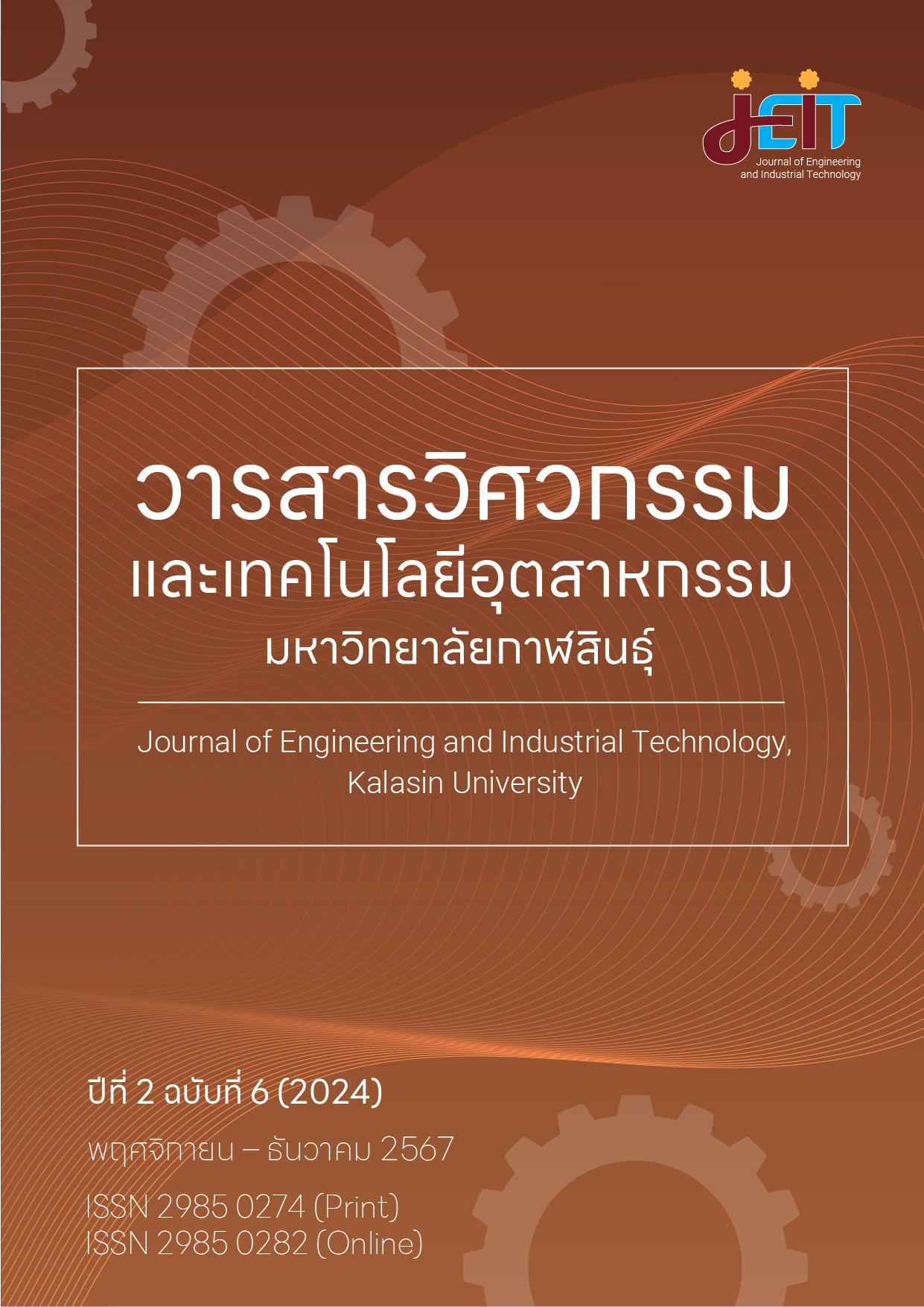
Improvement of the Production Process for Handwoven Shawls with Nature Dye Printing to Add Value and Reduce Waste by Applying Value Strem Mapping
DOI:
https://doi.org/10.14456/jeit.2024.25Keywords:
Hand woven fabric, Natural dye printing, Value-added activity analysis, Value stream mapping, Waste reductionAbstract
This research focuses on studying the production process of handwoven shawls with natural dye printing (ECO PRINT) with the objectives of analyzing production steps and developing strategies to reduce waste and enhance product value. The research involved field data collection at Ban Dong Noi, Moo 5, Huai Pho Subdistrict, Mueang District, Kalasin Province, using production process charts and value stream mapping as key analytical tools. The production process is divided into two main parts: cotton weaving, consisting of seven steps with an average duration of 761 minutes per cycle, and natural dye printing, comprising 24 steps with an average duration of 405.6 minutes per cycle. Data collection and time analysis were conducted over five production cycles. The analysis identified key wastes in the process, including unnecessary movements and waiting times, which can be addressed by workspace organization, the use of supporting technologies such as storage tools and automation, and improved time management. These improvements reduced production time by 5.2% and movement distances by 40%, enhancing process efficiency, minimizing waste, and sustainably increasing the value of ECO PRINT products.
References
[1] Ministry of Commerce, Thailand, OTOP strategic development plan 2022–2026. Ministry of Commerce, 2022.
[2] UNESCO, Creative economy report: Cultural times. United Nations Educational, Scientific and Cultural Organization, 2021.
[3] European Commission, Green economy and the role of circularity in crafts and design. European Union, 2021.
[4] K. Fletcher, Sustainable fashion and textiles: Design journeys. Earthscan, 2008.
[5] J. P. Womack and D. T. Jones, Lean thinking: Banish waste and create wealth in your corporation. Simon & Schuster, 1996.
[6] สำนักงานเศรษฐกิจการคลัง, รายงานภาวะเศรษฐกิจเศรษฐกิจฐานรากและการส่งเสริมภูมิปัญญาท้องถิ่น, กระทรวงการคลัง, 2564.
[7] Institute of Industrial Engineers, Lean tools for process improvement: Value stream mapping and beyond. Industrial Engineering Press, 2010.
[8] United Nations, Sustainable development goals: A decade of action. United Nations, 2020.
[9] Institute of Industrial Engineers, Lean tools for process improvement: Value stream mapping and beyond. Industrial Engineering Press, 2010.
[10] J. P. Womack and D. T. Jones, Lean thinking: Banish waste and create wealth in your corporation. Simon & Schuster, 1996.
[11] S. G. Naik and R. Kodali, "Value stream mapping: A recent literature review," Benchmarking: An International Journal, vol. 17, no. 4, pp. 536–559, 2010.
[12] วีระศักดิ์ ศรีลารัตน์, สุจาริณี สังข์วรรณะ, ภัทรภร พุฒพันธ์, ธิติรัตน์ วงษ์กาฬสินธุ์, ณรัช พรนิธิบุญ และ ธนัง ชาญกิจชัญโญ, "การพิมพ์สีธรรมชาติจากใบเพกาด้วยเทคนิคการถ่ายโอนสีสู่ผ้าฝ้าย," วารสารวิจัยวิจัยและพัฒนา วไลยอลงกรณ์, ปีที่ 1, ฉบับที่ 1, หน้า 45–55, 2565.
[13] รมิตา มุสิกพงศ์, "การประยุกต์ใช้แผนภูมิสายธารแห่งคุณค่าในการปรับปรุงกระบวนการผลิตของธุรกิจพลาสติกฟิล์ม: กรณีศึกษาบริษัท TPK," วิทยานิพนธ์ปริญญาโท, มหาวิทยาลัยบูรพา, 2558.
[14] โสรญา รอดประเสริฐ, "การพัฒนากระบวนการผลิตผ้าทอมือและเส้นใยย้อมสีธรรมชาติ (กลุ่มแม่บ้านทอผ้าบ้านหนองสังข์)," กรมวิทยาศาสตร์บริการ, 2566.
[15] วรดา พรมหนู, "การจัดการสายธารแห่งคุณค่าและการจัดสมดุลสายการผลิตเพื่อเพิ่มประสิทธิภาพทางการผลิต: กรณีศึกษากระบวนการผลิต 4Q00 บริษัท AUTOMOTIVE จำกัด," วิทยานิพนธ์ปริญญาโท, มหาวิทยาลัยบูรพา, 2559.
[16] ธนาภรณ์ สุทธิโพธิ์, ชฎาพร อินหลี, ธีราภรณ์ ลักขณาอำไพ และ สุธิดา ทับทิมศรี, "การจัดการซัพพลายเชนการผลิตผ้าทอ: กรณีศึกษาผ้าทอจอมป่า ตำบลแม่จัน อำเภออุ้มผาง จังหวัดตาก," รายงานการประชุมวิชาการระดับชาติ สำหรับนักศึกษา มหาวิทยาลัยราชภัฏกำแพงเพชร ครั้งที่ 1, 22 กุมภาพันธ์ 2564, หน้า 651–658.
[17] P. Srithiphan, "Study of process cotton fabric tie-dye with natural dyes from nipa palm: A case study of cotton fabric tie-dye with natural dyes group Wat Prasittaram School," ResearchGate, 2020.
[18] ชัยวัฒน์ แก้วคล้ายขจรศิริ, "การศึกษากระบวนการผ้าย้อมครามและพืชชนิดอื่น เพื่อพัฒนาผ้าทอมือจากสีธรรมชาติ," วิทยานิพนธ์ปริญญาเอก, มหาวิทยาลัยอุบลราชธานี, 2555.
[19] กาสัก เต๊ะขันหมาก, พนิตสุภา ธรรมประมวง และ กานดา เต๊ะขันหมาก, "การพัฒนาผ้าฝ้ายมัดหมี่ทอมือย้อมสีธรรมชาติต่อยอดภูมิปัญญาสู่เศรษฐกิจสร้างสรรค์ ตำบลโคกเจริญ อำเภอโคกเจริญ จังหวัดลพบุรี," วารสารการวิจัยเพื่อพัฒนาชุมชน (มนุษยศาสตร์และสังคมศาสตร์), 2564, หน้า 84–99.
Downloads
Published
How to Cite
Issue
Section
Categories
License
Copyright (c) 2024 Journal of Engineering and Industrial Technology, Kalasin University

This work is licensed under a Creative Commons Attribution-NonCommercial-NoDerivatives 4.0 International License.
ลิขสิทธิ์ของวารสาร
เนื้อหาและข้อมูลในบทความที่ลงตีพิมพ์ในวารสารศูนย์ดัชนีการอ้างอิงวารสารไทย ถือเป็นข้อคิดเห็นและความรับผิดชอบของผู้เขียนบทความโดยตรงซึ่งกองบรรณาธิการวารสาร ไม่จำเป็นต้องเห็นด้วย หรือร่วมรับผิดชอบใด ๆ
บทความ ข้อมูล เนื้อหา รูปภาพ ฯลฯ ที่ได้รับการตีพิมพ์ในวารสารศูนย์ดัชนีการอ้างอิงวารสารไทย ถือเป็นลิขสิทธิ์ของวารสารศูนย์ดัชนีการอ้างอิงวารสารไทย หากบุคคลหรือหน่วยงานใดต้องการนำทั้งหมดหรือส่วนหนึ่งส่วนใดไปเผยแพร่ต่อหรือเพื่อกระทำการใด จะต้องได้รับอนุญาตเป็นลายลักอักษรจากวารสารศูนย์ดัชนีการอ้างอิงวารสารไทยก่อนเท่านั้น