
Genetic Diversity Analysis of Sodium Azide-Induced Mutants of Ornamental Banana (Musa ornata Roxb.) Using ISSR Markers
Article Sidebar
Main Article Content
บทคัดย่อ
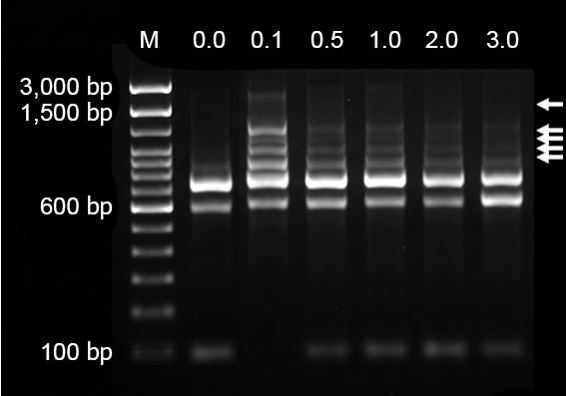
Chemical mutagenesis is widely used to generate genetic variation in clonally propagated crops where conventional hybridization is limited. This study evaluated the mutagenic effects of sodium azide (NaN3) on Musa ornata Roxb. and assessed the resulting genetic diversity using inter simple sequence repeat (ISSR) markers. In vitro–propagated plantlets were treated with NaN3 concentrations ranging from 0.1 to 4.0 mM, and survival responses were used to determine optimal mutagenic doses. Plant survival decreased linearly with increasing NaN3 concentration (y = −20.92x + 93.59, R² = 0.938), with estimated LD30 and LD50 values of 1.13 mM and 2.08 mM, respectively. Sublethal NaN3 treatments induced measurable morphological variation in regenerated plantlets, including changes in fresh weight, leaf number, leaf length, and root development. Molecular analysis using ten ISSR primers generated 81 scorable ISSR bands, of which 36 were polymorphic (43.02%). Genetic diversity indices indicated moderate variation among mutants (PIC = 0.28, Nei’s gene diversity = 0.24, Shannon’s index = 0.34). Cluster analysis based on UPGMA grouped the plantlets into three major genetic clusters, with pairwise genetic dissimilarities ranging from 34.7% to 68.4%. The clustering pattern showed partial correspondence with observed morphological variation, suggesting that NaN3-induced genomic changes contributed to phenotypic diversification. These findings demonstrate that the combination of in vitro sodium azide mutagenesis and ISSR marker analysis is an effective approach for generating and identifying novel variation in M. ornata. The resulting lines represent valuable genetic resources for the improvement of ornamental bananas through mutation breeding.
Article Details

อนุญาตภายใต้เงื่อนไข Creative Commons Attribution-NonCommercial-NoDerivatives 4.0 International License.
เอกสารอ้างอิง
Abdullah, T. L., Endan, J., & Nazir, B. M. (2009). Changes in flower development, chlorophyll mutation and alteration in plant morphology of Curcuma alismatifolia by gamma irradiation. American Journal of Applied Sciences, 6(7), 1436–1439.
Adeosun, C. A., Elem, K. A., & Eze, C. D. (2020). Mutagenic effects of sodium azide on the survival and morphological characters of tomato varieties. Nigerian Journal of Biotechnology, 37(1), 55–62.
Ahmad, B. T., Sharma, M., & Anis, M. (2007). Comparative analysis of meiotic aberrations induced by diethylsulphate and sodium azide in broad bean (Vicia faba L.). Asian Journal of Plant Sciences, 6(7), 1051–1057.
Al-Quariny, F., & Khan, S. (2009). Mutagenic effects of sodium azide and its application in crop improvement. World Applied Sciences Journal, 6(11), 1589–1601.
Amano, E. (2004). Practical suggestion for mutation breeding. Forum for Nuclear Cooperation in Asia (FNCA) Mutation Breeding Project. https://www.fnca.mext.go.jp/english/mb/mbm/pdf/06_midcover.pdf
Beyramizadeh, E., Arminian, A., & Fazeli, A. (2023). Evaluating the effect of gamma rays on Zamiifolia (Zamioculcas zamiifolia) plant in vitro and genetic diversity of the resulting genotypes using ISSR marker. Scientific Reports, 13(1), 8308.
Bornet, B., & Branchard, M. (2001). Nonanchored inter simple sequence repeat (ISSR) markers: Reproducible and specific tools for genome fingerprinting. Plant Molecular Biology Reporter, 19(3), 209–215.
Dahiru, M. B., Yarima, A., Abubakar, A. I., & Abubakar, Z. A. (2021). Mutagenic effects of sodium azide on some qualitative traits of maize (Zea mays). African Journal of Biological Sciences, 3(1), 52–57.
Ganesan, M., Bhanumathi, P., & Jayabalan, N. (2005). Mutagenic effect of sodium azide on somatic embryo regeneration and root growth of cotton (Gossypium hirsutum L. cv. SVPR2). Journal of Agricultural Technology, 1(2), 365–380.
Hamdan, Y. A. (2024). Genetic diversity analysis of Palestinian safflower (Carthamus tinctorius L.) using inter simple sequence repeat (ISSR) markers. Genetic Resources and Crop Evolution, 71(2), 1–13.
Horsburgh, C., & Noller, J. (2005). Exotic tropical fruits and vegetables – Category marketing opportunities. Rural Industries Research and Development Corporation, Australian Government.
Khatri, A., Bibi, S., Dahot, M. U., Khan, I. A., & Nizamani, G. S. (2011). In vitro mutagenesis in banana and variant screening through ISSR. Pakistan Journal of Botany, 43(5), 2427–2431.
Khan, S., Al-Qurainy, F., & Anwar, F. (2009). Sodium azide: A chemical mutagen for enhancement of agronomic traits of crop plants. Environment & We: An International Journal of Science & Technology, 4(1), 1–21.
Lamo, K., Bhat, D. J., Kour, K., & Solanki, S. P. S. (2017). Mutation studies in fruit crops: A review. International Journal of Current Microbiology and Applied Sciences, 6(12), 3620–3633.
Lo, K. L., Chen, Y. N., Chiang, M. Y., Chen, M. C., Panibe, J. P., Chiu, C. C., Liu, L. W., Chen, L. J., Chen, C. W., Li, W. H., & Wang, C. S. (2022). Two genomic regions of a sodium azide-induced rice mutant confer broad-spectrum and durable resistance to blast disease. Rice, 15(1), 2.
Mostafa, G. G. (2011). Effect of sodium azide on the growth and variability induction in Helianthus annuus L. International Journal of Plant Breeding and Genetics, 5(1), 76–85.
Owais, W. M., & Kleinhofs, A. (1988). Metabolic activation of the mutagen azide in biological systems. Mutation Research/Fundamental and Molecular Mechanisms of Mutagenesis, 197(2), 313–323.
Ramzan, M., Sarwar, S., Kauser, N., Saba, R., Hussain, I., Shah, A. A., ... & Alwahibi, M. S. (2020). Assessment of inter simple sequence repeat (ISSR) and simple sequence repeat (SSR) markers to reveal genetic diversity among Tamarix ecotypes. Journal of King Saud University – Science, 32(8), 3437–3446.
Srivastava, P., Marker, S., Pandey, P., & Tiwari, D. K. (2011). Mutagenic effects of sodium azide on the growth and yield characteristics in wheat (Triticum aestivum L. em. Thell.). Asian Journal of Plant Sciences, 10(3), 190–201.
Srisamoot, N., & Padsri, I. (2018). Assessing genetic diversity of some Anthurium andraeanum Hort. cut-flower cultivars using ISSR markers. Genomics and Genetics, 11(1–2), 1–8.
Türkoğlu, A., Tosun, M., & Haliloğlu, K. (2023). Sodium azide as a chemical mutagen in wheat (Triticum aestivum L.): Patterns of the genetic and epigenetic effects with iPBS and CRED-iPBS techniques. Agriculture, 13(6), 1242.
Velemínský, J., Gichner, T., & Pokornỳ, V. (1977). Induction of DNA single-strand breaks in barley by sodium azide applied at pH 3. Mutation Research/Fundamental and Molecular Mechanisms of Mutagenesis, 42(1), 65–70.
Wannajindaporn, A., Kativat, C., & Tantasawat, P. A. (2016). Mutation induction of Dendrobium ‘Earsakul’ using sodium azide. HortScience, 51(11), 1363–1370.
Yang, T., Zhang, X., Huang, S., Gao, M., Li, T., & Zhang, S. (2023). Evaluating the genetic diversity of Erythropalum scandens using inter-simple sequence repeat markers. Genetic Resources and Crop Evolution, 70(8), 2377–2390.
