เว็บแอปพลิเคชันสำหรับวิเคราะห์ความรู้สึกของผู้ชมชาวไทยบน YouTube
คำสำคัญ:
Sentiment Analysis, Thai Word Segmentation, Social Media, YouTubeบทคัดย่อ
งานวิจัยนี้นำเสนอการพัฒนาและประยุกต์ใช้เทคนิคการวิเคราะห์อารมณ์ (Sentiment Analysis)
สำหรับข้อความภาษาไทยบน YouTube โดยใช้ชุดข้อมูลที่ระบุอารมณ์ใน 3 ประเภท ได้แก่ อารมณ์เชิงบวก
เชิงลบ และเป็นกลาง ขั้นตอนการวิจัยเริ่มจากการเตรียมข้อความและประมวลผลข้อความ เช่น การตัดคำ
ภาษาไทยและการลบคำหยุด (Stopwords) เพื่อทำความสะอาดข้อมูล และได้ใช้เทคนิคการสร้างแบบจำลอง
ข้อความและเครื่องมือ VADER ในการวิเคราะห์อารมณ์ของข้อความ หลังจากกระบวนการประมวลผล
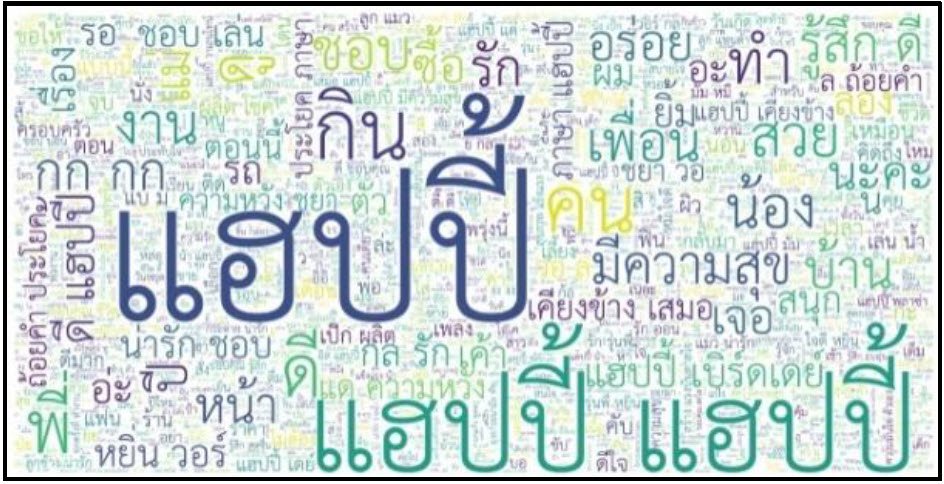
งานวิจัยได้สร้าง Word Cloud เพื่อแสดงคำที่ปรากฏบ่อยในข้อความที่มีอารมณ์เชิงบวกและเชิงลบ รวมถึง
การสร้างกราฟเพื่อแสดงการกระจายตัวของอารมณ์ในชุดข้อมูล ผลการวิเคราะห์แสดงให้เห็นถึงรูปแบบการ
กระจายตัวของอารมณ์ในข้อความต่าง ๆ ซึ่งสามารถนำไปใช้ในการศึกษาพฤติกรรมผู้ใช้สื่อสังคมออนไลน์
นอกจากนี้ยังมีการนำข้อมูลจากคลิปที่เป็นกระแสในปัจจุบันที่เกี่ยวข้องกับฮิปโปแคระชื่อ “หมูเด้ง” มาเป็น กรณีศึกษา
เอกสารอ้างอิง
Zhang, L., & Liu, B. (2017). Sentiment Analysis and Opinion Mining. In C. Sammut & G. I. Webb (Eds.), Encyclopedia of
Machine Learning and Data Mining (pp. 1152–1161). Springer US.
Saad, S., & Saberi, B. (2017). Sentiment Analysis or Opinion Mining: A Review. International Journal on Advanced Science, Engineering and Information Technology, 7(5), 1660 -1666.
Statista (2023). YouTube – Statistics & Facts. Retrieved from https://www.statista.com
DataReportal (2022). Digital 2022: Thailand. Retrieved from https://datareportal.com
YouTube Marketing (2022). Consumer Behavior Insights on YouTube. Retrieved from https://www.thinkwithgoogle.com
Ongkrutraksa, W. (2021). The Influences of Marketing Communications in YouTube on Behavior of Generation Y and Z Consumer. Journal of Public Relations and Advertising, 14(1), 1-12.
Phatthiyaphaibun, W., Chaovavanich, K., Polpanumas, C., Suriyawongkul, A., Lowphansirikul, L., Chormai, P., Limkonchotiwat, P., Suntorntip, T., & Udomcharoenchaikit, C.(2023). PyThaiNLP: Thai Natural Language Processing in Python. In L. Tan, D. Milajevs, G. Chauhan, J. Gwinnup, & E. Rippeth (Eds.), Proceedings of the 3rd Workshop for Natural Language Processing Open Source Software (NLP-OSS 2023) (pp. 25-36).Association for Computational Linguistics. https://doi.org/10.18653/v1/2023.nlposs-1.4
Hutto C. J. & Gilbert E. (2014). VADER: A Parsimonious Rulebased Model for Sentiment Analysis of Social Media Text. Proceedings of the International AAAI Conference on Web and Social Media, 8(1), 216 – 225. https://doi.org/10.1609/icwsm.v8i1.14550
Jurafsky D. & Martin J.H. (2025) . Speech and Language Processing. (3rd ed.). Pearson Education.
Mikolov T., Chen K., Corrado G., & Dean J. (2013). Efficient Estimation of Word Representations in Vector Space. arXiv preprint arXiv:1301.3781. https://doi.org/10.48550/arXiv.1301.3781
Greyling, L., & Rossouw, J. (2022). Twitter sentiment and stock market movements: The predictive power of social media. VoxEU.org. 6.
Devlin J., Chang M.-W., Lee K., & Toutanova K. (2019). BERT: Pre-training of Deep Bidirectional Transformers for Language Understanding. Proceedings of the 2019 NAACL-HLT.pp.4171 – 4186.
Jenkarn, N. (2020). Thai-textual Cyberbullying Detection using Support Vector Machines. Science Technology and Innovation Journal,1(1).
ดาวน์โหลด
เผยแพร่แล้ว
รูปแบบการอ้างอิง
ฉบับ
ประเภทบทความ
หมวดหมู่
สัญญาอนุญาต
ลิขสิทธิ์ (c) 2025 วารสารวิชาการวิทยาศาสตร์และวิทยาศาสตร์ประยุกต์

อนุญาตภายใต้เงื่อนไข Creative Commons Attribution-NonCommercial-NoDerivatives 4.0 International License.
บทความวิชาการ/บทความวิจัยที่ได้ตอบรับการตีพิมพ์ถือเป็นลัขสิทธิ์ของคณะวิทยาศาสตร์และเทคโนโลยีมหาวิทยาลัยราชภัฏอุตรดิตถ์