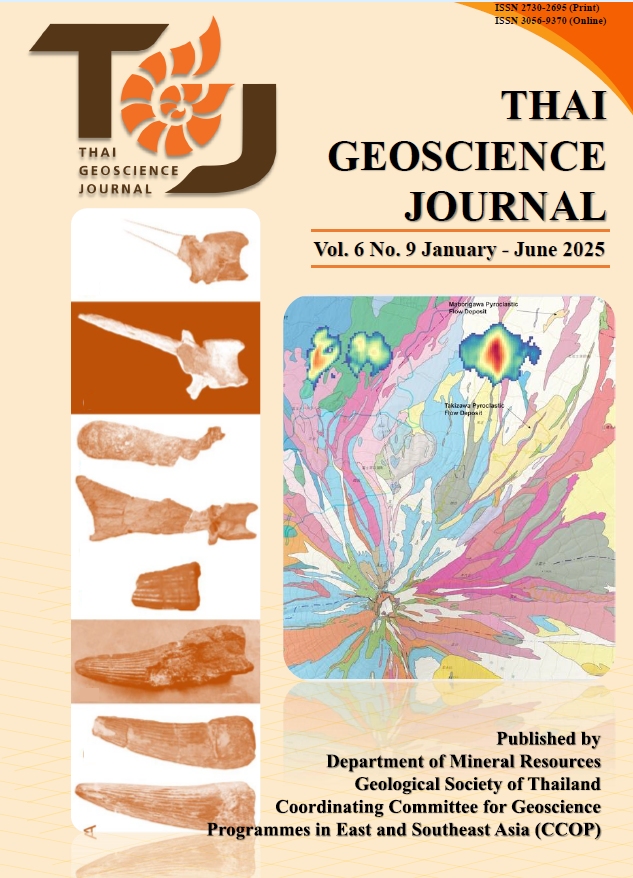
The occurrence of Spinosauridae (Dinosauria: Theropoda) during the Cretaceous of Asia: Implications for biogeography and distribution
Keywords:
Asia, dispersal event, Early Cretaceous, SpinosauridaeAbstract
The theropod dinosaur clade Spinosauridae lived on almost all continents during the Cretaceous. It has been suggested that the group originated in Laurasia, likely in Europe. Asian spinosaurid fossils have been discovered in Southeast and East Asia, particularly from Barremian–Aptian deposits of the Early Cretaceous, with some additional evidence from Cenomanian-aged sediments in the Late Cretaceous. The presence of this theropod clade in Asia, including Thailand, Malaysia, Laos, China, and Japan, may have been influenced by the regression of the Uralian seaway, which temporarily connected Europe and Asia via an ephemeral landbridge. This change likely affected the dispersal of spinosaurids from Europe, facilitating their spread across Asia and shaping their evolution through geographic vicariance. This study reviews the Asian fossil record of Spinosauridae to examine their emergence, paleogeographic distribution, and dispersal patterns. The reports of Asian spinosaurids suggested that the distribution of this clade in Asia is complex and dubious due to the incompleteness of materials and uncertainty of the age of several fossil-bearing strata. The spinosaurid ancestors dispersed along the coastal shoreline from Europe by crossing ephemeral landbridge during pre-Barremian. Then, they spread out to Thailand, Malaysia, southern China, and Japan. The presence of Late Cretaceous spinosaurids in China suggests that Asian spinosaurids persisted until the extinction event of this clade, as happened in western Laurasia and Gondwana during the Cenomanian.
References
Allain, R. (2014). New material of the theropod Ichthyovenator from ban Kalum type locality (Laos): implications for the synonymy of Spinosaurus and Sigilmassasaurus and the phylogeny of Spinosauridae. 74th Annual Meeting of Society of Vertebrate Paleontology in Berlin, Germany.
Allain, R., Xaisanavong, T., Richir, P., & Khentavong, B. (2012). The first definitive Asian spinosaurid (Dinosauria: Theropoda) from the early cretaceous of Laos. Naturwissenschaften, 99, 369-377.
Amiot, R., Buffetaut, E., Lécuyer, C., Wang, X., Boudad, L., Ding, Z., Fourel, F., Hutt, S., Martineau, F.,Medeiros, M. A., Mo, J., Simon, L., Suteethorn, V., Sweetman, S., Tong, H., Zhang, F., & Zhou, Z. (2010). Oxygen isotope evidence for semi-aquatic habits among spinosaurid theropods. Geology, 38(2), 139-142.
Barker, C. T., Hone, D. W., Naish, D., Cau, A., Lockwood, J. A., Foster, B., Clarkin, C. E., Schneider, R., & Gostling, N. J. (2021). New spinosaurids from the Wessex Formation (Early Cretaceous, UK) and the European origins of Spinosauridae. Scientific Reports, 11(1), 19340.
Barker, C.T., Naish, D., & Gostling, N.J. (2023). Isolated tooth reveals hidden spinosaurid dinosaur diversity in the British Wealden Supergroup (Lower Cretaceous). PeerJ 11:e15453 http://doi.org/10.7717/peerj.15453
Benson, R. B. (2010). A description of Megalosaurus bucklandii (Dinosauria: Theropoda) from the Bathonian of the UK and the relationships of Middle Jurassic theropods. Zoological Journal of the Linnean Society, 158(4), 882-935.
Bertin, T. (2010). A catalogue of material and review of the Spinosauridae. PalArch’s. Journal of Vertebrate Palaeontology, 7(4), 1–39.
Buffetaut, E., & Ingavat, R. (1986). Unusual theropod dinosaur teeth from the Upper Jurassic of Phu Wiang, northeastern Thailand. Revue de paléobiologie, 5(2), 217-220.
Buffetaut, E., & Tong, H. (2024). The first discovery of spinosaurid remains in Asia: Thailand, 1962. Annales de Paléontologie, 110(1), 102664.
Buffetaut, E., Suteethorn, V., & Tong, H. (2006). Dinosaur assemblages from Thailand: a comparison with Chinese faunas. In: Papers from the 2005 Heyuan International Dinosaur Symposium. Geological Publishing House, Beijing, 19-37.
Buffetaut, E., Suteethorn, V., & Tong, H. (2009). An early'ostrich dinosaur'(Theropoda: Ornitho-mimosauria) from the Early Cretaceous Sao Khua Formation of NE Thailand. Geological Society, London, Special Publications, 315(1), 229-243.
Buffetaut, E., Suteethorn, V., Le Loeuff, J., Khansubha, S., Tong, H., & Wongko, K. (2005a). The dinosaur fauna from the Khok Kruat formation (Early Cretaceous) of Thailand. Proceedings of the International Conference on Geology, Geotechnology and Mineral Resources of Indochina (GEOINDO 2005). Khon Kaen University, Khon Kaen.
Buffetaut, E., Suteethorn, V., Tong, H., & Amiot, R. (2008). An Early Cretaceous spinosaurid theropod from southern China. Geological Magazine, 145(5), 745-748.
Buffetaut, E., Suteethorn, V., Tong, H., & Košir, A. (2005b). First dinosaur from the Shan–Thai Block of SE Asia: a Jurassic sauropod from the southern peninsula of Thailand. Journal of the Geological Society, 162(3), 481-484.
Buffetaut, E., Suteethorn, S., Suteethorn, V., Tong, H., & Wongko, K. (2019). Spinosaurid teeth from the Lower Cretaceous of Ko Kut, eastern Thailand. Annales de Paléontologie, 105(3), 239-243).
Candeiro, C. R. A., Brusatte, S. L., & de Souza, A. L. (2017). Spinosaurid Dinosaurs from the Early Cretaceous of North Africa and Europe: Fossil Record, Biogeography and Extinction. Anuário do Instituto de Geociências, 40(3).
Charig, A. J., & Milner, A. C. (1986). Baryonyx, a remarkable new theropod dinosaur. Nature, 324(6095), 359-361.
Charig, A. J., & Milner, A. C. (1997). Baryonyx walkeri, a fish-eating dinosaur from the Wealden of Surrey. Bulletin-Natural History Museum Geology Series, 53, 11-70.
Chokchaloemwong, D., Hattori, S., Cuesta, E., Jintasakul, P., Shibata, M., Azuma, Y. (2019). A new carcharodontosaurian theropod (Dinosauria: Saurischia) from the Lower Cretaceous of Thailand. PLoS ONE, 14(10), e0222489.
Eaton, J. G., Kirkland, J. I., Hutchinson, J. H., Denton, R., O'Neill, R. C., & Parrish, J. (1997). Nonmarine extinction across the Cenomanian-Turonian boundary, southwestern Utah, with a comparison to the Cretaceous-Tertiary extinction event. Geological Society of America Bulletin, 109(5), 560–567.
Fowler, D. (2007). Recently rediscovered baryonychine teeth (Dinosauria: Theropoda): New morphologic data, range extension & similarity to Ceratosaurus. Journal of Vertebrate Paleontology, 27(3), 76.
Hasegawa, Y. (2003). A possible spinosaurid tooth from the Sebayashi formation (Lower Cretaceous), Gunma, Japan. Bulletin of Gunma Museum of Natural History, 7, 1-6.
Hattori, S., & Azuma, Y. (2020). Spinosaurid teeth from the Lower Cretaceous Kitadani Formation of the Tetori Group, Fukui, Japan. Memoir of the Fukui Prefectural Dinosaur Museum, 19, 1-9.
Hendrickx, C., Mateus, O., da Lourinhã, M., Araújo, R., da Lourinhã, M., & Choiniere, J. (2019). The distribution of dental features in non-avian theropod dinosaurs: Taxonomic potential, degree of homoplasy, and major evolutionary trends. Palaeontologia Electronica 22.3.74 1–110.
Hone, D. W. E., & Holtz Jr, T. R. (2017). A century of spinosaurs‐a review and revision of the Spinosauridae with comments on their ecology. Acta Geologica Sinica‐English Edition, 91(3), 1120-1132.
Hone, D. W., Xing, X. U., & De-You, W. A. N. G. (2010). A probable baryonychine (Theropoda: Spinosauridae) tooth from the Upper Cretaceous of Henan Province, China. Vertebrata PalAsiatica, 48(1), 19.
Hou, L., Yeh, H., & Zhao, X. (1975). Fossil reptiles from Fusui, Kwangshi. Vertebrata PalAsiatica, 13(1), 24-33.
Ibrahim, N., Maganuco, S., Dal Sasso, C., Fabbri, M., Auditore, M., Bindellini, G., Martill, D. M., Zouhri, S., Mattarelli, D. A., Unwin, D. M., & Wiemann, J. (2020). Tail-propelled aquatic locomotion in a theropod dinosaur. Nature, 581(7806), 67-70.
Ide, Y., & Maejima, W. (2011). Distal Storm Sedimentation of the Lower Cretaceous Arida Formation. Journal of Geosciences, 54(3), 31-41.
Isasmendi, E., Cuesta, E., Díaz-Martínez, I., Company, J., Sáez-Benito, P., Viera, L. I., Torices, A., & Pereda-Suberbiola, P. (2024). Increasing the theropod record of Europe: a new basal spinosaurid from the Enciso Group of the Cameros Basin (La Rioja, Spain). Evolutionary implications and palaeobiodiversity. Zoological Journal of the Linnean Society. doi:10.1093/ zoolinnean/zlad193
Khansubha, S., Pothichaiya, C., Rugbumrung, M., & Meesook., A. (2017). The gigantic titanosauriform sauropod from the Early Cretaceous Khok Kruat Formation in the northeastern of Thailand. In: SVP 77th annual meeting. Calgary, Canada. 141-142
Kobayashi, T. (1963). On the Cretaceous Ban Na Yo fauna of east Thailand with a note on the distribution of Nippononaia, Trigonioides and Plicatounio. Japanese Journal of geology and geography, 34(1).
Kobayashi, T. (1968). The Cretaceous non-marine pelecypods from the Nam Phung Dam site in the northeastern part of the Khorat Plateau, Thailand with a note on the Trigonioididae. Verlag nicht ermittelbar. Geology and Palaeontology of Southeast Asia, 4, 109-138
Kubota, K., Takakuwa, Y., & Hasegawa, Y. (2017). Second discovery of a spinosaurid tooth from the Sebayashi Formation (Lower Cretaceous), Kanna Town, Gunma Prefecture, Japan. Bulletin of Gunma Museum of Natural History, 21, 1–6.
Kubota, K. (2023). A list of Mesozoic dinosaur fossils from Japan in 2022. Bulletin of Gunma Museum of Natural History, 27, 157-170
Lü, J., Xu, L., Jiang, X., Jia, S., Li, M., Yuan, C., Zhang, X., & Ji, Q. (2009). A preliminary report on the new dinosaurian fauna from the Cretaceous of the Ruyang Basin, Henan Province of central China. 고생물학회지, 25(1), 43-56.
Malafaia, E., Miguel Gasulla, J., Escaso, F., Narváez, I., Luis Sanz, J., & Ortega, F. (2019). A new spinosaurid theropod (Dinosauria: Megalosauroidea) from the late Barremian of Vallibona, Spain: Implications for spinosaurid diversity in the Early Cretaceous of the Iberian Peninsula. Cretaceous Research. 106: 104221. doi:10.1016/j.cretres.2019.104221. S2CID 202189246
Martill, D. M., Cruickshank, A. R. I., Frey, E., Small, P. G., & Clarke, M. (1996). A new crested maniraptoran dinosaur from the Santana Formation (Lower Cretaceous) of Brazil. Journal of the Geological Society, 153(1), 5-8.
Mateus, O., Araujo, R., Natário, C., & Castanhinha, R. (2011). A new specimen of the theropod dinosaur Baryonyx from the early Cretaceous of Portugal and taxonomic validity of Suchosaurus. Zootaxa, 2827(5).
Mateus, O., & Estraviz-López, D. (2022). A new theropod dinosaur from the Early Cretaceous (Barremian) of Cabo Espichel, Portugal: Implications for spinosaurid evolution. PLOS ONE. 17 (2): e0262614. Bibcode:2022PLoS O..1762614M. doi:10.1371/journal.pone.0262 614. PMC 8849621. PMID 35171930.
Matsukawa, M. (1983). Stratigraphy and sedimentary environments of the Sanchu Cretaceous, Japan. Memoir of Ehime University, Science, 9, 1-50.
Matsukawa, M., & Obata, I. (1994). Dinosaurs and sedimentary environments in the Japanese Cretaceous: a contribution to dinosaur facies in Asia based on molluscan palaeontology and stratigraphy. Cretaceous Research, 15(1), 101-125.
Milner, A. C. (2003). Fish-eating theropods: a short review of the systematics, biology and palaeobiogeography. Actas de las II Jornadas Internacionales sobre Paleontología de Dinosaurios y su Entorno: Salas de los Infantes (Burgos, España), septiembre de 2001,
Owen, R. (1840). Odontography. London. Bailliere. (1840–1845).
Poropat, S. F., White, M. A., Vickers-Rich, P., & Rich, T. H. (2019). New megaraptorid (Dinosauria: Theropoda) remains from the Lower Cretaceous Eumeralla Formation of Cape Otway, Victoria, Australia. Journal of Vertebrate Paleontology, 39(4), e1666273.
Racey, A., & Goodall, J. G. (2009). Palynology and stratigraphy of the Mesozoic Khorat Group red bed. Geological Society, 315, 69-83.
Racey, A., Love, M. A., Canham, A. C., Goodall, J. G. S., Polachan, S., & Jones, P. D. (1996). Stratigraphy and reservoir potential of the Mesozoic Khorat Group, NE Thailand: Part 1: stratigraphy and sedimentary evolution. Journal of Petroleum Geology, 19(1), 5-39.
Rauhut, O. W., Bakirov, A. A., Wings, O., Fernandes, A. E., & Hübner, T. R. (2024). A new theropod dinosaur from the Callovian Balabansai Formation of Kyrgyzstan. Zoological Journal of the Linnean Society, 201(4), p.zlae090.
Samathi, A., Chanthasit, P., & Sander, P. M. (2019a). Two new basal coelurosaurian theropod dinosaurs from the Lower Cretaceous Sao Khua Formation of Thailand. Acta Palaeontologica Polonica, 64(2), 239-260.
Samathi, A., Chanthasit, P., & Sander, P. M. (2019b). A review of theropod dinosaurs from the Late Jurassic to mid-Cretaceous of Southeast Asia. Annales de Paléontologie, 105(3), 201-215.
Samathi, A., Sander, P. M., & Chanthasit, P. (2021). A spinosaurid from Thailand (Sao Khua Formation, Early Cretaceous) and a reassessment of Camarillasaurus cirugedae from the Early Cretaceous of Spain. Historical Biology, 33(12), 3480-3494.
Samathi, A., Suteethorn, S., Boonjarern, T., Sutcha, K., & Suteethorn, V. (2024). Dinosaur fauna from the Lower Cretaceous of Phu Kao-Phu Phan Kham, northeastern Thailand: a review and update. Palaeoworld, 33(2), 402–438.
Sánchez-Hernández, B. R., & Benton, M. (2014). Filling the ceratosaur gap: A new ceratosaurian theropod from the Early Cretaceous of Spain. Acta Palaeontologica Polonica. 59 (3): 581–600. doi:10.4202/app.2011.0144
Sano, S. 2015. New view of the stratigraphy of the Tetori Group in Central Japan. Memoir of the Fukui Prefectural Dinosaur Museum, 14, 25–61
Santos-Cubedo, A., de Santisteban, C., Poza, B., & Meseguer, S. (2023). A new spinosaurid dinosaur species from the Early Cretaceous of Cinctorres (Spain). Scientific Reports. 13 (1). 6471. doi:10.1038/s41598-023-33418-2. hdl: 10234/203142
Sattayarak, N., Srigulawong, S., & Patarametha, M. (1991). Subsurface stratigraphy of the non-marine Mesozoic Khorat Group, northeastern Thailand. GEOSEA VII Abstracts, Bangkok, 36.
Sereno, P. C., Beck, A. L., Dutheil, D. B., Gado, B., Larsson, H. C., Lyon, G. H., Marcot, J. D., Rauhut, O. W. M., Sadleir, R. W., Sidor, C. A., Varrichio, D. D., Wilson, G. P., & Wilson, J. A. (1998). A long-snouted predatory dinosaur from Africa and the evolution of spinosaurids. Science, 282(5392), 1298-1302.
Sereno, P. C., Myhrvold, N., Henderson, D. M., Fish, F. E., Vidal, D., Baumgart, S. L., Keillor, T. M., Formoso, K. K., & Conroy, L. L. (2022). Spinosaurus is not an aquatic dinosaur. eLife, 11, e80092.
Solonin, S. V., Vodorezov, A. V., & Kear, B. P. (2021). Late Cretaceous marine reptiles from Malyy Prolom in Ryazan Oblast, Central Russia. Cretaceous Research, 127, 104946.
Sone, M., Hirayama, R., He, T. Y., Yoshida, M., & Komatsu, T. (2015). First dinosaur fossils from Malaysia: spinosaurid and ornithischian teeth. The 2nd International Symposium on Asian Dinosaurs (ISAD2015) Program and Abstract, Bangkok, 19–20 November 2015.
Sone, M., Cuny, G., Hirayama, R., Kocsis, L., Buffetaut, E., & Deesri, U. (2022). New unique fossils from the Cretaceous dinosaur-bearing deposit of Malaysia. In: Burrett, C. (Ed.), 6th International Palaeontological Congress, Abstract Book. Mahasarakham University, Maha Sarakham, Thailand, p. 180.
Stromer, E. (1915). Ergebnisse der Forschung-sergebnisse der Forschungsreisen Prof. E. Stromers in den Wüsten Ägyptens. II. Wirbeltie-Reste der Baharîje-Stufe (unterstes Cenoman). III. Das Original des Theropoden Spinosaurus aegyptiacus. nov. gen., nov. espc. Abhandlungen der Königlich Bayerischen Akademie der wissenschaften, Mathematisch-physikalische Klasse, 28, 1-32.
Sues, H. D., Frey, E., Martill, D. M., & Scott, D. M. (2002). Irritator challengeri, a spinosaurid (Dinosauria: Theropoda) from the Lower Cretaceous of Brazil. Journal of Vertebrate Paleontology, 22(3), 535-547.
Suteethorn, V., Buffetaut, E., Wongko, K., Suteethorn, S., & Tong, H. (2018). Morpho-logical diversity of spinosaurid teeth from the Pra Prong locality (Lower Cretaceous of eastern Thailand). In Proceeding of 5th International Paleontological Congress 9th-13rd July.
Teng, Y. H., Sone, M., Hirayama, R., Yoshida, M., Komatsu, T., Khamha, S., & Cuny, G. (2019). First Cretaceous fish fauna from Malaysia. Journal of Vertebrate Paleontology, DOI: 10.1080/02724634.2019.1573735
Tucker, R. T., Hyland, E. G., Gates, T. A., King, M. R., Roberts, E. M., Foley, E. K., Berndt, D., Hanta, R., Khansubha, S. O., Aswasereelert, W., & Zanno, L. E. (2022). Age, depositional history, and paleoclimatic setting of Early Cretaceous dinosaur assemblages from the Sao Khua Formation (Khorat Group), Thailand. Palaeogeography, Palaeoclimatology, Palaeo-ecology, 601, 111107.
Tumpeesuwan, S. (2010). Palaeontology of the Early Cretaceous non-marine molluscan assemblages from the Sao Khua Formation in Nong Bua Lamphu, Phu Wiang and Sahat Sakhan Areas, northeastern Thailand. PhD Thesis, Chulalongkorn University, Bangkok.
Upchurch, P., & Chiarenza, A. A. (2024). A brief review of non-avian dinosaur biogeography: state-of-the-art and prospectus. Biology Letters, 20(10), 20240429.
Ward, D. E., & Bunnag, D. (1964). Stratigraphy of the Mesozoic Khorat Group in northeastern Thailand (No. 6). Department of Mineral Resources 6, 1–95.
Wongko, K., Buffetaut, E., Khamha, S., & Lauprasert, K. (2019). Spinosaurid theropod teeth from the red beds of the Khok Kruat formation (Early Cretaceous) in Northeastern Thailand. Tropical Natural History, 19(1), 8-20.
Downloads
Published
How to Cite
License
Copyright (c) 2025 Department of Mineral Resources

This work is licensed under a Creative Commons Attribution-NonCommercial-NoDerivatives 4.0 International License.