Chitosan-coated Eggshells Help Slow the Deterioration of Internal Egg Quality During Storage at Room Temperature under Tropical Conditions
DOI:
https://doi.org/10.69650/ahstr.2026.4850Keywords:
Chitosan, Egg quality, Edible coating, Haugh Unit, Room-temperature storageAbstract
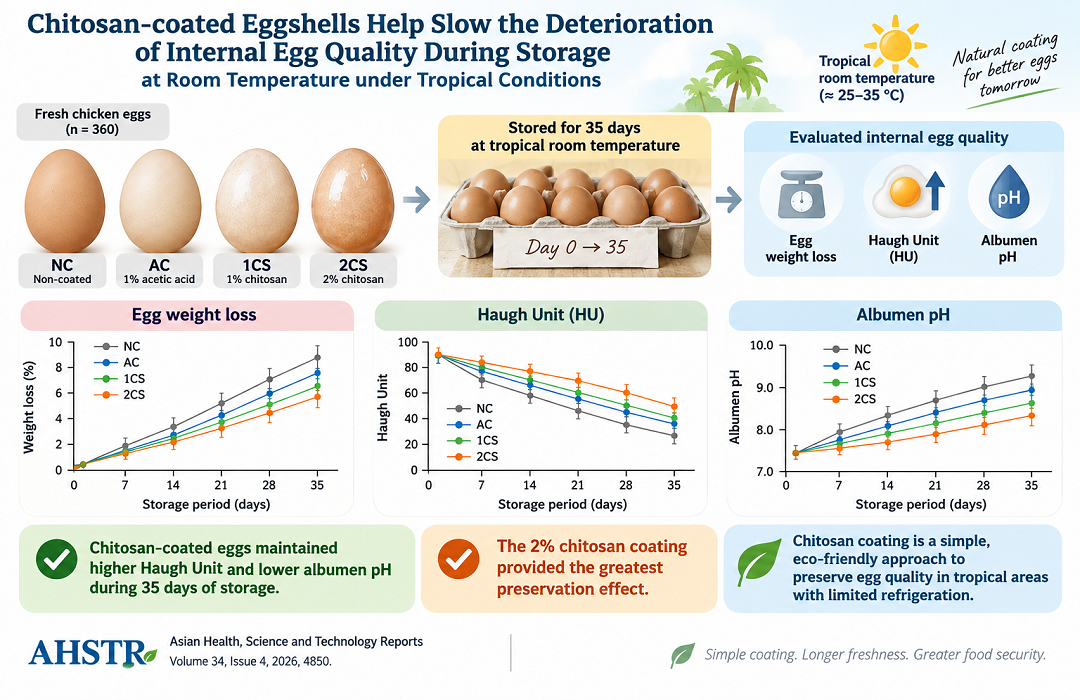
Egg deterioration during room-temperature storage is a major challenge in tropical regions lacking practical refrigeration. While chitosan coatings preserve eggs, research on how different concentrations perform under tropical ambient conditions remains limited. Therefore, this study evaluated the concentration-dependent effects of chitosan coatings on internal egg quality during extended room-temperature storage. A total of 360 freshly laid chicken eggs were randomly assigned to four treatments: non-coated eggs (NC), eggs coated with 1% acetic acid (AC), eggs coated with 1% chitosan solution (1CS), and eggs coated with 2% chitosan solution (2CS). Eggs were stored at tropical room temperature for 35 days, and egg weight loss, Haugh Unit (HU), and albumen pH were evaluated at weekly intervals. Egg weight loss increased progressively in all treatments throughout storage. Although chitosan-coated eggs tended to exhibit lower cumulative weight loss than the NC and AC groups, differences among treatments were not statistically significant (P > 0.05). In contrast, chitosan coating significantly affected internal egg quality parameters. Chitosan-coated eggs maintained significantly higher HU values during storage than non-coated or acetic acid-treated eggs (P < 0.05), demonstrating superior preservation of internal quality. Similarly, albumen pH increased in all treatments during storage; however, the increase was significantly slower in chitosan-coated eggs (P < 0.05). These results suggest that chitosan coatings may act as semi-permeable barriers, reducing moisture and gas exchange to slow deterioration in internal egg quality during storage. Notably, the 2% chitosan treatment provided the greatest preservation effect, maintaining substantially higher HU values at the end of the 35-day storage period than the control treatments. Visually, eggs coated with 2% chitosan maintained Grade B quality after 40 days of storage, suggesting extended marketability under tropical ambient conditions. However, longer storage periods and quantitative evaluations are needed to confirm the exact shelf-life extension. In conclusion, chitosan coating effectively delayed the deterioration of internal egg quality during room-temperature storage, with the 2% concentration providing the greatest protective effect. This study supports using concentration-dependent chitosan coatings as an eco-friendly way to preserve egg quality in tropical areas with limited refrigeration.
References
Alemu, T. T., Intipunya, P., & Gebeyo, B. A. (2025). A comprehensive review of edible coatings for postharvest management of fruits and vegetables: enhancing food and nutrition security. Discover Agriculture, 3, 190. https://doi.org/10.1007/s44279-025-00348-8
Caffa, I., Proietti, E., Turrini, F., Borgarelli, C., Ferrando, M. R., Formisano, E., de Cassya Lopes Neri, L., Martini, D., Angelino, D., Tagliabue, A., & Pisciotta, L. (2025). Nutritional Aspects of Eggs for a Healthy and Sustainable Consumption: A Narrative Review. Food Science & Nutrition, 13(9), e70285. https://doi.org/10.1002/fsn3.70285
Çelebi, M., Tav, A., Kaya, M. A., & Özdemir, Z. Ö. (2026). Scalable Production of Low-Molecular-Weight Chitosan: Comparative Study of Conventional, Microwave, and Autoclave-Assisted Methods. Polymers, 18(2), 213. https://doi.org/10.3390/polym18020213
Derelioglu, E., & Turgay, Ö., (2022). Effect of chitosan coatings on quality and shelf-life of chicken and quail eggs. African Journal of Food Science, 16(3), 63–70. https://doi.org/10.5897/AJFS2021.2158
Duan, C., Meng, X., Meng, J., Khan, M. I. H., Dai, L., & Zhang, X. (2019). Chitosan as a preservative for fruits and vegetables: A review on chemistry and antimicrobial properties. Journal of Bioresources and Bioproducts, 4(1), 11–21. https://doi.org/10.21967/jbb.v4i1.189
Kaya, S., Özdemir, H. H., & Erdem, B. G. (2024). Physical changes in hen eggs stored at different temperatures. Food and Health, 10(4), 253-261. https://doi.org/10.3153/FH24024
Kocetkovs, V., Radenkovs, V., Juhnevica-Radenkova, K., Jakovlevs, D., & Muizniece-Brasava, S. (2022). The Impact of Eggshell Thickness on the Qualitative Characteristics of Stored Eggs Produced by Three Breeds of Laying Hens of the Cage and Cage-Free Housed Systems. Applied Sciences, 12(22), 11539. https://doi.org/10.3390/app122211539
Moradinezhad, F., Adiba, A., Ranjbar, A., & Dorostkar, M. (2025). Edible coatings to prolong the shelf life and improve the quality of subtropical fresh/fresh-cut fruits: A Review. Horticulturae, 11(6), 577. https://doi.org/10.3390/horticulturae11060577
Muñoz-Tebar, N., Pérez-Álvarez J. A., López, J. F., & Viuda-Martos, M. (2023). Chitosan edible films and coatings with added bioactive compounds: Antibacterial and antioxidant properties and their application to food products: A review. Polymers, 15(2), 396. https://doi.org/10.3390/polym15020396
Pires, P. G. S., Bavaresco, C., Prato, B. S., Wirth, M. L., & Moraes, P. D. O. (2021). The relationship between egg quality and hen housing systems - A systematic review. Livestock Science, 250, 104597. https://doi.org/10.1016/j.livsci.2021.104597
Pires, P. G. S., Cardinal, K. M., & Bavaresco, C. (2020). The use of coatings in eggs: A systematic review. Trends in Food Science & Technology, 106, 312-321. https://doi.org/10.1016/j.tifs.2020.10.019
Purnawarman, T., Nasution, M. I. A., Soenarno, M. S., Siswanto, Yunilas., Hasanah, U., & Wahyuni, S. (2025). Effects of chitosan-stearin on quality of chicken egg storage at room temperature. Journal of World’s Poultry Research, 15(1), 92-102, https://dx.doi.org/10.36380/jwpr.2025.9
Yaashikaa, P. R., Kamalesh, R., Senthil-Kumar, P., Saravanan, A., Vijayasri, K., & Rangasamy, G. (2023). Recent advances in edible coatings and their application in food packaging. Food Research International, 173(2), 113366. https://doi.org/10.1016/j.foodres.2023.113366
Downloads
Published
How to Cite
License
Copyright (c) 2026 Asian Health, Science and Technology Reports

This work is licensed under a Creative Commons Attribution-NonCommercial 4.0 International License.