The Effect of Inlet and Outlet Pattern on a Parabolic Dome Solar Collector
DOI:
https://doi.org/10.69650/ahstr.2026.4806Keywords:
inlet and outlet patterns, parabolic solar collector, solar energyAbstract
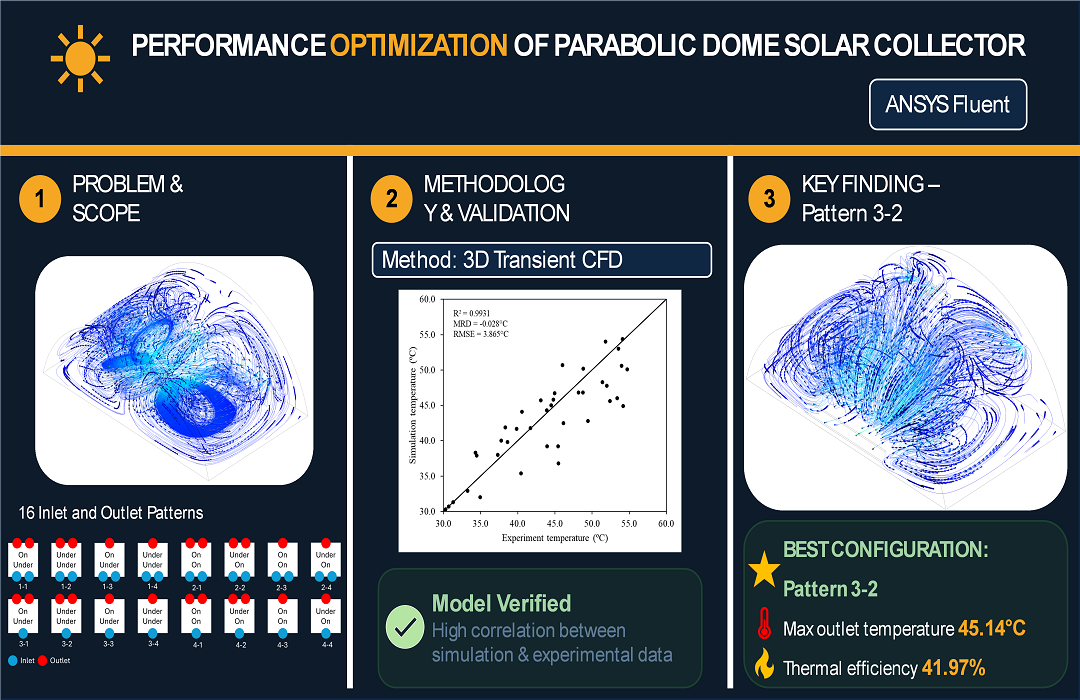
This research aims to investigate the effects of air inlet and outlet patterns on parabolic-dome solar collectors. A three-dimensional transient computational fluid dynamics (CFD) simulation in ANSYS Fluent was used to analyze sixteen different inlet-outlet patterns and compare their effects on air behavior, outlet air temperature, and thermal efficiency. Simulation results show that most patterns led to recirculating air, resulting in hot spots and reduced heat transfer efficiency. Conversely, pattern 3-2 exhibited the most uniform air distribution. This 3-2 pattern also had an outlet air temperature and average thermal efficiency of about 42.75°C and 41.97%, respectively. Furthermore, the numerical model was validated using statistical indicators R², MRD, and RMSE, which showed that the model results were highly consistent with the experimental results (R² = 0.9942, MRD = -0.031°C, and RMSE = 3.656°C). These observations underscore the critical role of the inlet-outlet pattern in optimizing airflow and improving heat transfer efficiency. Therefore, this study presents an effective design for air inlet-outlet patterns that improves the efficiency of parabolic dome solar collectors through an optimized air channel design.
References
Aghakhani, S., & Afrand, M. (2022). Experimental study of the effect of simultaneous application of the air-and water-cooled flow on efficiency in a Photovoltaic thermal solar collector with porous plates. Applied Thermal Engineering, 217, 119161. https://doi.org/10.1016/j.applthermaleng.2022.119161
Demissie, P., Hayelom, M., Kassaye, A., Hailesilassie, A., Gebrehiwot, M., & Vanierschot, M. (2019). Design, development and CFD modeling of indirect solar food dryer. Energy procedia, 158, 1128-1134. https://doi.org/10.1016/j.egypro.2019.01.278
Duffie, J. A., Beckman, W. A., & Blair, N. (2020). Solar engineering of thermal processes, photovoltaics and wind. John Wiley & Sons. https://doi.org/10.1002/9781119540328
Famiglietti, A., Lecuona-Neumann, A., Nogueira, J., & Rahjoo, M. (2020). Direct solar production of medium temperature hot air for industrial applications in linear concentrating solar collectors using an open Brayton cycle. Viability analysis. Applied Thermal Engineering, 169, 114914. https://doi.org/10.1016/j.applthermaleng.2020.114914.
Hajiyat, H. R., Hussain, S. A., & Harun, M. Y. (2023). Inlet Size and Location Impact on Greenhouse Dryer Process Dynamics. Chemical Engineering Transactions, 106, 1123-1128. https://doi.org/10.3303/CET23106188
Janjai, S., Lamlert, N., Intawee, P., Mahayothee, B., Bala, B. K., Nagle, M., & Müller, J. (2009). Experimental and simulated performance of a PV-ventilated solar greenhouse dryer for drying of peeled longan and banana. Solar energy, 83(9), 1550-1565. https://doi.org/10.1016/j.solener.2009.05.003
Kherrafi, M. A., Benseddik, A., Saim, R., Bahaz, S., & Messeguem, T. (2025). Experimental and numerical study of performance enhancement in a direct solar dryer integrated with obstacles. Applied Thermal Engineering, 259, 124942. https://doi.org/10.1016/j.applthermaleng.2024.124942
Lingayat, A., Das, P., & Chandramohan, V. P. (2025). A detailed review on performance enhancement of solar air collector systems. Applied Thermal Engineering, 127530. https://doi.org/10.1016/j.applthermaleng.2025.127530
Lokeswaran, S., & Eswaramoorthy, M. (2013). An experimental analysis of a solar greenhouse drier: computational fluid dynamics (CFD) validation. Energy Sources, Part A: Recovery, Utilization, and Environmental Effects, 35(21), 2062-2071. https://doi.org/10.1080/15567036.2010.532195
Mahapatra, A., & Tripathy, P. P. (2019). Thermal performance analysis of natural convection solar dryers under no load condition: experimental investigation and numerical simulation. International journal of green energy, 16(15), 1448-1464. https://doi.org/10.1080/15435075.2019.1671417
Mekhilef, S., Saidur, R., & Safari, A. (2011). A review on solar energy use in industries. Renewable and sustainable energy reviews, 15(4), 1777-1790. https://doi.org/10.1016/j.rser.2010.12.018
Omeiza, L. A., Abid, M., Dhanasekaran, A., Subramanian, Y., Raj, V., Kozak, K., Mamudu, U., & Azad, A. K. (2024). Application of solar thermal collectors for energy consumption in public buildings–An updated technical review. Journal of Engineering Research, 12(4), 994-1010. https://doi.org/10.1016/j.jer.2023.09.011
Østergaard, P. A., Duic, N., Noorollahi, Y., & Kalogirou, S. (2023). Advances in renewable energy for sustainable development. Renewable energy, 219, 119377. https://doi.org/10.1016/j.renene.2023.119377
Rahmat, M. A. A., Ibrahim, A., Ishak, M. A. A., Syafiq, U., & Al-Aribe, K. M. (2025). Numerical investigation of thermal and airflow profiles in diverse solar dryer chamber configurations. Case Studies in Thermal Engineering, 73, 106612. https://doi.org/10.1016/j.csite.2025.106612
Singh, A. K., & Kumar, R. (2025). Enhancing renewable energy systems using loop heat pipes: A case research on solar thermal applications. Applied Thermal Engineering, 275, 126866. https://doi.org/10.1016/j.applthermaleng.2025.126866
Stevovic, I., Mirjanic, D., & Petrovic, N. (2021). Integration of solar energy by nature-inspired optimization in the context of circular economy. Energy, 235, 121297. https://doi.org/10.1016/j.energy.2021.121297
Tuncer, A. D., Khanlari, A., Afshari, F., Sözen, A., Ciftci, E., Kusun, B., & Şahinkesen, İ. (2023). Experimental and numerical analysis of a grooved hybrid photovoltaic-thermal solar drying system. Applied Thermal Engineering, 218, 119288. https://doi.org/10.1016/j.applthermaleng.2022.11928
Downloads
Published
How to Cite
Issue
Section
Categories
License
Copyright (c) 2026 Asian Health, Science and Technology Reports

This work is licensed under a Creative Commons Attribution-NonCommercial 4.0 International License.