Assessment of Milking Hygiene Practices and Raw Goat Milk Quality: A Case Study of a Dairy Goat Farm in Narathiwat Province, Thailand
DOI:
https://doi.org/10.69650/ahstr.2026.4776Keywords:
Milking hygiene, Goat milk quality, Mastitis, Antibiotic residues, Food safetyAbstract
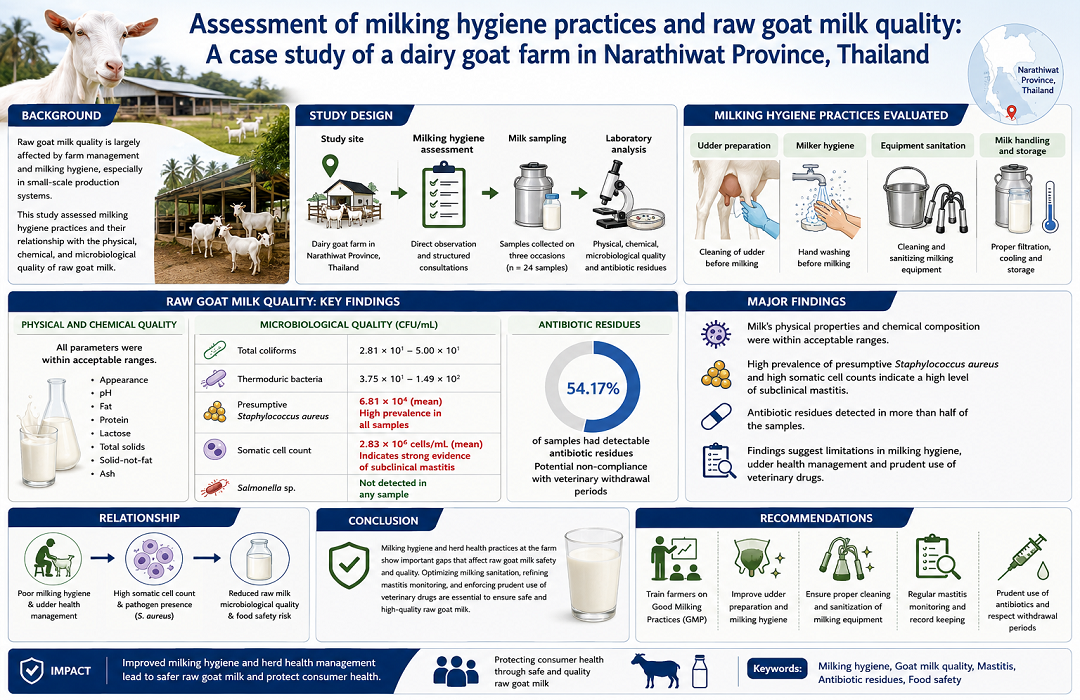
The quality of raw goat milk is largely affected by farm management and milking hygiene, especially in small-scale production systems. This study aimed to assess milking hygiene practices and their relationship with the physical, chemical, and microbiological quality of raw goat milk from a dairy goat farm in Southern Thailand. Milking practices were evaluated through direct observation and structured consultations with the farm personnel. Milk samples were collected on three occasions, resulting in a total of 24 samples for laboratory analysis. The results showed that the milk's physical properties and chemical composition were within acceptable ranges, indicating generally adequate nutritional quality. Total coliform counts and thermoduric bacteria ranged from 2.81×101 to 5.00×101 CFU/mL and 3.75×101 to 1.49×10² CFU/mL, respectively, and Salmonella sp. was not detected in any sample. However, a consistently high prevalence of presumptive Staphylococcus aureus and markedly elevated somatic cell counts were observed across all samples, indicating strong evidence of subclinical mastitis, with mean values of 6.81×10⁴ CFU/mL and 2.83×10⁶ cells/mL, respectively. These findings may indicate limitations in milking hygiene and udder health management. Furthermore, antibiotic residues were detected in 54.17% of the evaluated samples, suggesting potential non-compliance with prescribed veterinary withdrawal periods. Overall, these findings highlight important gaps in current milking hygiene and herd health management practices, which may compromise raw milk safety and quality. Although the single-farm scope of this study limits the broader generalizability of the insights across diverse dairy goat production systems, the evidence underscores that optimizing milking sanitation, refining mastitis monitoring, and enforcing the prudent administration of veterinary drugs are imperative to safeguard raw goat milk quality at the farm level.
References
Abebe, R., Hatiya, H., Abera, M., Megersa, B., & Asmare, K. (2020). Bovine mastitis: Prevalence, riskfactors, and bacterial isolation in dairy farms in Ethiopia. Veterinary Medicine International, 2020, 1–10. https://doi.org/10.1155/2020/8894345
Ahmadi, S. A. (2025). Evaluation of raw milk quality using the methylene blue reduction test. Journal of Natural Science Review, 3(4), 250–263. https://doi.org/10.62810/jnsr.v3i4.300
AlKaisy, Q. H., Al-Saadi, J. S., Al-Rikabi, A. K. J., Altemimi, A. B., Hesarinejad, M. A., & Abedelmaksoud, T. G. (2023). Exploring the health benefits and functional properties of goat milk proteins. Food Science & Nutrition, 11(10), 5641–5656. https://doi.org/10.1002/fsn3.3531
Buckley, M. P., & Hayman, K. P. (2025). Mastitis therapy in small ruminants. Veterinary Clinics of North America: Food Animal Practice, 41(2), 285–295. https://doi.org/10.1016/j.cvfa.2025.02.011
Codex Alimentarius Commission. (2018). Code of practice on good animal feeding (CAC/RCP 54-2004). Food and Agriculture Organization of the United Nations.
Department of Livestock Development. (2021). Raising goats. Agricultural Cooperative Community Printing House of Thailand.
Fadillah, A., van den Borne, B. H. P., Poetri, O. N., Hogeveen, H., Slijper, T., Pisestyani, H., & Schukken, Y. H. (2023). Evaluation of factors associated with bulk milk somatic cell count and total plate count in Indonesian smallholder dairy farms. Frontiers in Veterinary Science, 10, Article 1280264. https://doi.org/10.3389/fvets.2023.1280264
Girma, A., & Tamir, D. (2022). Prevalence of bovine mastitis and its associated risk factors among dairy cows in Ethiopia during 2005–2022: A systematic review and meta-analysis. Veterinary Medicine International, 2022, Article 7775197. https://doi.org/10.1155/2022/7775197
Hassani, S., Moosavy, M. H., Gharajalar, S. N., Khatibi, S. A., Hajibemani, A., & Barabadi, Z. (2022). High prevalence of antibiotic resistance in pathogenic foodborne bacteria isolated from bovine milk. Scientific Reports, 12, Article 3878. https://doi.org/10.1038/s41598-022-07845-6
Hoving-Bolink, R. A. H., Antonis, A. F. G., te Pas, M. F. W., & Schokker, D. (2023). An observational study of the presence and variability of the microbiota composition of goat herd milk related to mainstream and artisanal farm management. PLoS ONE, 18(10), e0292650. https://doi.org/10.1371/journal.pone.0292650
International Dairy Federation. (1990). Handbook on milk collection in warm developing countries (IDF Special Issue No. 9002). International Dairy Federation.
International Organization for Standardization. (2006). ISO 4832:2006 Microbiology of food and animal feeding stuffs—Horizontal method for the enumeration of coliforms—Colony-count technique. International Organization for Standardization.
Kebede, G., Zenebe, T., Haimanot, D., & Tolosa, T. (2014). Review on detection of antimicrobial residues in raw bulk milk in dairy farms. African Journal of Basic & Applied Sciences, 6(4), 87–97. https://doi.org/10.5829/idosi.ajbas.2014.6.4.8642
Kornacki, J. L., Ryser, E. T., Mangione, C. M., & Wehr, H. M. (2024). Standard methods for the examination of dairy products (18th ed.). American Public Health Association.
Limcharoen, S., Tangwiwat, P., Khlibtong, J., & Kochapakdee, S. (2020). The extension model for business development of meat goat production in Southern Border Provinces. Princess of Naradhiwas University Journal, 12(3), 337–360. https://li01.tci-thaijo.org/index.php/pnujr/article/view/241815
Manyi-Loh, C., Mamphweli, S., Meyer, E., & Okoh, A. (2018). Antibiotic use in agriculture and its consequential resistance in environmental sources: Potential public health implications. Molecules, 23(4), 795. https://doi.org/10.3390/molecules23040795
Martin, N. H., Trmčić, A., Hsieh, T. H., Boor, K. J., & Wiedmann, M. (2016). The evolving role of coliforms as indicators of unhygienic processing conditions in dairy foods. Frontiers in Microbiology, 7, Article 1549. https://doi.org/10.3389/fmicb.2016.01549
Mogotu, M. W., Abong, G., Mburu, J., & Ndambi, O. A. (2022). Assessment of hygiene practices and microbial safety of milk supplied by smallholder farmers to processors in selected counties in Kenya. Tropical Animal Health and Production, 54, Article 220. https://doi.org/10.1007/s11250-022-03214-7
Moraes, M. S., Ramos, G. L. P. A., & Nascimento, J. D. S. (2025). Benefits of goat, sheep and buffalo milk: A concise review. International Journal of Veterinary Sciences and Animal Husbandry, 10(3), 150–155. https://doi.org/10.22271/veterinary.2025.v10.i3c.2122
Munera-Bedoya, O. D., Cassoli, L. D., Machado, P. F., & Cerón-Muñoz, M. F. (2017). Influence of attitudes and behavior of milkers on the hygienic and sanitary quality of milk. PLoS ONE, 12(9), e0184640. https://doi.org/10.1371/journal.pone.0184640
National Conference on Interstate Milk Shipments. (2024). Direct microscopic somatic cell count (IMS #12). National Conference on Interstate Milk Shipments.
National Research Council. (2011). Guide for the care and use of laboratory animals (8th ed.). National Academies Press. https://doi.org/10.17226/12910
Oladeji, O. M., Mugivhisa, L. L., & Olowoyo, J. O. (2025). Antibiotic residues in animal products from some African countries and their possible impact on human health. Antibiotics, 14(1), 90. https://doi.org/10.3390/antibiotics14010090
Requejo, L. M. I., López, F. J. P., Jáquez, J. A. M., Viramontes, U. F. & Gonzalez, H. S. (2024) Microbiological quality of raw milk under a scheme of good milking and storage practices in a goat production system in the Lagunera Region, Mexico. Journal of Food and Agriculture, 6, 1–7. https://doi.org/10.3897/ejfa.2024.121230
Sachi, S., Ferdous, J., Sikder, M. H., & Hussani, A. K. (2019). Antibiotic residues in milk: Past, present, and future. Journal of Advanced Veterinary and Animal Research, 6(3), 315–332. https://doi.org/10.5455/javar.2019.f350
Senata, M. C., Eminoglu, G., Djaouti, S., Akal, C., & Ozer, B. (2025). Residual antibiotics in milk at maximum residual limits affects yoghurt fermentation but not yoghurt rheology. International Journal of Dairy Technology, 78(2), e70017. https://doi.org/10.1111/1471-0307.70017
Shandilya, S. K., Mishra, A., Pathak, A., & Dhial, K. (2025). Packaging, transportation, storage and distribution of milk and milk products. In Handbook of Milk Production, Quality and Nutrition (pp. 559–566). Elsevier. https://doi.org/10.1016/B978-0-443-24820-7.00002-X
Siddiqui, S. A., Salman, S. H. M., Redha, A. A., Zannou, O., Chabi, I. B., Oussou, K. F., Bhowmik, S., Nirmal, N. P., & Maqsood, S. (2024). Physicochemical and nutritional properties of different non-bovine milk and dairy products: A review. International Dairy Journal, 148, 105790. https://doi.org/10.1016/j.idairyj.2023.105790
Tallent, S., Hait, J., Bennett, R. W., & Lancette, G. A. (2016). BAM Chapter 12: Staphylococcus aureus. U.S. Food and Drug Administration.
Touaitia, R., Ibrahim, N. A., Touati, A., & Idres, T. (2025). Staphylococcus aureus in Bovine Mastitis: A Narrative Review of Prevalence, Antimicrobial Resistance, and Advances in Detection Strategies. Antibiotics (Basel), 14(8), 810. https://doi.org/10.3390/antibiotics14080810
Thai Agricultural Commodity and Food Standards. (2008). Raw goat milk (TACFS 6006-2008). National Bureau of Agricultural Commodity and Food Standards.
Tibebu, A., Teshome, Y., Tamrat, H., Bahiru, A., Yitbarek, T., Moliso, M. M., & Assefa, A. (2026). Mastitis in goats: A comprehensive systematic review and meta-analysis of prevalence and the pathogens. Preventive Veterinary Medicine, 246, 106711. https://doi.org/10.1016/j.prevetmed.2025.106711
Downloads
Published
How to Cite
License
Copyright (c) 2026 Asian Health, Science and Technology Reports

This work is licensed under a Creative Commons Attribution-NonCommercial 4.0 International License.