Role of Telemedicine in Blood Glucose Control among Diabetes Mellitus Patients in Thailand
DOI:
https://doi.org/10.69650/ahstr.2026.4747Keywords:
Blood glucose control, Diabetes mellitus, Spatial regression, Thailand, TelemedicineAbstract
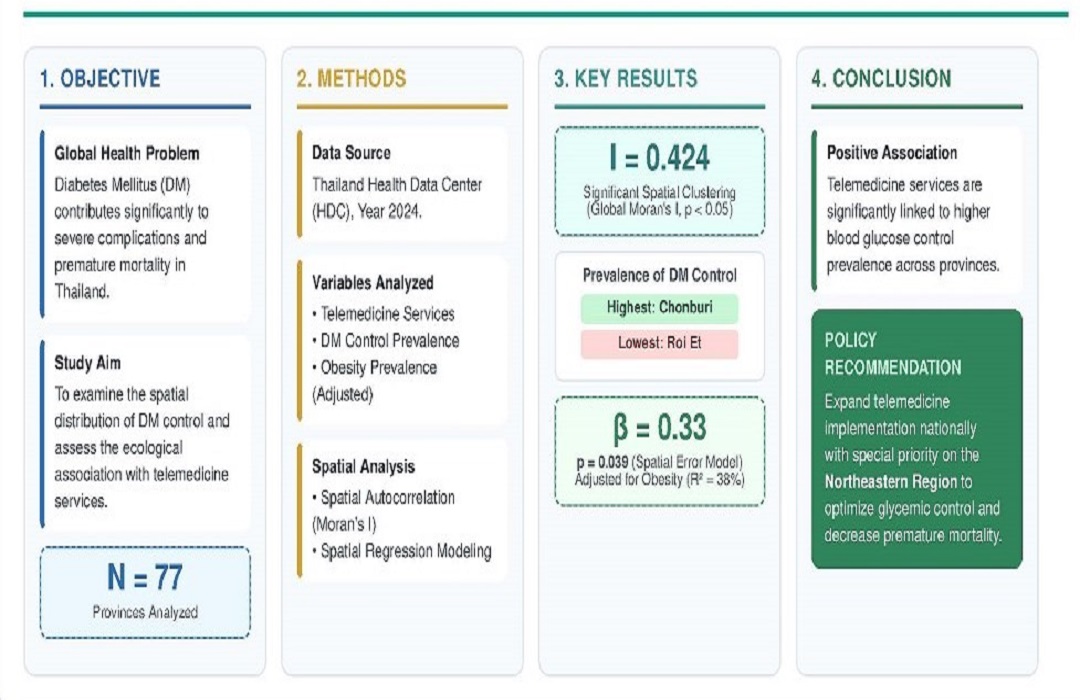
Diabetes mellitus (DM) is a major health problem that contributes to severe complications and mortality. This study aimed to examine the spatial distribution of DM control across Thailand and to assess the ecological association between telemedicine services and DM control at the provincial level. We conducted an ecological study using publicly available data from the Thailand Health Data Center (HDC) for 2024. We extracted and analyzed data on telemedicine services, obesity prevalence, and DM control using spatial analysis techniques. The unit of analysis was the 77 provinces. We assessed spatial autocorrelation using Global Moran’s I and fitted spatial regression models to examine the association between telemedicine services and DM control, adjusting for obesity prevalence. Statistical significance was set at 0.05. Chonburi province had the highest DM control prevalence, while Roi Et province had the lowest. Significant spatial autocorrelation was identified (Global Moran’s I = 0.424). The spatial error model demonstrated the lowest Akaike Information Criterion and explained 38% of the variation in DM control. Telemedicine services were significantly associated with higher DM control (β = 0.33, p = 0.039) after adjustment for obesity prevalence. Expanding telemedicine services at the national level, particularly in northeastern Thailand, may improve glycemic control among patients with DM and help prevent severe complications and premature mortality.
References
Arora, S., Huda, R. K., Verma, S., Khetan, M., & Sangwan, R. K. (2024). Challenges, Barriers, and Facilitators in telemedicine implementation in India: a scoping review. Cureus, 16(8), e67388. https://doi.org/10.7759/cureus.67388
Ayanan, P., Chomchuen, T., & Tangkawanich, T. (2021). Factors associated with obesity behaviors among upper secondary school students in Mueang District, Chiang Rai Province. Journal of Health Research and Development (Nakhon Ratchasima), 7(1), 75–89. https://he02.tci-thaijo.org/index.php/journalkorat/article/view/252506
Bernocchi, P., Scalvini, S., Bertacchini, F., Rivadossi, F., & Muiesan, M. L. (2014). Home-based telemedicine intervention for patients with uncontrolled hypertension: A real-life non-randomized study. BMC Medical Informatics and Decision Making, 14(1), 1–8.
Bramante, C. T., Lee, C. J., & Gudzune, K. A. (2017). Treatment of obesity in patients with diabetes. Diabetes Spectrum, 30(4), 237–243. https://doi.org/10.2337/ds17-0030
Di Molfetta, S., Cormio, P. P. S., Paleari, A. C. R., & Lamacchia, A. M. O. (2022). A telemedicine-based approach with real-time transmission of blood glucose data improves metabolic control in insulin-treated diabetes: The DIAMONDS randomized clinical trial. Journal of Endocrinological Investigation, 45(9), 1663–1671.
Deng, L., Jia, L., Wu, X.-L., & Cheng, M. (2025). Association between body mass index and glycemic control in type 2 diabetes mellitus: A cross-sectional study. Diabetes, Metabolic Syndrome and Obesity, 18, 555–563. https://doi.org/10.2147/dmso.s508365
Fakthongyoo, S. (2024). Effect of telepharmacy in diabetic patients at service units in the network of Somdejprajoataksin Maharaj Hospital. Journal of Nakornping Hospital, 15(2), 392–406. https://he01.tci-thaijo.org/index.php/jnkp/article/view/271985
Franz, M. J. (2017). Weight management: Obesity to diabetes. Diabetes Spectrum, 30(3), 149–153. https://doi.org/10.2337/ds17-0011
Gilani, A., Umar, K., Gilani, F., Ahmad, M., Abbasi, M. S., Yaseen, M., Zeeshan, M., Ullah, N., Waseem, A., Batool, F., & Safdar, S. (2024). The Effect of Glycemic Control on Cardiovascular Disease Progression in Adults With Early-Onset Type 2 Diabetes: A Longitudinal Cohort Analysis. Cureus, 16(12), e75058. https://doi.org/10.7759/cureus.75058
Han, C., Zhang, J., Ye, X., Lu, J., Jin, H., Xu, W., et al. (2023). Telemedicine-assisted structured self-monitoring of blood glucose in management of type 2 diabetes mellitus: Results of a randomized clinical trial. BMC Medical Informatics and Decision Making, 23, 1–8.
International Diabetes Federation. (2025). IDF diabetes atlas (11th ed.). International Diabetes Federation.
Kesavadev, J., Saboo, B., Shankar, A., Krishnan, G., & Jothydev, S. (2015). Telemedicine for diabetes care: An Indian perspective - feasibility and efficacy. Indian Journal of Endocrinology and Metabolism, 19(6), 764. https://doi.org/10.4103/2230-8210.167560
Lee, S. W. H., Ooi, L., & Lai, Y. K. (2017). Telemedicine for the management of glycemic control and clinical outcomes of type 1 diabetes mellitus: A systematic review and meta-analysis of randomized controlled studies. Frontiers in Pharmacology, 8, 330. https://doi.org/10.3389/fphar.2017.00330
Leung, C. H., Tzeng, M. S., Tsai, C. Y., Tsai, W. R., Liu, S. C., Hsu, P. H., & Chuang, S. M. (2025). Enhanced glycemic control and cardiovascular risk reduction in type 2 diabetes patients using quantified tableware: A randomized controlled study. Primary care diabetes, 19(2), 149–156. https://doi.org/10.1016/j.pcd.2025.02.001
Lim, J. U., Lee, J. H., Kim, J. S., Hwang, Y. I., Kim, T. H., Lim, S. Y., Yoo, K. H., Jung, K. S., Kim, Y. K., & Rhee, C. K. (2017). Comparison of World Health Organization and Asia-Pacific body mass index classifications in COPD patients. International journal of chronic obstructive pulmonary disease, 12, 2465–2475. https://doi.org/10.2147/COPD.S141295
Manda, S., Haushona, N., & Bergquist, R. (2020). A scoping review of spatial analysis approaches using health survey data in sub-Saharan Africa. International Journal of Environmental Research and Public Health, 17(9), 1–20. https://doi.org/10.3390/ijerph17093079
Ministry of Public Health. (2024a). Percentage of population aged 35 years and over screened for diabetes and hypertension. Health Data Center (HDC). Ministry of Public Health.
Ministry of Public Health. (2024b). Percentage of diabetic patients with good glycemic control. Health Data Center (HDC). Ministry of Public Health.
Ministry of Public Health. (2024c). Number of Telemedicine service. Health Data Center (HDC).
Ministry of Public Health. (2024d). Percentage of working-age population (aged 19–59 years) with normal body mass index. Health Data Center (HDC).
Numsang, P., Oumtanee, A., Kurat, S., Sananok, R., Kraichan, S., &Sarapoke, P. (2023). “Failure to control blood sugar” experiences of persons with type 2 diabetes mellitus. International Journal of Nursing Sciences, 10(4), 527–532. https://doi.org/10.1016/j.ijnss.2023.09.004
Omboni, S., & Ferrari, R. (2015). The role of telemedicine in hypertension management: Focus on blood pressure telemonitoring. Current Hypertension Reports, 17(4), 1–13. https://doi.org/10.1007/s11906-015-0535-8
Pellegrini, D., Torlasco, C., Ochoa, J. E., & Parati, G. (2020). Contribution of telemedicine and information technology to hypertension control. Hypertension Research, 43(7), 621–628. https://doi.org/10.1038/s41440-020-0422-4
Phuwilert, P., Khiewkhern, S., Phajan, T., Wongprachum, K., Wibuloutai, J., Srichomphoo, C., Nghiep, L. K., & Tudpor, K. (2024). Factors affecting glycemic control in patients with type 2 diabetes in Kalasin Province, Thailand: An analytical cross-sectional study. Healthcare, 12(19), Article 1916. https://doi.org/10.3390/healthcare12191916
Ramlan, D., & Polytechnic, S. H. (2023). Telehealth DM group Android smartphones in controlling blood sugar levels in patients with type 2 DM. Indonesian Journal of Community Research and Engagement, 4(2), 687–705.
Sakboonyarat, B., Pima, W., Chokbumrungsuk, C., Pimpak, T., Khunsri, S., Ukritchon, S., Imjaijitt, W., Mungthin, M., Kaewput, W., Bhopdhornangkul, B., Sathavarodom, N., Tatsanavivat, P., & Rangsin, R. (2021). National trends in the prevalence of glycemic control among patients with type 2 diabetes receiving continuous care in Thailand from 2011 to 2018. Scientific Reports, 11(1), 14260. https://doi.org/10.1038/s41598-021-93733-4
Tanapibunphol, S. (2024). The development of a self-management model for diabetes patients combined with the use of telehealth technology for remote health monitoring at Phayakkhaphumphisai Hospital, Mahasarakham Province. Academic Journal of Mahasarakham Provincial Public Health Office, 8(17), 392–406. https://thaidj.org/index.php/AJMP/article/view/15900
Tangwanaprai, T., Saengkaew, S., & Leelapaiboon, J. (2023). Effectiveness of using telemedicine to control blood pressure levels in hypertensive patients during the COVID-19 pandemic: A retrospective study. Journal of Primary Service System and Family Medicine, 6(4), 316–327.
Tchero, H., Kangambega, P., Briatte, C., Brunet-Houdard, S., Retali, G. R., & Rusch, E. (2019). Clinical effectiveness of telemedicine in diabetes mellitus: A meta-analysis of 42 randomized controlled trials. Telemedicine and e-Health, 25(7), 569–583. https://doi.org/10.1089/tmj.2018.0156
Downloads
Published
How to Cite
License
Copyright (c) 2026 Asian Health, Science and Technology Reports

This work is licensed under a Creative Commons Attribution-NonCommercial 4.0 International License.