A Machine Learning-Based Student Dropout Risk Prediction and Early Warning System
DOI:
https://doi.org/10.69650/ahstr.2026.4692Keywords:
Higher Education Analytics, Early warning system, Machine Learning, XGBoost, Dropout PredictionAbstract
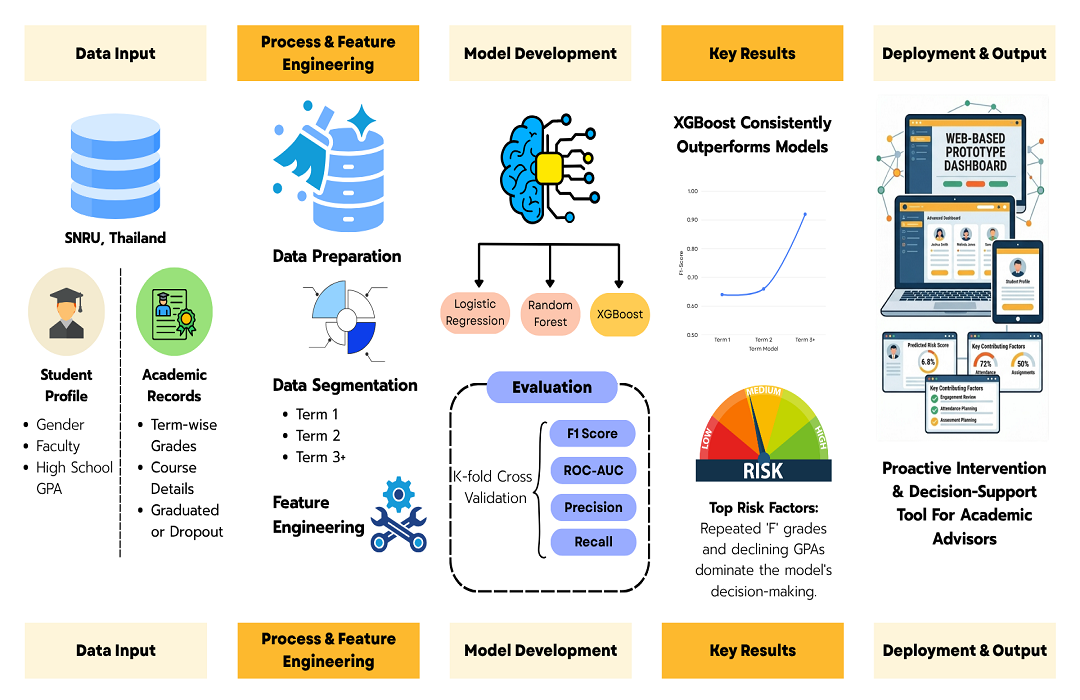
Student dropout rates in higher education have become a significant problem for universities worldwide, impacting both student academic achievement and institutional stability. To address this problem, this research proposes the Student Dropout Risk Prediction and Early Warning System (SDRP-EWS), a machine learning framework designed to predict the risk of eventual student dropout. Utilizing multi-semester academic performance data from 20,919 undergraduate students at Sakon Nakhon Rajabhat University, Thailand (2014–2024), the study developed logistic regression, random forest, and XGBoost models. To support early and continuous monitoring, these models were evaluated at three distinct prediction horizons: following the first semester, after the second semester, and after three or more semesters. Cohen's d effect size analysis compared ROC-AUC distributions across engineered feature sets, confirming the practical advantage of the selected model configurations. The results show that XGBoost consistently outperformed other models across all prediction stages, achieving F1-scores for the dropout class ranging from 0.65 in the early stages up to 0.93 in later semesters with comprehensive academic histories. This study's primary contribution is integrating the top-performing multi-semester model into a functional, web-based prototype dashboard tailored for Thai higher education. By providing academic advisors with intuitive risk scores and key contributing factors, the system demonstrates strong potential as an evidence-based decision-support tool to facilitate proactive, targeted institutional interventions.
References
Agrusti, F., Mezzini, M., & Bonavolontà, G. (2020). Deep learning approach for predicting university dropout: A case study at Roma Tre University. Journal of E-Learning and Knowledge Society, 16(1), 44-54. https://doi.org/10.20368/1971-8829/1135192
Albugami, S., Albugami, H., & Wali, A. M. (2024). From Data to Decision: Machine Learning and Explainable AI in Student Dropout Prediction. Journal of eLearning and Higher Education, 2024, Article 246301, https://doi.org/10.5171/2024.246301
Alhardi, A., & ALAN, S. (2024). Predicting student dropout in higher education using machine learning techniques: a predictive model using XGBoost algorithm. International Conference on Engineering Technologies (ICENTE’24) (p. 31). Turkey, Konya.
Bañeres, D., Rodríguez-González, M. E., Guerrero-Roldán, A. E., & Cortadas, P. (2023). An early warning system to identify and intervene online dropout learners. Computers & Education, 202, 104840. https://doi.org/10.1016/j.compedu.2023.104840
Burkov, A. (2019). The hundred-page machine learning book. Andriy Burkov.
Carballo-Mendívil, B., Arellano-González, A., Ríos-Vázquez, N. J., & Lizardi-Duarte, M. D. P. (2025). Predicting student dropout from day one: XGBoost-based early warning system using pre-enrollment data. Applied Sciences, 15(16), 9202. https://doi.org/10.3390/app15169202
Cho, C. H., Yu, Y. W., & Kim, H. G. (2023). A study on dropout prediction for university students using machine learning. Applied Sciences, 13(21), 12004. https://doi.org/10.3390/app132112004
Córdova-Esparza, D. M., Terven, J., Romero-González, J. A., & Córdova, K. E. (2025). Predicting and preventing school dropout with business intelligence: Insights from a systematic review. Information, 16(4), 326. https://doi.org/10.3390/info16040326
Dasi, H., & Kanakala, S. (2022). Student dropout prediction using machine learning techniques. International Journal on Informatics Visualization, 6(3), 678-683. https://doi.org/10.30630/joiv.6.3.2276
Fernández, A., García, S., Galar, M., Prati, R. C., Krawczyk, B., & Herrera, F. (2018). Learning from imbalanced data sets. Springer. https://doi.org/10.1007/978-3-319-98074-4
He, H., & Ma, Y. (2013). Imbalanced learning: Foundations, algorithms, and applications. Wiley-IEEE Press. https://doi.org/10.1002/9781118646106
Liu, Z., Zhou, X., & Liu, Y. (2025). Student dropout prediction using ensemble learning with SHAP-based explainable AI analysis. Journal of Social Systems and Policy Analysis, 2(3), 111-132. https://doi.org/10.62762/JSSPA.2025.321501
Marbouti, F., Diefes-Dux, H. A., & Madhavan, K. (2016). Models for early prediction of at-risk students in a course using standards-based grading. Computers & Education, 103, 1-15. https://doi.org/ 10.1016/j.compedu.2016.09.006
Markson, R., Thiago, R., Tiago, R., Rafael, T., Vinicius, R., Emanuel, M., Roberto, M., & Cristian, C. (2025). Student dropout prediction through machine learning optimization: Insights from Moodle log data. Scientific Reports, 15, 93918. https://doi.org/10.1038/s41598-025-93918-1
Mustofa, S., Emon, Y. R., Mamun, S. B., Akhy, S. A., & Ahad, M. T. (2025). A novel AI-driven model for student dropout risk analysis with explainable AI insights. Computers and Education: Artificial Intelligence, 8(1), 100352. https://doi.org/10.1016/j.caeai.2024.100352
Sushmitha, K., & Shivamurthy, R. C. (2023). A real-time web application using machine learning for predicting university dropouts. International Journal of Scientific Development and Research, 8(8), 63-67.
Tanantong, T., Moolngearn, P., Kraiwanit, T., Limna, P., & Rafiyya, A. (2024) People Skills in the 21st Century: A Perspective on the Smart City in an Emerging Economy. Human Behavior and Emerging Technologies, 2024, 5211958. https://doi.org/10.1155/2024/5211958
Tantiathimongkhon, T., Ketcham, M., & Rattanasiriwongwut, M. (2026). The strategic-behavioral analysis: Factors influencing AI-Powered learning platform adoption in Thai higher education. Journal of Information Technology Education: Research, 25, 12. https://doi.org/10.28945/5694
Theobald, O. (2021). Machine learning for absolute beginners: A plain English introduction (3rd ed.). Scatterplot Press.
Tian, X., Nunes, B. P., Liu, Y., & Manrique, R. (2023). Predicting student engagement using sequential ensemble model. IEEE Transactions on Learning Technologies, 17, 939-950. https://doi.org/10.1109/TLT.2023.334286
Tinto, V. (2012). Completing College: Rethinking Institutional Action. University of Chicago Press. https://doi.org/10.7208/chicago/9780226804545.001.0001
Downloads
Published
How to Cite
Issue
Section
Categories
License
Copyright (c) 2026 Asian Health, Science and Technology Reports

This work is licensed under a Creative Commons Attribution-NonCommercial 4.0 International License.