Burnout and Sleep Health: Epidemiology and Policy Implications in Healthcare Workers
DOI:
https://doi.org/10.69650/ahstr.2026.4662Keywords:
Burnout, Sleep disturbance, Shift work, Occupational stress, Healthcare workersAbstract
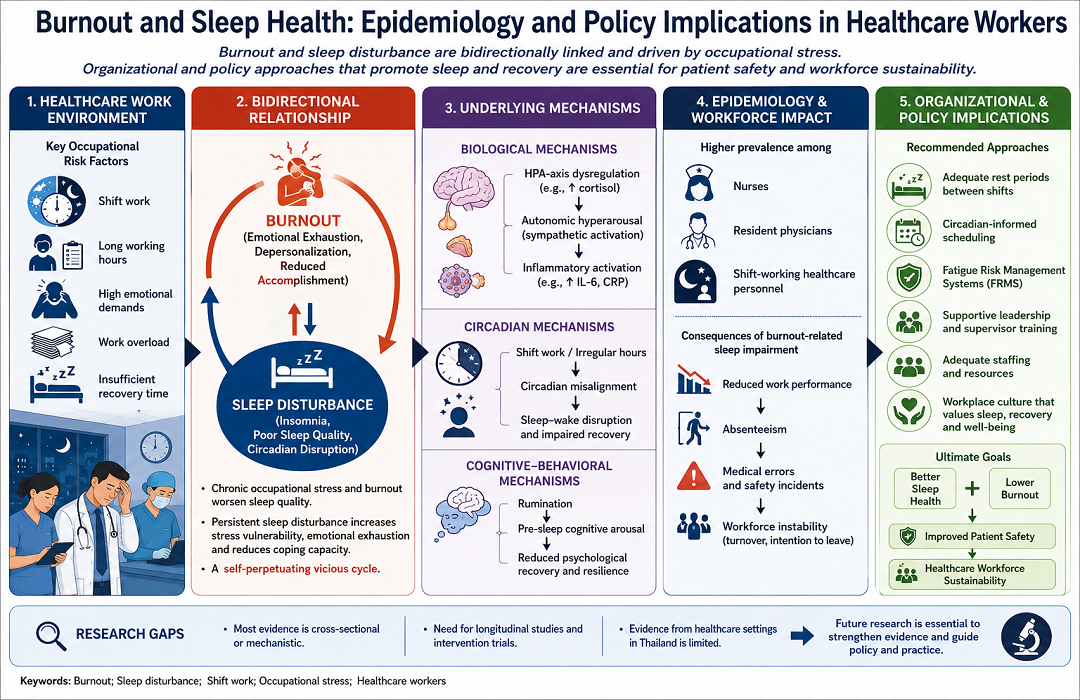
Burnout and sleep disturbance are increasingly recognized as interconnected occupational health problems among healthcare workers, particularly in professions characterized by shift work, prolonged working hours, high emotional demands, and insufficient recovery time. This narrative review aimed to synthesize current evidence regarding the bidirectional relationship between burnout and sleep disturbance, describe potential biological, circadian, and cognitive-behavioral mechanisms underlying this interaction, and discuss organizational and policy implications relevant to healthcare workforce sustainability and patient safety. A structured literature search was conducted using PubMed, Scopus, and Google Scholar for studies published up to January 2026. The review included systematic reviews, meta-analyses, narrative reviews, mechanistic studies, cross-sectional studies, and organizational and policy-related literature relevant to burnout and sleep among healthcare workers. Current evidence suggests that chronic occupational stress and burnout are associated with poor sleep quality, insomnia symptoms, circadian disruption, and impaired recovery, while persistent sleep disturbance may further increase stress vulnerability, emotional exhaustion, and reduced coping capacity. Proposed mechanisms include HPA-axis dysregulation, autonomic hyperarousal, inflammatory activation, circadian misalignment, rumination, and pre-sleep cognitive arousal. Epidemiological evidence consistently shows higher burnout and sleep-related problems among nurses, resident physicians, and shift-working healthcare personnel. Burnout-related sleep impairment has also been associated with reduced work performance, absenteeism, medical errors, and workforce instability. From an organizational perspective, burnout prevention should not rely solely on individual resilience strategies. Practical approaches may include adequate rest periods between shifts, circadian-informed scheduling, fatigue risk management systems, supportive leadership, staffing support, and workplace cultures that recognize sleep and recovery as important components of patient safety and workforce sustainability. However, most currently available evidence remains cross-sectional or mechanistic in nature. Further longitudinal and interventional research is needed, particularly in healthcare settings in Thailand.
References
Alhassan, M. A., Alarabi, M. A., Alhassan, S. A., Albalawi, W. M., & AlRabiah, E. S. (2025). Prevalence of burnout and its risk and protective factors among healthcare workers in the Middle East, North Africa, and Turkey: a systematic review and meta-analysis. Frontiers in Psychology, 16, 1539105. https://doi.org/10.3389/fpsyg.2025.1539105
Baranwal, N., Yu, P. K., & Siegel, N. S. (2023). Sleep physiology, pathophysiology, and sleep hygiene. Progress in Cardiovascular Diseases, 77, 59-69. https://doi.org/10.1016/j.pcad.2023.02.005
Bonnet, M. H., & Arand, D. L. (2010). Hyperarousal and insomnia: state of the science. Sleep Med Rev, 14(1), 9-15. https://doi.org/10.1016/j.smrv.2009.05.002
Boonthep, S., Prasit, N., Nonthamat, A., & Nidthumsakul, N. (2025). Factors Associated With Burnout Syndrome Among Healthcare Workers at Sub-District Health Promoting Hospitals in Khon Kaen Province, Thailand. Journal of Population and Social Studies, 34, 510-530. https://so03.tci-thaijo.org/index.php/jpss/article/view/284320
Buckley, T. M., & Schatzberg, A. F. (2005). On the Interactions of the Hypothalamic-Pituitary-Adrenal (HPA) Axis and Sleep: Normal HPA Axis Activity and Circadian Rhythm, Exemplary Sleep Disorders. The Journal of Clinical Endocrinology & Metabolism, 90(5), 3106-3114. https://doi.org/10.1210/jc.2004-1056
Caruso, C. C., Baldwin, C. M., Berger, A., Chasens, E. R., Edmonson, J. C., Gobel, B. H., Landis, C. A., Patrician, P. A., Redeker, N. S., Scott, L. D., Todero, C., Trinkoff, A., & Tucker, S. (2019). Policy brief: Nurse fatigue, sleep, and health, and ensuring patient and public safety. Nurs Outlook, 67(5), 615-619. https://doi.org/10.1016/j.outlook.2019.08.004
Chahal, K., & Matwala, K. (2024). A systematic review of the prevalence of burnout in orthopaedic surgeons. The Annals of The Royal College of Surgeons of England, 107(1), 61-67. https://doi.org/10.1308/rcsann.2024.0009
Chatlaong, T. (2020). Sleep Quality and Burnout Syndrome among Residents in Training at the Faculty of Medicine, Prince of Songkla University. Siriraj Medical Journal, 72, 307-314. https://doi.org/10.33192/Smj.2020.41
Chienwattanasook, K., & Jermsittiparsert, K. (2019). Factors Affecting Job Stress among Employees in the Banking Sector of Malaysia. International Journal of Innovation, Creativity and Change, 6(2), 288-302.
Chinvararak, C., Kerdcharoen, N., Pruttithavorn, W., Polruamngern, N., Asawaroekwisoot, T., Munsukpol, W., & Kirdchok, P. (2022). Mental health among healthcare workers during COVID-19 pandemic in Thailand. PLoS One, 17(5), e0268704. https://doi.org/10.1371/journal.pone.0268704
Chodyka, M., Grudniewski, T., Chrzaszcz, A., Krawczynska, S., Ciekanowski, Z., & Król, A. (2025). The Impact of Burnout and Professional Rust on Organisational Safety and the Effectiveness of Human Resource Management. European Research Studies Journal, XXVIII(3), 758-768. https://doi.org/10.35808/ersj/4074
Conceoção, A., & Palma-Moreira, A. (2025). The Relationship Between Occupational Stress, Burnout, and Perceived Performance: The Moderating Role of Work Regime. Administrative Sciences, 15(10), 377. https://www.mdpi.com/2076-3387/15/10/377
Danhof-Pont, M. B., van Veen, T., & Zitman, F. G. (2011). Biomarkers in burnout: a systematic review.
Journal of Psychosomatic Research , 70(6), 505-524. https://doi.org/10.1016/j.jpsychores.2010.10.012
de Vente, W., van Amsterdam, J. G. C., Olff, M., Kamphuis, J. H., & Emmelkamp, P. M. G. (2015). Burnout Is Associated with Reduced Parasympathetic Activity and Reduced HPA Axis Responsiveness, Predominantly in Males. BioMed Research International, 2015(1), 431725. https://doi.org/10.1155/2015/431725
Dent, J., Smeeton, N., Whiting, L., & Watson, T. (2024). The importance of recovery and staffing on midwives' emotional wellbeing: A UK national survey. Midwifery, 132, 103961. https://doi.org/10.1016/j.midw.2024.103961
Dyrbye, L. N., Shanafelt, T. D., Johnson, P. O., Johnson, L. A., Satele, D., & West, C. P. (2019). A cross-sectional study exploring the relationship between burnout, absenteeism, and job performance among American nurses. BMC Nurs, 18, 57. https://doi.org/10.1186/s12912-019-0382-7
Employee assistance program. (2024). Employee assistance program's effectiveness in addressing occupational stress. Annals of Spiru Haret University. Economic Series, 4, 625-656. https://doi.org/10.26458/24427
Feuth, T. (2024). Interactions between sleep, inflammation, immunity and infections: A narrative review. Immunity, Inflammation and Disease, 12(10), e70046. https://doi.org/10.1002/iid3.70046
Garcia, C. L., Abreu, L. C., Ramos, J. L. S., Castro, C. F. D., Smiderle, F. R. N., Santos, J. A. D., & Bezerra, I. M. P. (2019). Influence of Burnout on Patient Safety: Systematic Review and Meta-Analysis. Medicina (Kaunas), 55(9), 553. https://doi.org/10.3390/medicina55090553
Grossi, G., Perski, A., Osika, W., & Savic, I. (2015). Stress-related exhaustion disorder – clinical manifestation of burnout? A review of assessment methods, sleep impairments, cognitive disturbances, and neuro-biological and physiological changes in clinical burnout. Scandinavian Journal of Psychology, 56(6), 626-636. https://doi.org/10.1111/sjop.12251
Henry, D., McClellen, D., Rosenthal, L., Dedrick, D., & Gosdin, M. (2008). Is sleep really for sissies? Understanding the role of work in insomnia in the US. Social Science & Medicine, 66(3), 715-726. https://doi.org/10.1016/j.socscimed.2007.10.007
Jiyeon, S., Oragun, R., Dennis, S., Elen, G., Fariha, H., Sherzai, D., & Roy, A. (2026). Lifestyle and Behavioral Enhancements of Sleep: A Review. American Journal of Lifestyle Medicine, https://doi.org/10.1177/15598276251410479
Jonsdottir, I. H., & Sjörs Dahlman, A. (2019). Mechanisms in endocrinology: Endocrine and immunological aspects of burnout: a narrative review. European Journal of Endocrinology, 180(3), R147-r158. https://doi.org/10.1530/eje-18-0741
Kalmbach, D. A., Buysse, D. J., Cheng, P., Roth, T., Yang, A., & Drake, C. L. (2020). Nocturnal cognitive arousal is associated with objective sleep disturbance and indicators of physiologic hyperarousal in good sleepers and individuals with insomnia disorder. Sleep Med, 71, 151-160. https://doi.org/10.1016/j.sleep.2019.11.1184
Kanha, S., Prasit, N., Nilnate, N., Yarasee, J., Phordee, W., & Nonthamat, A. (2026). eHealth competency needs in the Mekong border region: a GLMM analysis of primary care personnel in Nong Khai, Thailand. BMC Health Services Research, 26(1), 296. https://doi.org/10.1186/s12913-026-14104-1
Kunno, J., Supawattanabodee, B., Sumanasrethakul, C., Wiriyasirivaj, B., & Yubonpunt, P. (2022). Burnout prevalence and contributing factors among healthcare workers during the COVID-19 pandemic: A cross-sectional survey study in an urban community in Thailand. PLoS One, 17(8), e0269421. https://doi.org/10.1371/journal.pone.0269421
Leape, L. L., Brennan, T. A., Laird, N., Lawthers, A. G., Localio, A. R., Barnes, B. A., Hebert, L., Newhouse, J. P., Weiler, P. C., & Hiatt, H. (1991). The nature of adverse events in hospitalized patients. Results of the Harvard Medical Practice Study II. The New England Journal of Medicine (NEJM), 324(6), 377-384. https://doi.org/10.1056/nejm199102073240605
Leiter, M. P., & Maslach, C. (2009). Nurse turnover: the mediating role of burnout. Journal of Nursing Management, 17(3), 331-339. https://doi.org/10.1111/j.1365-2834.2009.01004.x
Lerman, S. E., Eskin, E., Flower, D. J., George, E. C., Gerson, B., Hartenbaum, N., Hursh, S. R., & Moore-Ede, M. (2012). Fatigue risk management in the workplace. Journal of Occupational and Environmental Medicine, 54(2), 231-258. https://doi.org/10.1097/JOM.0b013e318247a3b0
Li, L. Z., Yang, P., Singer, S. J., Pfeffer, J., Mathur, M. B., & Shanafelt, T. (2024). Nurse Burnout and Patient Safety, Satisfaction, and Quality of Care: A Systematic Review and Meta-Analysis. JAMA Netw Open, 7(11), e2443059. https://doi.org/10.1001/jamanetworkopen.2024.43059
Lin, R. T., Lin, Y. T., Hsia, Y. F., & Kuo, C. C. (2021). Long working hours and burnout in health care workers: Non-linear dose-response relationship and the effect mediated by sleeping hours-A cross-sectional study. Journal of Occupational Health, 63(1), e12228. https://doi.org/10.1002/1348-9585.12228
Maslach, C., & Jackson, S. E. (1981). The measurement of experienced burnout. Journal of Organizational Behavior, 2(2), 99-113. https://doi.org/10.1002/job.4030020205
Meerlo, P., Sgoifo, A., & Suchecki, D. (2008). Restricted and disrupted sleep: Effects on autonomic function, neuroendocrine stress systems and stress responsivity. Sleep Medicine Reviews, 12(3), 197-210. https://doi.org/https://doi.org/10.1016/j.smrv.2007.07.007
Milczarek, M., Hassard, J., Teoh, K., Cox, T., & Et, C. (2014 ). Calculating the cost of work-related stress and psychosocial risks. European Risk Observatory, Literature Review. https://doi.org/10.2802/20493
World Health Organization (WHO) (2019, May 28). Burn-out an “occupational phenomenon”: International Classification of Diseases. https://www.who.int/news/item/28-05-2019-burn-out-an-occupational-phenomenon-international-classification-of-diseases
Murray, N. (2020, October 15). Burnout Britain: Overwork and Mental Health in the Age of Unemployment. 4 Day Week Campaign, Compass and Autonomy. https://coilink.org/20.500.12592/xtt1vh
Pansu, L. (2018). Evaluation of ‘right to disconnect’ legislation and its impact on employee’s productivity. International Journal of Management and Applied Research, 5(3), 99-119.
Paradis, K. C., Kerr, E. A., Griffith, K. A., Cutter, C. M., Feldman, E. L., Singer, K., Spector, N. D., Ubel, P. A., & Jagsi, R. (2024). Burnout Among Mid-Career Academic Medical Faculty. JAMA Network Open, 7(6), e2415593. https://doi.org/10.1001/jamanetworkopen.2024.15593
Pham, H., Chuang, H.-L., Kuo, C.-P., Yeh, T. P., & Liao, W.-C. (2021). Electronic Device Use before Bedtime and Sleep Quality among University Students. Healthcare, 9, 1091. https://doi.org/10.3390/healthcare9091091
Phordee, W., Prasit, N., Nonthamat, A., & Sresutham, P. (2025). Holistic intelligence and smart organization affecting the performance of standard medical laboratory guidelines of medical technologists at community hospitals in Health Region 7. Journal of Associated Medical Sciences, 58(2), 109-121. https://he01.tci-thaijo.org/index.php/bulletinAMS/article/view/275911
Pitanupong, J., & Jatchavala, C. (2018). A Study on the Comparison of Burnout Syndrome, Among Medical Doctors in the Restive Areas and Non-Restive Areas of the South Thailand Insurgency. Journal of Health Science and Medical Research (JHSMR),36(4), 277-289. https://doi.org/10.31584/jhsmr.201825
Prasit, N., Nilnate, N., Nonthamat, A., Yanarueng, S., & Yarasee, J. (2026). Economic changes and public health resources associated with satisfaction toward the state health service system among older adults under the Universal Coverage Scheme across 77 provinces in Thailand, 2017-2024. International Journal for Equity in Health, 25, article number 121. https://doi.org/10.1186/s12939-026-02820-3
Querstret, D., & Cropley, M. (2012). Exploring the Relationship Between Work-Related Rumination, Sleep Quality, and Work-Related Fatigue. Journal of Occupational Health Psychology, 17, 341-353. https://doi.org/10.1037/a0028552
Riemann, D., Spiegelhalder, K., Feige, B., Voderholzer, U., Berger, M., Perlis, M., & Nissen, C. (2010). The hyperarousal model of insomnia: A review of the concept and its evidence. Sleep Medicine Reviews, 14(1), 19-31. https://doi.org/10.1016/j.smrv.2009.04.002
Runglirdsittikul, K. (2022). Burnout and Associated Factors Among Healthcare Workers in Samutprakarn Hospital during the COVID-19 Pandemic. Journal of the Psychiatric Association of Thailand, 67(3), 240-255. https://he01.tci-thaijo.org/index.php/JPAT/article/view/251663
Sadangrit, K. (2022). Correlation Between Quality of Sleep and Occupational Burnout Among Hospital Workers. Journal of Positive Psychology and Wellbeing, 6(1), Article 4787. https://journalppw.com/index.php/jppw/article/view/4787
Saintila, J., Soriano-Moreno, A. N., Ramos-Vera, C., Oblitas-Guerrero, S. M., & Calizaya-Milla, Y. E. (2023). Association between sleep duration and burnout in healthcare professionals: a cross-sectional survey. Front Public Health, 11, 1268164. https://doi.org/10.3389/fpubh.2023.1268164
Salvagioni, D. A. J., Melanda, F. N., Mesas, A. E., Gonzalez, A. D., Gabani, F. L., & Andrade, S. M. (2017). Physical, psychological and occupational consequences of job burnout: A systematic review of prospective studies. PLoS One, 12(10), e0185781. https://doi.org/10.1371/journal.pone.0185781
Sangperm, N. (2019). Structural Equation Model Cause of Organizational Citizenship Behavior of Personnel of Kasetsart University Sriracha Campus, Thailand. Asian Interdisciplinary and Sustainability Review, 7(1), 31-41. https://so05.tci-thaijo.org/index.php/PSAKUIJIR/article/view/217430
Scott-Marshall, H. K. (2024). Safe limits on work hours for the nursing profession: a rapid evidence review. Front Glob Womens Health, 5, 1455422. https://doi.org/10.3389/fgwh.2024.1455422
Shaik, L., Cheema, M. S., Subramanian, S., Kashyap, R., & Surani, S. R. (2022). Sleep and Safety among Healthcare Workers: The Effect of Obstructive Sleep Apnea and Sleep Deprivation on Safety. Medicina (Kaunas), 58(12). https://doi.org/10.3390/medicina58121723
Sirinara, P., Hanprathet, N., Pongpirul, K., & Jiamjarasrangsi, W. (2023). Impact of shift work on sleep quality among nursing staff. Chulalongkorn Medical Journal, 63(4), 221-227. https://he05.tci-thaijo.org/index.php/CMJ/article/view/1128
Siriwan, J. (2020). Quality of work life and worke environment affecting organizational commitment employee. Rajamangala University of Technology Thanyaburi, Bangkok.
Smith, S. M., & Vale, W. W. (2006). The role of the hypothalamic-pituitary-adrenal axis in neuroendocrine responses to stress. Dialogues Clin Neurosci, 8(4), 383-395. https://doi.org/10.31887/DCNS.2006.8.4/ssmith
Soonthornkes, N., Sakornwattananon, O., Jirapitakkul, J., & Nuallaong, W. (2023). Burnout and Associated Factors among Thai Anesthesiology Residents. Siriraj Medical Journal, 75(10), 736-743. https://doi.org/10.33192/smj.v75i10.264582
Stewart, N. H., & Arora, V. M. (2019). The Impact of Sleep and Circadian Disorders on Physician Burnout. Chest, 156(5), 1022-1030. https://doi.org/10.1016/j.chest.2019.07.008
Surawattanasakul, V., Kiratipaisarl, W., & Siviroj, P. (2024). Burnout and Quality of Work Life among Physicians during Internships in Public Hospitals in Thailand. Behav Sci (Basel), 14(5), 361. https://doi.org/10.3390/bs14050361
Surawattanasakul, V., Siviroj, P., Kiratipaisarl, W., Sirikul, W., Phetsayanavin, V., Pholvivat, C., Auernaruemonsuk, N., & Lamlert, C. (2025). Physician burnout, associated factors, and their effects on work performance throughout first-year internships during the COVID-19 pandemic in Thailand: a cross-sectional study. BMC Public Health, 25(1), 1967. https://doi.org/10.1186/s12889-025-23172-7
Toker, S., Shirom, A., Shapira, I., Berliner, S., & Melamed, S. (2005). The association between burnout, depression, anxiety, and inflammation biomarkers: C-reactive protein and fibrinogen in men and women. Journal of Occupational Health Psychology, 10(4), 344-362. https://doi.org/10.1037/1076-8998.10.4.344
Tonboota, S., Wattanadumrong, B., & Pannarunothai, S. (2023). Distribution of Doctors and Outpatient Service Workload by Thai Elderly at the Provincial Level, 2021. Journal of Community Development Research (Humanities and Social Sciences), 16(1), 1-12.
Vela-Bueno, A., Moreno-Jiménez, B., Rodríguez-Muñoz, A., Olavarrieta-Bernardino, S., Fernández-Mendoza, J., De la Cruz-Troca, J. J., Bixler, E. O., & Vgontzas, A. N. (2008). Insomnia and sleep quality among primary care physicians with low and high burnout levels. Journal of Psychosomatic Research, 64(4), 435-442. https://doi.org/10.1016/j.jpsychores.2007.10.014
von Känel, R., Bellingrath, S., & Kudielka, B. M. (2008). Association between burnout and circulating levels of pro- and anti-inflammatory cytokines in schoolteachers. Journal of Psychosomatic Research, 65(1), 51-59. https://doi.org/10.1016/j.jpsychores.2008.02.007
von Känel, R., Princip, M., Holzgang, S. A., Sivakumar, S., Pazhenkottil, A. P., Gomez Vieito, D., & Zuccarella-Hackl, C. (2023). Sympathetic nervous system responses to acute psychosocial stress in male physicians with clinical burnout. Biological Psychology, 183, 108687. https://doi.org/10.1016/j.biopsycho.2023.108687
Woolley, C., Princip, M., Hackl-Zuccarella, C., Auschra, B., Holzgang, S. A., Pazhenkottil, A., Gomez Vieito, D., & von Känel, R. (2025). Reduced interleukin-6 stress reactivity in male physicians with occupational burnout. Journal of Neural Transmission, 132(9), 1255-1261. https://doi.org/10.1007/s00702-025-02945-9
Zhao, H., Li, Q., Huang, H., Lan, F., Yang, H., He, Y., & Huang, Z. (2025). Circadian rhythm types and shift work demands shape sleep quality and depressive symptoms in shift-working nurses. Frontiers in Public Health, 13, 1667778. https://doi.org/10.3389/fpubh.2025.1667778
Zieringer, R. C., & Zapf, D. (2024). The effects of an employee assistance program on productivity at work, workability, absenteeism, and smartphone measures of heart rate and heart rate variability. Journal of Occupational Health Psychology, 29(4), 280-298. https://doi.org/10.1037/ocp0000380
Downloads
Published
How to Cite
License
Copyright (c) 2026 Asian Health, Science and Technology Reports

This work is licensed under a Creative Commons Attribution-NonCommercial 4.0 International License.