Prevalence and Distribution of Protozoan Parasite Contamination in Fresh Vegetables from Bang Khla District, Chachoengsao Province, Thailand
DOI:
https://doi.org/10.69650/ahstr.2026.4621Keywords:
protozoan contamination, fresh vegetables, food safety, irrigation contamination, water spinachAbstract
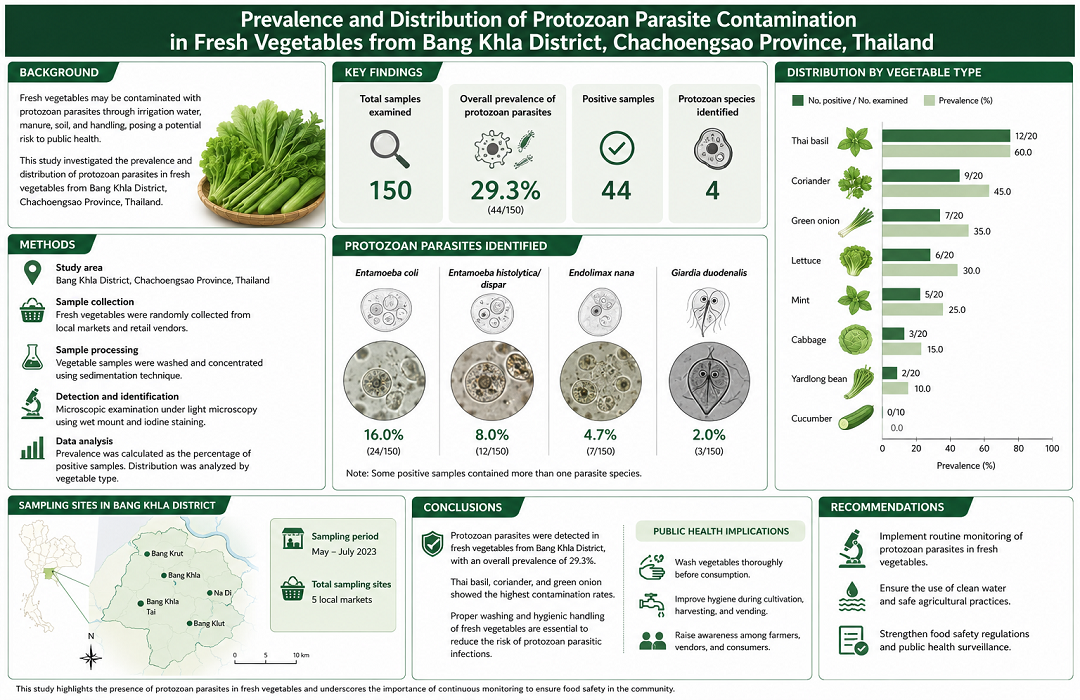
Intestinal protozoan infections pose a significant public health concern, particularly for children and the elderly. This cross-sectional study investigated the prevalence and distribution of protozoan cysts and oocysts in fresh vegetables grown in Bang Khla District, Thailand. The analysis employed the sedimentation technique and modified acid-fast staining method to analyze a total of 369 samples encompassing nine commonly consumed vegetable types collected from cultivation plots. The prevalence of four protozoan species was detected: Cryptosporidium spp. (11.9%), Entamoeba histolytica/E. dispar (7.6%), Blastocystis sp. (3.5%), and Giardia spp. (1.9%). Notably, there was a statistically significant variation in contamination rates across different types of fresh vegetables (p < 0.05). Among the nine vegetable types, water spinach exhibited the highest contamination rate (70.7%), followed by coriander (36.6%), lettuce (34.1%), celery and kale (each at 22.0%), hoary basil and sweet basil (each at 12.2%), spring onion (9.8%), and yardlong bean (4.9%). The high contamination observed in water spinach, a semi-aquatic plant, suggests a potential role of irrigation water as an important source of protozoan contamination. The consumption of raw vegetables, particularly water spinach, may therefore pose a significant risk for the transmission of protozoan infections. These findings underscore the importance of food safety practices, including proper washing and cooking, as well as improved management of irrigation water and cultivation environments. This study provides important evidence supporting the need for strengthened environmental sanitation, targeted public health interventions, and further research on contamination pathways in agricultural systems.
References
Al Nahhas, S., & Aboualchamat, G. (2020). Investigation of parasitic contamination of salad vegetables sold by street vendors in city markets in Damascus, Syria. Food and Waterborne Parasitology, 21, e00090. https://doi.org/10.1016/j.fawpar.2020.e00090
Alemu, G., Mama, M., Misker, D., & Haftu, D. (2019). Parasitic contamination of vegetables marketed in Arba Minch town, southern Ethiopia. BMC Infectious Diseases, 19, 410. https://doi.org/10.1186/s12879-019-4020-5
Alemu, G., Nega, M., & Alemu, M. (2020). Parasitic contamination of fruits and vegetables collected from local markets of Bahir Dar City, Northwest Ethiopia. Research and Reports in Tropical Medicine, 11, 17–25. https://doi.org/10.2147/rrtm.s244737
Asfaw, T., Genetu, D., Shenkute, D., Shenkutie, T. T., Amare, Y. E., & Yitayew, B. (2023). Parasitic contamination and microbiological quality of commonly consumed fresh vegetables marketed in Debre Berhan town, Ethiopia. Environmental Health Insights, 17, 11786302231154755. https://doi.org/10.1177/11786302231154755
Badri, M., Olfatifar, M., Karim, M. R., Modirian, E., Houshmand, E., Abdoli, A., Nikoonejad, A., Sotoodeh, S., Zargar, A., Samimi, R., Hashemipour, S., Mahmoudi, R., Harandi, M. F., Hajialilo, E., Piri, H., Bijani, B., & Eslahi, A. V. (2022). Global prevalence of intestinal protozoan contamination in vegetables and fruits: A systematic review and meta-analysis. Food Control, 133, 108656.
https://doi.org/10.1016/j.foodcont.2021.108656
Balarak, D., Ebrahimi, M., Modrek, M. J., Bazrafshan, E., Mahvi, A. H., & Mahdavi, Y. (2016). Investigation of parasitic contaminations of vegetables sold in markets in the city of Tabriz in 2014. Global Journal of Health Science, 8(10), 178–184. https://doi.org/10.5539/gjhs.v8n10p178
Bekele, F., & Shumbej, T. (2019). Fruit and vegetable contamination with medically important helminths and protozoans in Tarcha town, Dawuro Zone, South West Ethiopia. Research and Reports in Tropical Medicine, 10, 19–23. https://doi.org/10.2147/rrtm.s205250
Bekele, F., Tefera, T., Biresaw, G., & Yohannes, T. (2017). Parasitic contamination of raw vegetables and fruits collected from selected local markets in Arba Minch town, Southern Ethiopia. Infectious Diseases of Poverty, 6, 19. https://doi.org/10.1186/s40249-016-0226-6
Berhe, B., Bugssa, G., Bayisa, S., & Alemu, M. (2018). Foodborne intestinal protozoan infection and associated factors among patients with watery diarrhea in Northern Ethiopia; A cross-sectional study. Journal of Health, Population and Nutrition, 37, 5. https://doi.org/10.1186/s41043-018-0137-1
El Safadi, D., Osman, M., Hanna, A., Hajar, I., Kassem, I. I., Khalife, S., Dabboussi, F., & Hamze, M. (2023). Parasitic contamination of fresh leafy green vegetables sold in Northern Lebanon. Pathogens, 12(8), 1014. https://doi.org/10.3390/pathogens12081014
El-Sayed, N. M., Gawdat, S. S., El-Kholy, H. S., & Elmosalamy, A. (2023). Parasitic contamination in five leafy vegetables collected from open marketplaces in Giza, Egypt. Journal of Food Quality and Hazards Control, 10, 13–20. https://doi.org/10.18502/jfqhc.10.1.11984
Eslahi, A. V., Olfatifar, M., Zaki, L., Saryazdi, A. K., Barikbin, F., Maleki, A., Abdoli, A., Badri, M., & Karanis, P. (2023). Global prevalence of intestinal protozoan parasites among food handlers: A systematic review and meta-analysis. Food Control, 145, 109466. https://doi.org/10.1016/j.foodcont.2022.109466
Gabre, R. M., & Shakir, A. (2016). Prevalence of some human enteroparasites in commonly consumed raw vegetables in Tabuk, Saudi Arabia. Journal of Food Protection, 79(4), 655–658. https://doi.org/10.4315/0362-028x.jfp-15-485
Garcia, L. S. (2007). Diagnostic medical parasitology (5th ed.). ASM Press.
Garcia, L. S., Arrowood, M., Kokoskin, E., Paltridge, G. P., Pillai, D. R., Procop, G. W., Ryan, N., Shimizu, R. Y., & Visvesvara, G. (2017). Practical Guidance for Clinical Microbiology Laboratories: Laboratory Diagnosis of Parasites from the Gastrointestinal Tract. Clinical microbiology reviews, 31(1), e00025-17. https://doi.org/10.1128/CMR.00025-17
Gemechu, T., Bona, J., Aliyo, A., Dedecha, W., & Ashenafi, G. (2023). Assessment of intestinal parasites and its associated factors among fruits and vegetables collected from local markets of Bule Hora town, Southeast Ethiopia. Journal of Tropical Medicine, 2023, 1861919. https://doi.org/10.1155/2023/1861919
Hassan, E. M., Örmeci, B., DeRosa, M. C., Dixon, B. R., Sattar, S. A., & Iqbal, A. (2021). A review of Cryptosporidium spp. and their detection in water. Water Science and Technology, 83(1), 1–25. https://doi.org/10.2166/wst.2020.515
Hemphill, A., Müller, N., & Müller, J. (2019). Comparative pathobiology of the intestinal protozoan parasites Giardia lamblia, Entamoeba histolytica, and Cryptosporidium parvum. Pathogens, 8(3), 116. https://doi.org/10.3390/pathogens8030116
Isazadeh, M., Mirzaii-Dizgah, I., Shaddel, M., & Homayouni, M. M. (2020). The prevalence of parasitic contamination of fresh vegetables in Tehran, Iran. Turkiye Parazitol Derg, 44(3), 143–148. https://doi.org/10.4274/tpd.galenos.2020.6469
Ismail, Y. (2016). Prevalence of parasitic contamination in salad vegetables collected from supermarkets and street vendors in Amman and Baqa’a – Jordan. Polish Journal of Microbiology, 65(2), 201–207. https://doi.org/10.5604/17331331.1204480
Jinatham, V., Wandee, T., Nonebudsri, C., Popluechai, S., Tsaousis, A. D., & Gentekaki, E. (2023). Blastocystis subtypes in raw vegetables from street markets in northern Thailand. Parasitology Research, 122, 1027–1031. https://doi.org/10.1007/s00436-023-07781-y
Krainara, S., Buppan, P., Thummajitsakul, S., & Kosuwin, R. (2023). Detection of parasites and coliform bacteria in vegetables from fresh-food markets in Nakhon Nayok Province, Thailand. The Southeast Asian Journal of Tropical Medicine and Public Health, 54(1), 16–29.
Kudah, C., Sovoe, S., & Baiden, F. (2018). Parasitic contamination of commonly consumed vegetables in two markets in Ghana. Ghana Medical Journal, 52(2), 88–93. https://doi.org/10.4314/gmj.v52i2.5
Laoraksawong, P., Bunkasem, U., & Pradidthaprecha, A. (2025). Prevalence of intestinal parasitic contamination in fresh vegetables in Bangkok, Thailand, and surrounding areas: A cross-sectional survey. Parasite Epidemiology and Control, 29, e00416. https://doi.org/10.1016/j.parepi.2025.e00416
Li, J., Wang, Z., Karim, M. R., & Zhang, L. (2020). Detection of human intestinal protozoan parasites in vegetables and fruits: A review. Parasites & Vectors, 13, 380. https://doi.org/10.1186/s13071-020-04255-3
M’rad, S., Chaabane-Banaoues, R., Lahmar, I., Oumaima, H., Mezhoud, H., Babba, H., & Oudni-M’rad, M. (2020). Parasitological contamination of vegetables sold in Tunisian retail markets with helminth eggs and protozoan cysts. Journal of Food Protection, 83(6), 1104–1109. https://doi.org/10.4315/jfp-19-559
Matosinhos, F. C., Valenzuela, V. C., Silveira, J. A., & Rabelo, E. M. (2016). Standardization of a method for the detection of helminth eggs and larvae in lettuce. Parasitology Research, 115, 1827–1834. https://doi.org/10.1007/s00436-016-4922-8
Mirzaei, Y., Mohammadi, C., Ahmad, S. F., Hamad, P. M., & Samiei, A. (2021). Prevalence of intestinal parasites in raw vegetables consumed in Soran city, Kurdistan Region, Iraq. Annals of Parasitology, 67(3), 275–279. https://doi.org/10.17420/ap6702.339
Mohamed, M. A., Siddig, E. E., Elaagip, A. H., Edris, A. M. M., & Nasr, A. A. (2016). Parasitic contamination of fresh vegetables sold at central markets in Khartoum state, Sudan. Annals of Clinical Microbiology and Antimicrobials, 15, 17. https://doi.org/10.1186/s12941-016-0133-5
Morales-Figueroa, G. G., Sánchez-Guerrero, M. A., Castro-García, M., Esparza-Romero, J., López-Mata, M. A., & Quihui-Cota, L. (2021). Occurrence of intestinal parasites in fruits and vegetables from markets of Northwest Mexico. Journal of Food Quality and Hazards Control, 8(2), 57–65. https://doi.org/10.18502/jfqhc.8.2.6469
Moreno-Mesonero, L., Soler, L., Amorós, I., Moreno, Y., Ferrús, M. A., & Alonso, J. L. (2023). Protozoan parasites and free-living amoebae contamination in organic leafy green vegetables and strawberries from Spain. Food and Waterborne Parasitology, 32, e00200. https://doi.org/10.1016/j.fawpar.2023.e00200
Niamnuy, N., Subkeaw, R., Aksornniam, N., Nimnagorn, W., Saibuadaeng, P., Panasophonkul, C., & Paojinda, P. (2022). Parasitic contamination of vegetables from open markets and supermarkets in Thonburi District, Bangkok. Journal of Health Science of Thailand, 31(1), 5–13.
Nyirenda, S. S., Bukowa, K. M., Banda, W. R., Mbewe, J., Hamankolo, F., Banda, F., Kwenda, G., Mumba, M., & Zulu, E. (2021). Parasitic contamination of common vegetables sold in Lusaka, Zambia. Journal of Food Quality and Hazards Control, 8(3), 112–118. https://doi.org/10.18502/jfqhc.8.3.7197
Poochada, W., Uengchuen, K., Junggoth, R., Donprajum, T., Seesophon, S., Sanpool, O., & Laoraksawong, P. (2024). Current High Prevalence of Intestinal Parasitic Contamination in Fresh Vegetables in Northeast Thailand. The American journal of tropical medicine and hygiene, 112(2), 314–318. https://doi.org/10.4269/ajtmh.24-0234
Salamandane, C., Lobo, M. L., Afonso, S., Miambo, R., & Matos, O. (2021). Occurrence of intestinal parasites of public health significance in fresh horticultural products sold in Maputo markets and supermarkets, Mozambique. Microorganisms, 9(9), 1806. https://doi.org/10.3390/microorganisms9091806
Shams, M., Shamsi, L., Sadrebazzaz, A., Asghari, A., Badali, R., Omidian, M., & Hassanipour, S. (2021). A systematic review and meta-analysis on the global prevalence and subtypes distribution of Blastocystis sp. infection in cattle: A zoonotic concern. Comparative Immunology, Microbiology and Infectious Diseases, 76, 101650. https://doi.org/10.1016/j.cimid.2021.101650
Sripanompong, J., Tipayamongkholgul, M., Mahittikron, A., & Kosaisavee, V. (2021). Giardia duodenalis contamination of fresh vegetables in a wholesale market. Thai Journal of Public Health, 51(3), 276–283.
Suleiman, J. B., & Azlan, M. (2025). Burden and Distribution of Protozoan Pathogens in Diarrhea Cases Worldwide: A Systematic Review and Meta-Analysis, 1999-2024. Cureus, 17(9), e91561. https://doi.org/10.7759/cureus.91561
Suntaravitun, P., & Dokmaikaw, A. (2017). Prevalence of intestinal protozoan infections among schoolchildren in Bang Khla District, Chachoengsao Province, Central Thailand. Asian Pacific Journal of Tropical Disease, 7(9), 523–526. https://doi.org/10.12980/apjtd.7.2017d7-142
Suntaravitun, P., & Dokmaikaw, A. (2018). Prevalence of intestinal parasites and associated risk factors for infection among rural communities of Chachoengsao Province, Thailand. The Korean Journal of Parasitology, 56(1), 33–39. https://doi.org/10.3347/kjp.2018.56.1.33
Sutthikornchai, C., Yingklang, M., Mora, C., Chupongthanet, N., Dumidae, A., Vitta, A., Clegg, S. R., & Nuchjangreed Gordon, C. (2025). Parasitic contamination in raw vegetables from street markets in Chonburi Province, Eastern Thailand. Acta Tropica, 271, 107886. https://doi.org/10.1016/j.actatropica.2025.107886
Taghipour, A., Javanmard, E., Haghighi, A., Mirjalali, H., & Zali, M. R. (2019). The occurrence of Cryptosporidium sp. and eggs of soil-transmitted helminths in market vegetables in the north of Iran. Gastroenterology and Hepatology from Bed to Bench, 12(4), 364–369. https://doi.org/10.22037/ghfbb.v12i4.1689
Tantiamornkul, K., & Mataradchakul, T. (2019). Detecting insecticide contamination and determining prevalence of protozoa in fresh vegetables from fresh markets, Maung Phayao, Phayao Province. Journal of Public Health, 49(1), 118–129.
Yahia, S. H., Etewa, S. E., Al Hoot, A. A. A., Arafa, S. Z., Saleh, N. S., Sarhan, M. H., Rashad, S. I., & Hassan, S. S. (2023). Investigating the occurrence of soil-transmitted parasites contaminating soil, vegetables, and green fodder in the East of Nile Delta, Egypt. Journal of Parasitology Research, 2023, 6300563. https://doi.org/10.1155/2023/6300563
Downloads
Published
How to Cite
Issue
Section
License
Copyright (c) 2026 Asian Health, Science and Technology Reports

This work is licensed under a Creative Commons Attribution-NonCommercial 4.0 International License.