Greenhouse Gas Emissions from a Petroleum Naphtha Storage Tank
DOI:
https://doi.org/10.69650/ahstr.2026.4585Keywords:
Naphtha, Greenhouse gas Emission, TANKS MODEL, Root Cause Analysis, Storage TankAbstract
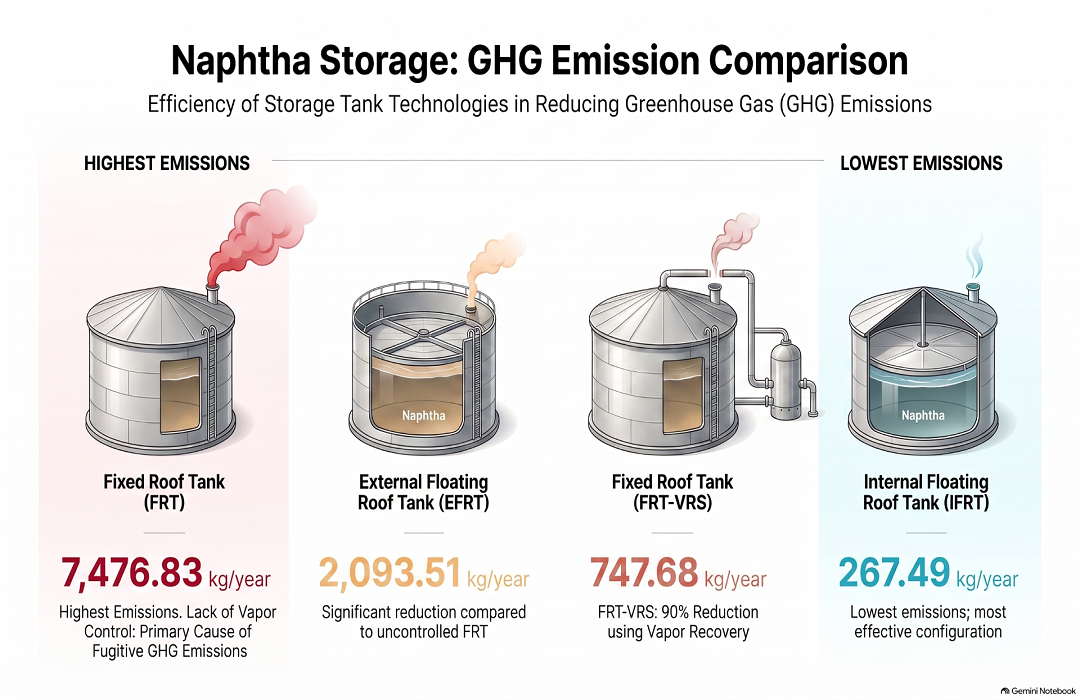
Greenhouse gas (GHG) emissions from a petroleum naphtha storage tank are a significant environmental concern. During crude oil refining, naphtha accounts for approximately 20–30% of total products as a key feedstock for petrochemical industries worldwide. However, naphtha storage is one of the most pressing issues in Thailand due to the use of Fixed Roof Tank (FRT) lacking effective vapor control mechanisms, which leads to fugitive GHG emissions. This study estimated GHG emissions at the petroleum refinery in Chonburi Province from four types of petroleum naphtha storage tanks, including FRT without emission control, FRT with a Vapor Recovery System (FRT-VRS), Internal Floating Roof Tank (IFRT), and External Floating Roof Tank (EFRT), using the TANKS 5.1 model, GHG emissions calculation equations, and Root Cause Analysis (RCA). The results indicate that FRT without emission control emits the highest at 7,476.83 kg/year, while EFRT releases a total of 2,093.51 kg/year. FRT-VRS reduces emissions by 90% to 747.68 kg/year. IFRT has the lowest emissions at 267.49 kg/year. This study highlights the importance of implementing effective control technologies and operational improvements to minimize environmental impacts and promote long-term sustainable industrial management.
References
American Petroleum Institute. (2015). API standard 2517: Vapor recovery units. American Petroleum Institute.
American Petroleum Institute. (2021). Evaporative loss from fixed-roof tanks (8th ed.). American Petroleum Institute.
Andersen, B., & Fagerhaug, T. (2006). Root cause analysis: Simplified tools and techniques. ASQ Quality Press.
Barbhaya, D., Chan, C., Goel, A., Hejjaji, V., Khetan, A., Jain, S. S., & Tran, J. (2023). Rationale and design of a study to test the effect of personal protective aids on hypertension and diabetes in people living with high levels of air pollution: Study protocol. Heart, Lung and Circulation, 32(1), 124–130. https://doi.org/10.1016/j.hlc.2022.11.001
Borkowski, J. (1995). The Quality Toolbox. Journal of Quality Technology, 27, 391-392. https://doi.org/10.1080/00224065.1995.11979623
Capelli, L., Invernizzi, M., & Sironi, S. (2021). Odour emission rate estimation methods for hydrocarbon storage tanks. Chemical Engineering Transactions, 85, 67-72. https://doi.org/10.3303/CET2185012
Carter, W. P. L. (2010). Development of the SAPRC-07 chemical mechanism. Atmospheric Environment, 44(40), 5324–5335. https://doi.org/10.1016/j.atmosenv.2010.01.026
Choi, S.-G., Park, D.-Y., Choi, D.-S., & Jung, Y.-H. (2024). Performance analysis of thermal energy storage tanks and chillers for optimizing cooling efficiency in smart greenhouses in hot and arid climates. Sustainability, 16(24), 11136. https://doi.org/10.3390/su162411136
Department of Climate Change and Environment. (2024). Thailand Biennial Transparency Report (BTR1) under the UNFCCC. Department of Climate Change and Environment.
Derwent, R. G., Jenkin, M. E., Utembe, S. R., Shallcross, D. E., Murrells, T. P., & Passant, N. R. (2010). Secondary organic aerosol formation from a large number of reactive man-made organic compounds. Science of the Total Environment, 408(16), 3374–3381. https://doi.org/10.1016/j.scitotenv.2010.04.013
Guo, X., Ji, J., Khan, F., & Ding, L. (2020). Fuzzy Bayesian network based on an improved similarity aggregation method for risk assessment of storage tank accidents. Process Safety and Environmental Protection, 144, 242–252. https://doi.org/10.1016/j.psep.2020.07.030
Hibbert, P. D., Thomas, M. J. W., Deakin, A., Runciman, W. B., Braithwaite, J., Lomax, S., Prescott, J., Gorrie, G., Szczygielski, A., Surwald, T., & Fraser, C. (2018). Are root cause analyses recommendations effective and sustainable? An observational study. International Journal for Quality in Health Care, 30(2), 124–131. https://doi.org/10.1093/intqhc/mzx181
Hongling, Y., Ren, B., Huang, Y., Zhang, Z., Hu, W., Liu, M., Zhao, H., Jiang, G., & Hao, Z. (2024). Volatile organic compounds (VOCs) emissions from internal floating-roof tank in oil depots in Beijing: Influencing factors and emission reduction strategies analysis. Science of The Total Environment, 916, 170222. https://doi.org/10.1016/j.scitotenv.2024.170222
International Energy Agency. (2021). World energy balances 2021. International Energy Agency.
International Energy Agency. (2023). The future of petrochemicals: Towards more sustainable plastics and fertilizers. International Energy Agency.
Intergovernmental Panel on Climate Change. (2006). 2006 IPCC guidelines for national greenhouse gas inventories (Vol. 2, Energy, Ch. 4: Fugitive emissions). Institute for Global Environmental Strategies. https://www.ipcc-nggip.iges.or.jp/public/2006gl/vol2.html
Intergovernmental Panel on Climate Change. (2023). Climate change 2023: Synthesis report. Contribution of working groups I, II and III to the sixth assessment report of the Intergovernmental Panel on Climate Change. IPCC. https://doi.org/10.59327/IPCC/AR6-9789291691647
James, G. S., & Nour, S. E-G. (2018). Chapter 2 - Refinery Products and By-Products, Introduction to Petroleum Biotechnology. Gulf Professional Publishing, 2018, 41-68, https://doi.org/10.1016/B978-0-12-805151-1.00002-3
Jindamanee, K., Thepanondh, S., Keawboonchu, J., Pinthong, N., & Meeyai, A. (2024). Manifesting the hidden pollutants: Quantifying emissions and environmental impact of petroleum refinery on PM2.5. Atmospheric Environment: X, 24, 100300, https://doi.org/10.1016/j.aeaoa.2024.100300
Kang, J., Liang, W., Zhang, L., Lu, Z., Liu, D., Yin, W., & Zhang, G. (2014). A new risk evaluation method for oil storage tank zones based on the theory of two types of hazards. Journal of Loss Prevention in the Process Industries, 29(1), 267–276. https://doi.org/10.1016/j.jlp.2014.03.007
Karbassi, A. R., Nabi, R., Moattar, F., & Abdollahzadeh, E. (2009). Role of oil storage tank structure in the prevention emission of hydrocarbon pollution. Journal of Environmental Studies, 35, 73–82.
Khalid, A., & Muhammad, J. (2013). Energy consumption, carbon emissions and economic growth in Saudi Arabia: An aggregate and disaggregate analysis. Energy Policy, 62, 1525-1532. https://doi.org/10.1016/j.enpol.2013.07.068
Lee, K., & Chen, S. (2021). Challenges in managing vapor recovery systems for floating roof tanks. Industrial Safety Journal, 18(3), 33–47.
Maimaiti, S., Yufang, H., Jing, L., Yuqi, S., Jie, R., Ziyan, X., & Shaodong, X. (2021). Historical volatile organic compounds emission performance and reduction potentials in China’s petroleum refining industry. Journal of Cleaner Production, 292, 125810. https://doi.org/10.1016/j.jclepro.2021.125810
Matthew, A., Gajendran, T., Erdiaw-Kwasie, M., Baah, C., Okyere, S., & Kankanamge, A. (2025). The multidimensional impacts of heatwaves on human ecosystems: A systematic literature review and future research direction. Environmental Science & Policy, 165, 104024, https://doi.org/10.1016/j.envsci.2025.104024
Minh-Hoang, N., Tam-Tri, L., Thu-Trang, V., Quan-Hoang, V., & Viet-Phuong, L. (2023). Investigation into the rationale of migration intention due to air pollution integrating the homo oeconomicus traits. Urban Science, 7(2), 59. https://doi.org/10.3390/urbansci7020059
Mothe, J. P., Safar, S., Gumy, P., & Nada, S. O. (2023). Air Pollution: The Invisible Health Threat. Atmospheric Sciences.
Mzad, H., Abdallah, H. (2020). Optimization approach of insulation thickness of non-vaccum cryogenic storage tank. Progress in Superconductivity and Cryogenics, 22(1), 17-23. https://doi.org/10.9714/psac.2020.22.1.017
Pagliaro, M., Fabiano-Tixier, A., & Ciriminna, R. (2023). Limonene as a natural product extraction solvent. Green Chemistry, 25(16), 6108–6119. https://doi.org/10.1039/D3GC02068A
Saikomol, S., Thepanondh, S., & Laowagul, W. (2019). Emission losses and dispersion of volatile organic compounds from tank farm of petroleum refinery complex. Journal of Environmental Health Science and Engineering, 17(2), 561–570. https://doi.org/10.1007/s40201-019-00370-1
Serrat, O. (2017). The five whys technique. In Knowledge solutions (pp. 307–310). Springer. https://doi.org/10.1007/978-981-10-0983-9_32
Singkaew, P., Kongtip, P., Yoosook, W., & Chantanakul, S. (2013). Health risk assessment of volatile organic compounds in a high risk group surrounding Map Ta Phut industrial estate, Rayong Province. Journal of the Medical Association of Thailand, 96(Suppl. 5), S73–S81.
Siru, C., Lin, K., Pan, A., Ho, T., Zhu, Y., & Tso, C. (2023). Study of a passive radiative cooling coating on chemical storage tanks for evaporative loss control. Renewable Energy, 211, 326–335. https://doi.org/10.1016/j.renene.2023.04.141
Speight, J. G. (2016). Handbook of petroleum refining (1st ed.). CRC Press, Boca Raton. https://doi.org/10.1201/9781315374079
Thailand Greenhouse Gas Management Organization. (2023). Thailand emission factors for greenhouse gas inventory and reporting. Thailand Greenhouse Gas Management Organization.
U.S. Environmental Protection Agency. (2023). Compilation of air pollutant emission factors (AP-42), Chapter 7: Liquid storage tanks. U.S. Environmental Protection Agency.
U.S. Environmental Protection Agency. (2024). Standards of performance for volatile organic liquid storage vessels. U.S. Environmental Protection Agency.
Downloads
Published
How to Cite
Issue
Section
Categories
License
Copyright (c) 2026 Asian Health, Science and Technology Reports

This work is licensed under a Creative Commons Attribution-NonCommercial 4.0 International License.