Effect of Nine-Square Counting Dance on Physical and Cognitive Function in Older Adults with Mild Cognitive Impairment: A Randomized Controlled Trial
DOI:
https://doi.org/10.69650/ahstr.2026.4566Keywords:
Exercise, Dancing, Alzheimer's, Balance, Older PeopleAbstract
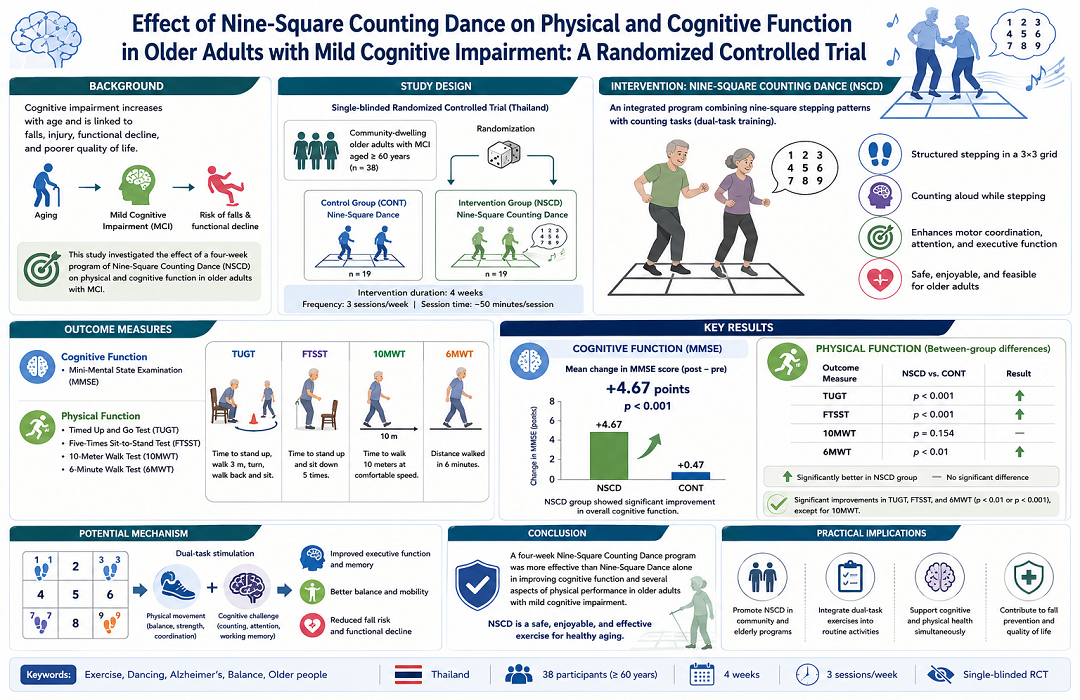
The cognitive impairment was increasingly prevalent with advancing age and was associated with an elevated risk of falls, injury, functional decline, and cognitive impairment. This study aimed to investigate the impact of a four-week integrated intervention involving a nine-square dance and a counting program on physical function by the Timed Up and Go Test (TUGT), the five-times sit-to-stand test (FTSST), 10-meter walk test (10MWT), 6-minute walk test (6MWT), and cognitive functioning by the Mini-Mental State Examination (MMSE) in older adults diagnosed with mild cognitive impairment. A single-blinded randomized controlled trial was conducted in Thailand, involving 38 older adults from the community, each aged 60 years or older. In a random selection process, participants were designated to either the control group (which participated in the nine-square dance: CONT) or a nine-square counting dance (NSCD) intervention. The finding indicated that the NSCD group demonstrated a positive effect of the intervention on the overall cognitive test in MMSE (mean change of 4.67 points, p < 0.001). Moreover, statistically significant differences were observed between the groups across all physical function outcome measures (p < 0.01 or p < 0.001), except for the 10MWT. Therefore, the nine-square counting dance intervention was more effective in enhancing cognitive and physical performance among older adults exhibiting mild cognitive impairment when compared to the nine-square dance modality alone.
References
Amatachaya, S., Kwanmongkolthong, M., Thongjumroon, A., Boonpew, N., Amatachaya, P., Saensook, W., Thaweewannakij, T., & Hunsawong, T. (2020). Influence of timing protocols and distance covered on the outcomes of the 10-meter walk test. Physiotherapy Theory and Practice, 36(12), 1348–1353. https://doi.org/10.1080/09593985.2019.1570577
Ambrose, A. F., Cruz, L., & Paul, G. (2015). Falls and Fractures: A systematic approach to screening and prevention. Maturitas, 82(1), 85–93. https://doi.org/10.1016/j.maturitas.2015.06.035
Andrews, J. S., Desai, U., Kirson, N. Y., Zichlin, M. L., Ball, D. E., & Matthews, B. R. (2019). Disease severity and minimal clinically important differences in clinical outcome assessments for Alzheimer's disease clinical trials. Alzheimer's & dementia (New York, N. Y.), 5, 354–363. https://doi.org/10.1016/j.trci.2019.06.005
Arevalo-Rodriguez, I., Smailagic, N., Roqué-Figuls, M., Ciapponi, A., Sanchez-Perez, E., Giannakou, A., Pedraza, O. L., Bonfill Cosp, X., & Cullum, S. (2021). Mini-Mental State Examination (MMSE) for the early detection of dementia in people with mild cognitive impairment (MCI). The Cochrane Database of Systematic Reviews, 7(7), CD010783. https://doi.org/10.1002/14651858.CD010783.pub3
Arfanda, P., Wiriawan, O., Setijono, H., Kusnanik, N., Muhammad, H., Puspodari, P., Ayubi, N., Aprilo, I., & Mb, A. (2022). The effect of low-impact aerobic dance exercise video on cardiovascular endurance, flexibility, and concentration in females with sedentary lifestyle. Physical Education Theory and Methodology, 22, 303–308. https://doi.org/10.17309/tmfv.2022.3.01
Atipas, S., Chongkolwatana, C., Suwannutsiri, T., Thongyai, K., Henggrathock, S., & Akarasereenont, P. (2019). Effect of Kao-Ta (9-Square Step Exercise) and Kao-Ten (9-Square Dance Exercise) on balance rehabilitation in patients with balance disorders. Siriraj Medical Journal, 71, 1–7. https://doi.org/10.33192/Smj.2019.01
Bahureksa, L., Najafi, B., Saleh, A., Sabbagh, M., Coon, D., Mohler, M. J., & Schwenk, M. (2017). The impact of mild cognitive impairment on gait and balance: A systematic review and meta-analysis of studies using instrumented assessment. Gerontology, 63(1), 67–83. https://doi.org/10.1159/000445831
Barry, E., Galvin, R., Keogh, C., Horgan, F., & Fahey, T. (2014). Is the Timed Up and Go test a useful predictor of risk of falls in community dwelling older adults: A systematic review and meta-analysis. BMC Geriatrics, 14, 14. https://doi.org/10.1186/1471-2318-14-14
Cesari, M., Kritchevsky, S. B., Penninx, B. W. H. J., Nicklas, B. J., Simonsick, E. M., Newman, A. B., Tylavsky, F. A., Brach, J. S., Satterfield, S., Bauer, D. C., Visser, M., Rubin, S. M., Harris, T. B., & Pahor, M. (2005). Prognostic value of usual gait speed in well-functioning older people—results from the health, aging and body composition study. Journal of the American Geriatrics Society, 53(10), 1675–1680. https://doi.org/10.1111/j.1532-5415.2005.53501.x
Chan, W. L. S., & Pin, T. W. (2019). Reliability, validity and minimal detectable change of 2-minute walk test, 6-minute walk test and 10-meter walk test in frail older adults with dementia. Experimental Gerontology, 115, 9–18. https://doi.org/10.1016/j.exger.2018.11.001
Chow, B.-C., Jiao, J., Man, D., & Lippke, S. (2022). Study protocol for “the effects of multimodal training of cognitive and/or physical functions on cognition and physical fitness of older adults: A cluster randomized controlled trial.” BMC Geriatrics, 22(1), 398. https://doi.org/10.1186/s12877-022-03031-5
Dejvajara, D., Aungkasuraphan, R., Palee, P., Piankusol, C., Sirikul, W., & Siviroj, P. (2022). Effects of home-based nine-square step exercises for fall prevention in Thai community-dwelling older adults during a covid-19 lockdown: A pilot randomized controlled study. International Journal of Environmental Research and Public Health, 19(17), 10514. https://doi.org/10.3390/ijerph191710514
Diniz, B. S. O., Yassuda, M. S., Nunes, P. V., Radanovic, M., & Forlenza, O. V. (2007). Mini-mental State Examination performance in mild cognitive impairment subtypes. International Psychogeriatrics, 19(4), 647–656. https://doi.org/10.1017/S104161020700542X
Dolega, J., Lukasz, S. P., Mol, P., Maciejczyk, T., Sienko, A., Labus, M., Zabawa, B., Hudzinska, P., Krzykawski, K., & Sadowski, J. (2024). Neuroplasticity. How regular physical activity influences the brain’s structure and function. Quality in Sport, 34, 56026–56026. https://doi.org/10.12775/QS.2024.34.56026
Potter, K., Fulk, G. D., Salem, Y., & Sullivan, J. (2011). Outcome measures in neurological physical therapy practice: part I. Making sound decisions. Journal of neurologic physical therapy: JNPT, 35(2), 57–64. https://doi.org/10.1097/NPT.0b013e318219a51a
Fissler, P., Küster, O. C., Loy, L. S., Laptinskaya, D., Rosenfelder, M. J., von Arnim, C. A. F., & Kolassa, I.-T. (2017). Jigsaw Puzzles As Cognitive Enrichment (PACE) - the effect of solving jigsaw puzzles on global visuospatial cognition in adults 50 years of age and older: Study protocol for a randomized controlled trial. Trials, 18(1), 415. https://doi.org/10.1186/s13063-017-2151-9
Galea, M., & Woodward, M. (2005). Mini-Mental State Examination (MMSE). The Australian Journal of Physiotherapy, 51(3), 198. https://doi.org/10.1016/s0004-9514(05)70034-9
Geary, D. C., Frensch, P. A., & Wiley, J. G. (1993). Simple and complex mental subtraction: Strategy choice and speed-of-processing differences in younger and older adults. Psychology and Aging, 8(2), 242–256. https://doi.org/10.1037//0882-7974.8.2.242
Gómez-Soria, I., Peralta-Marrupe, P., Calatayud-Sanz, E., & Latorre, E. (2021). Efficacy of cognitive intervention programs in amnesic mild cognitive impairment: A systematic review. Archives of Gerontology and Geriatrics, 94, 1-10. https://doi.org/10.1016/j.archger.2020.104332
Indrakumar, J., & Silva, S. (2024). Physical activity in the older adults: a review of the benefits and recommendations for promoting healthy aging through exercise. Journal of the Indian Academy of Geriatrics, 20(4), 207-213. https://doi.org/10.4103/jiag.jiag_49_24
Intaruk, R., Phadungkit, S., Kanpai, A., Pawanta, K., Srihapol, N., Saengsuwan, J., Amatachaya, S., & Thaweewannakij, T. (2024). Test-retest reliability and minimal detectable change of four functional tests in community-dwelling older adults with high risk of falls. Turkish journal of physical medicine and rehabilitation, 70(2), 164–170. https://doi.org/10.5606/tftrd.2024.12725
Hao, M., & Chen, J. (2025). Trend analysis and future predictions of global burden of alzheimer's disease and other dementias: a study based on the global burden of disease database from 1990 to 2021. BMC medicine, 23(1), 378. https://doi.org/10.1186/s12916-025-04169-w
Judge, J. (2017). Can physical activity prevent falls in older adults with poor physical performance? Journal of the American Geriatrics Society, 65(11), 2457–2458. https://doi.org/10.1111/jgs.15071
Kempermann, G., Fabel, K., Ehninger, D., Babu, H., Leal-Galicia, P., Garthe, A., & Wolf, S. A. (2010). Why and how physical activity promotes experience-induced brain plasticity. Frontiers in Neuroscience, 4, 189. https://doi.org/10.3389/fnins.2010.00189
Kwok, B. C., Pua, Y. H., Mamun, K., & Wong, W. P. (2013). The minimal clinically important difference of six-minute walk in Asian older adults. BMC geriatrics, 13, 23. https://doi.org/10.1186/1471-2318-13-23
Li, C., Li, M., & Shang, Y. (2025). Cognitive training with adaptive algorithm improves cognitive ability in older people with MCI. Aging Clinical and Experimental Research, 37(20), 1-8. https://doi.org/10.1007/s40520-024-02913-5
Lord, S. R., Murray, S. M., Chapman, K., Munro, B., & Tiedemann, A. (2002). Sit-to-stand performance depends on sensation, speed, balance, and psychological status in addition to strength in older people. The Journals of Gerontology. Series A, Biological Sciences and Medical Sciences, 57(8), M539-M543. https://doi.org/10.1093/gerona/57.8.m539
Manjavong, M., Limpawattana, P., & Sawanyawisuth, K. (2021). Performance of the Rowland Universal dementia assessment scale in screening mild cognitive impairment at an outpatient setting. Dementia and Geriatric Cognitive Disorders EXTRA, 11(2), 181–188. https://doi.org/10.1159/000517821
Mathews, R. M., Clair, A. A., & Kosloski, K. (2001). Keeping the beat: Use of rhythmic music during exercise activities for the elderly with dementia. American Journal of Alzheimer’s Disease and Other Dementias, 16(6), 377–380. https://doi.org/10.1177/153331750101600608
Mato, L., Chankavee, N., Amatachaya, S., & Thaweewannakij, T. (2022). Knee extensor muscle strength to measure the ability of five times sit to stand independently in patients with incomplete spinal cord injury. The Malaysian Journal of Medical Sciences: MJMS, 29(5), 74–82. https://doi.org/10.21315/mjms2022.29.5.8
Moon, A., Jang, S., Kim, J.-H., & Jang, S. (2024). Risk of falls or fall-related injuries associated with potentially inappropriate medication use among older adults with dementia. BMC Geriatrics, 24(1), 699. https://doi.org/10.1186/s12877-024-05300-x
Müller, P., Rehfeld, K., Schmicker, M., Hökelmann, A., Dordevic, M., Lessmann, V., Brigadski, T., Kaufmann, J., & Müller, N. G. (2017). Evolution of Neuroplasticity in Response to Physical Activity in Old Age: The Case for Dancing. Frontiers in Aging Neuroscience, 9(56), 1-8. https://doi.org/10.3389/fnagi.2017.00056
Orr, R., de Vos, N. J., Singh, N. A., Ross, D. A., Stavrinos, T. M., & Fiatarone-Singh, M. A. (2006). Power training improves balance in healthy older adults. The Journals of Gerontology: Series A, 61(1), 78-85. https://doi.org/10.1093/gerona/61.1.78
Pieruccini-Faria, F., Sarquis-Adamson, Y., Anton-Rodrigo, I., Noguerón-García, A., Bray, N. W., Camicioli, R., Muir-Hunter, S. W., Speechley, M., McIlroy, B., & Montero-Odasso, M. (2020). Mapping associations between gait decline and fall risk in mild cognitive impairment. Journal of the American Geriatrics Society, 68(3), 576–584. https://doi.org/10.1111/jgs.16265
Poncumhak, P., Suwannakul, B., & Srithawong, A. (2016). Validity of five times sit to stand test for the evaluation of risk of fall in community-dwelling older adults. Journal of Associated Medical Sciences, 49(2), Article 2.
Rodríguez, B., & Paris-Garcia, F. (2022). Influence of Dance Programmes on Gait Parameters and Physical Parameters of the Lower Body in Older People: A Systematic Review. International journal of environmental research and public health, 19(3), 1547. https://doi.org/10.3390/ijerph19031547
Shigematsu, R., Okura, T., Sakai, T., & Rantanen, T. (2008). Square-stepping exercise versus strength and balance training for fall risk factors. Aging Clinical and Experimental Research, 20(1), Article 1. https://doi.org/10.1007/BF03324743
Shumway-Cook, A., Brauer, S., & Woollacott, M. (2000). Predicting the probability for falls in community-dwelling older adults using the Timed Up & Go Test. Physical Therapy, 80(9), 896–903.
Steffen, T. M., Hacker, T. A., & Mollinger, L. (2002). Age- and gender-related test performance in community-dwelling elderly people: Six-Minute Walk Test, Berg Balance Scale, Timed Up & Go Test, and gait speeds. Physical Therapy, 82(2), 128–137. https://doi.org/10.1093/ptj/82.2.128
Sun, R., Li, X., Zhu, Z., Li, T., Zhao, M., Mo, L., Li, W., Xi, X., Huang, P., & Gong, W. (2022). Effects of dual-task training in patients with post-stroke cognitive impairment: A randomized controlled trial. Frontiers in Neurology, 13, 1027104. https://doi.org/10.3389/fneur.2022.1027104
Tanglakmankhong, K., Hampstead, B. M., Ploutz-Snyder, R. J., & Potempa, K. (2022). Cognitive screening assessment in Thai older adults: A prospective study of the reliability and validity of the Abbreviated Mental Test. Journal of Health Research, 36(1), 99–109. https://doi.org/10.1108/jhr-02-2020-0049
Thaweewannakij, T., Wilaichit, S., Chuchot, R., Yuenyong, Y., Saengsuwan, J., Siritaratiwat, W., & Amatachaya, S. (2013). Reference values of physical performance in Thai elderly people who are functioning well and dwelling in the community. Physical Therapy, 93(10), 1312–1320. https://doi.org/10.2522/ptj.20120411
Tian, R., Jiang, Y., Zhang, Y., Yan, X., Zhou, Y., & Chen, D. (2022). Cognitive training program improves cognitive ability and daily living ability in elderly patients with mild cognitive impairment. Aging Clinical and Experimental Research, 34(5), 997–1005. https://doi.org/10.1007/s40520-021-02015-6
Turgut, B. A., & Naz, I. (2023). Physical activity in neurological disorders: A narrative review. European Journal of Therapeutics, 29(1), 97–102. https://doi.org/10.58600/eurjther-344
Udom, C., Kerdnet, S., Wohmae, S., Pitakkumpon, A., Wadeng, A., & Chandee, N. (2022). The Effect of the nine-square step dance on the postural stability of overweight female undergraduate students: A Randomized Trial. Trends in Sciences, 19(14), 4713. https://doi.org/10.48048/tis.2022.4713
Van Patten, R., Britton, K., & Tremont, G. (2019). Comparing the Mini-Mental State Examination and the modified Mini-Mental State Examination in the detection of mild cognitive impairment in older adults. International Psychogeriatrics, 31(5), 693–701. https://doi.org/10.1017/S1041610218001023
Vaportzis, E., Georgiou-Karistianis, N., Stout, J. C. (2014). Age and task difficulty differences in dual tasking using circle tracing and serial subtraction tasks. Aging Clin Exp Res, 26(2), 201-211. https://doi: 10.1007/s40520-013-0151-5
Verghese, J., Mahoney, J. R., Ayers, E., Ambrose, A., Wang, C., & Holtzer, R. (2021). Computerised cognitive remediation to enhance mobility in older adults: A single-blind, single-centre, randomised trial. The Lancet. Healthy Longevity, 2(9), e571–e579. https://doi.org/10.1016/s2666-7568(21)00173-2
Wei, Z., Zhao, X., & Liu, Y. (2024). A meta-analysis of the consequences of cognitive training on the cognitive function of aged mild cognitive impairment patients. Psychogeriatrics: the official journal of the Japanese Psychogeriatric Society, 24(6), 1371–1388. https://doi.org/10.1111/psyg.13177
Yan, Z.-W., Yang, Z., Yang, J.-H., Song, C.-L., Zhao, Z., & Gao, Y. (2022). Comparison between Tai Chi and square dance on the antihypertensive effect and cardiovascular disease risk factors in patients with essential hypertension: A 12-week randomized controlled trial. The Journal of Sports Medicine and Physical Fitness, 62(11), Article 11. https://doi.org/10.23736/S0022-4707.22.13424-9
Downloads
Published
How to Cite
Issue
Section
Categories
License
Copyright (c) 2026 Asian Health, Science and Technology Reports

This work is licensed under a Creative Commons Attribution-NonCommercial 4.0 International License.