Predicting Health Insurance Claims in Thailand Using Bayesian Multilevel Logistic Regression and Socioeconomic Indicators
DOI:
https://doi.org/10.69650/ahstr.2026.4564Keywords:
Multilevel Analysis, Markov Chain Monte Carlo, Posterior Distribution, Actuarial Analytics, ThailandAbstract
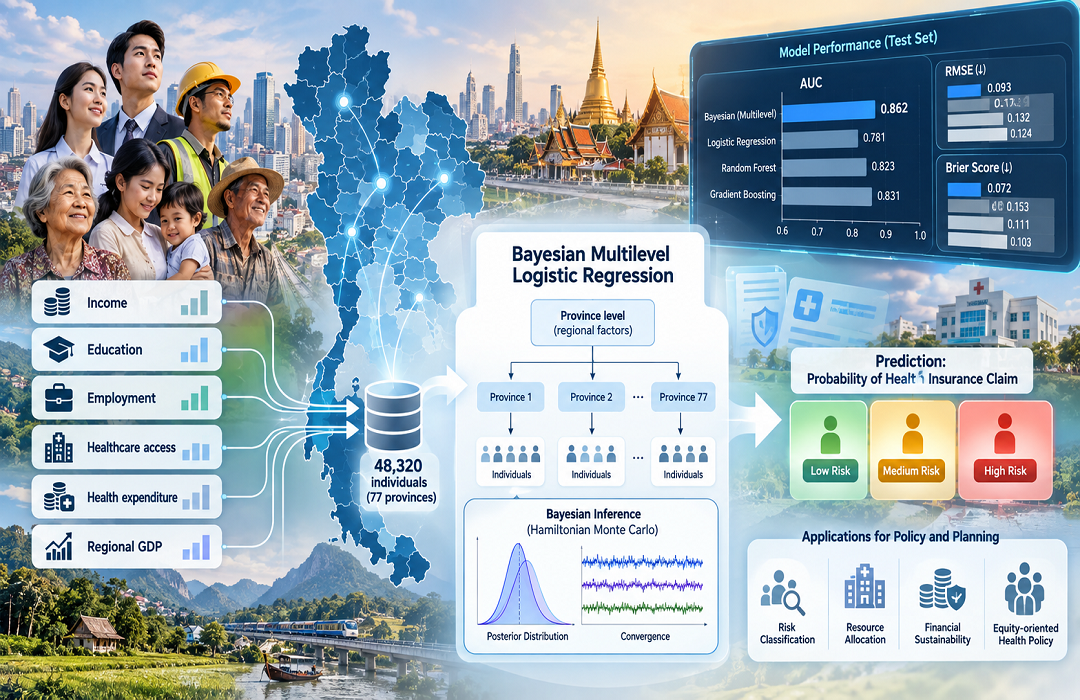
Socioeconomic disparities may influence the probability of health insurance claims and the financial sustainability of insurance systems. This study developed a Bayesian hierarchical logistic model to predict the probability that an individual had at least one recorded health insurance claim during the study period. Secondary individual-level data covering 2020–2023 were obtained from the National Statistical Office of Thailand and linked with province-level healthcare indicators from the Ministry of Public Health and regional economic indicators. The initial merged dataset contained 52,870 observations. After excluding records with missing outcomes, incomplete predictors, duplicate identifiers, and unmatched geographic information, the final analytic sample comprised 48,320 individuals from 77 provinces. Individuals were modeled as nested within provinces, and posterior distributions were estimated using Hamiltonian Monte Carlo. The Bayesian hierarchical model achieved an area under the curve of 0.862, exceeding logistic regression, random forest, and gradient boosting by 0.081, 0.039, and 0.031, respectively. It also produced the lowest root mean square error of 0.093 and Brier score of 0.072. Higher income, education, employment, healthcare access, and regional gross domestic product were associated with lower claim probability, whereas higher health expenditure was associated with greater claim probability. Posterior convergence and sensitivity analyses indicated stable estimates across alternative prior specifications. These findings demonstrate that Bayesian hierarchical modeling can improve claim-risk prediction while explicitly quantifying parameter and predictive uncertainty. The model may support risk classification, resource allocation, and equity-oriented health insurance policy in Thailand.
References
Betancourt, M., & Girolami, M. (2015). Hamiltonian Monte Carlo for hierarchical models. In S. K. Upadhyay, U. Singh, D. K. Dey, & A. Loganathan (Eds.). Current trends in Bayesian methodology with applications (pp. 79–101). CRC Press. https://doi.org/10.1201/b18502-5
Boy-ngbogbele, R. D., Ngesa, O., Mageto, T., & Kokonendji, C. (2026). Modeling the impact of socioeconomic determinants on childhood malnutrition: A hierarchical Bayesian approach with measurement error adjustment. Applied and Computational Mathematics, 15(1), 35–48. https://doi.org/10.11648/j.acm.20261501.14
Espinosa, O., Bejarano, V., Mejía, A., Castro, H., & Paternina-Caicedo, A. (2025). Bayesian inference in racial health inequity analyses for noncommunicable diseases: A systematic review. Systematic Reviews, 14, 145. https://doi.org/10.1186/s13643-025-02898-w
Karel, T., & Plašil, M. (2024). Application of hierarchical Bayesian models for modeling economic costs in the implementation of new diagnostic tests. International Journal of Economic Sciences, 13(2), 20–37. https://doi.org/10.52950/ES.2024.13.2.002
Khan, K. (2025). Bayesian statistical models for predicting type 2 diabetes prevalence in urban populations. Review of Applied Science and Technology, 4(02), 370-406. https://doi.org/10.63125/db2e5054
Moreira, C., Nguyen, N. L. C., Francis, G., Mohasel Afshar, H., Lopatnikova, A., Cripps, S., & Marchant, R. (2025). Bayesian causal discovery for policy decision making. Data & Policy, 7, e26. https://doi.org/10.1017/dap.2024.93
Nkrumah, M. A. (2025). Actuarial risk evaluation of health insurance portfolios using copula-based time series and Bayesian statistical learning approaches. International Journal of Computer Applications Technology and Research, 9(12), 394–407. https://doi.org/10.7753/ijcatr0912.1009
Nyavor, H., & Obeng-Gyasi, E. (2025). Bayesian network modeling of environmental, social, and behavioral determinants of cardiovascular disease risk. International Journal of Environmental Research and Public Health, 22(10), 1551. https://doi.org/10.3390/ijerph22101551
Shams, M., & Ghosh, K. (2026). Modeling insurance claims using Bayesian nonparametric regression. PLOS ONE, 21(4), e0346734. https://doi.org/10.1371/journal.pone.0346734
Shi, J., Shi, Y., Wang, P., & Zhu, D. (2024). Multi-population mortality modelling: A Bayesian hierarchical approach. ASTIN Bulletin: The Journal of the IAA, 54(1), 46–74. https://doi.org/10.1017/asb.2023.29
Shiferaw, Y. A., & Yilema, S. M., & Moyehodie, Y. A. (2024). A hierarchical Bayesian approach to small area estimation of health insurance coverage in Ethiopian administrative zones for better policies and programs. Health Economics Review, 14, 29. https://doi.org/10.1186/s13561-024-00498-3
Tangcharoensathien, V., Limwattananon, S., Patcharanarumol, W., Thammatacharee, J., Jongudomsuk, P., & Sirilak, S. (2015). Achieving universal health coverage goals in Thailand: The vital role of strategic purchasing. Health Policy and Planning, 30(9), 1152–1161. https://doi.org/10.1093/heapol/czu120
World Bank. (2023). Thailand Economic Monitor: Maintaining Resilience amid Global Uncertainty. World Bank Group.
Zhi, Y.-C., Anguajibi, V., Oryema, J. B., Nabatte, B., Opio, C. K., Kabatereine, N. B., & Chami, G. F. (2026). Bayesian machine learning enables discovery of risk factors for hepatosplenic multimorbidity related to schistosomiasis. Nature Communications, 17(1), 3377. https://doi.org/10.1038/s41467-026-69528-4
Downloads
Published
How to Cite
Issue
Section
Categories
License
Copyright (c) 2026 Asian Health, Science and Technology Reports

This work is licensed under a Creative Commons Attribution-NonCommercial 4.0 International License.