Biomarkers for Occupational Chemical Exposure: A Narrative Review from Traditional Monitoring to Omics and Digital Health Applications
DOI:
https://doi.org/10.69650/ahstr.2026.4559Keywords:
biomarkers, occupational chemical exposure, biomonitoring, occupational health surveillance, precision occupational healthAbstract
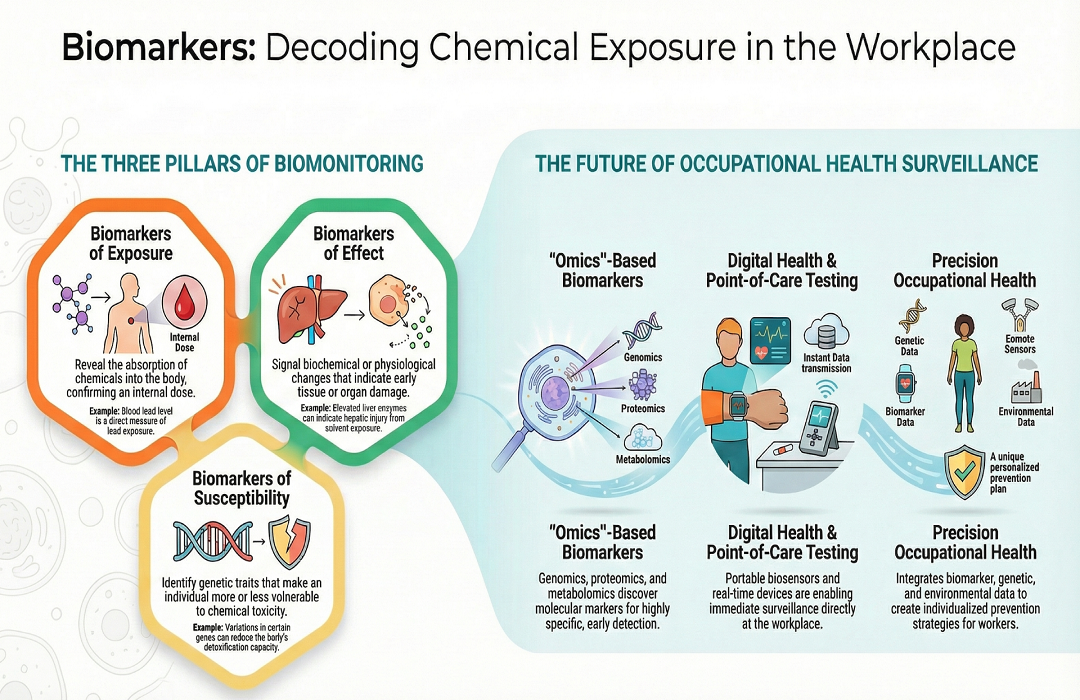
Occupational exposure to hazardous chemicals remains a major public health challenge, particularly in developing countries where regulatory enforcement and surveillance systems are limited. This review synthesizes recent advances in the application of biomarkers for assessing occupational chemical exposure and related health effects. Relevant literature published between 2015 and 2025 was identified through searches of major scientific databases, including PubMed and Google Scholar, using keywords related to occupational exposure, biomarkers, biomonitoring, omics, and digital health. Studies addressing biomarkers of exposure, effect, and susceptibility in occupational settings were reviewed and synthesized. Biomarkers of exposure, effect, and susceptibility provide direct and sensitive measures that link external exposure with internal dose and biological responses. Evidence shows strong associations between benzene exposure and hematotoxicity, organophosphate pesticides and neurotoxicity, heavy metals and renal impairment, as well as organic solvents and hepatic injury. Importantly, the usefulness of biomarkers depends on their biological half-life and the exposure window they represent, ranging from recent exposure to cumulative long-term exposure. Validation criteria such as sensitivity, specificity, reproducibility, and clinical relevance are essential to ensure analytical reliability and health risk interpretation. Emerging technologies, including omics-based molecular markers, non-invasive matrices, multi-matrix monitoring, and biosensor-driven point-of-care testing, are revolutionizing biomonitoring practices. These innovations, together with the integration of genetic and environmental data, are shaping a new era of Precision Occupational Health, enabling early intervention and individualized prevention. Furthermore, advances in wearable sensors and digital health platforms support near real-time occupational health surveillance and more proactive risk management. In conclusion, the integration of validated biomarkers into occupational health surveillance systems provides a powerful strategy to enhance chemical risk management, safeguard workers’ health, and inform policy decisions globally.
References
Angerer, J., Ewers, U., & Wilhelm, M. (2018). Human biomonitoring: State of the art. International Journal of Hygiene and Environmental Health, 211(3–4), 201-228. http://doi.org/10.1016/j.ijheh.2007.01.024
Apel, P., Rousselle, C., Lange, R., Sissoko, F., Kolossa-Gehring, M., & Ougier, E. (2020). Human biomonitoring initiative (HBM4EU) - strategy to derive human biomonitoring guidance values (HBM-GVs) for health risk assessment. International Journal of Hygiene and Environmental Health, 230, 113622. http://doi.org/10.1016/j.ijheh.2020.113622
Aylward, L. L., Hays, S. M., Smolders, R., Koch, H. M., Cocker, J., Jones, K., Warren, N., Levy, L., & Bevan, R. (2014). Sources of variability in biomarker concentrations, Journal of Toxicology and Environmental Health, Part B: Critical Reviews, 17(1), 45-61. https://doi.org/10.1080/10937404.2013.864250
Barr, D. B., Bravo, R., Weerasekera, G., Caltabiano, L. M., Whitehead, R. D., Olsson, A. O., & Needham, L. L. (2004). Concentrations of dialkyl phosphate metabolites of organophosphorus pesticides in the U.S. population. Environmental Health Perspectives, 112(2), 186-200. http://doi.org/10.1289/ehp.6503
Bolt, H. M., & Thier, R. (2006). Relevance of the deletion polymorphisms of the glutathione S-transferases GSTT1 and GSTM1 in pharmacology and toxicology. Current Drug Metabolism, 7(6), 613-628. http://doi.org/10.2174/138920006778017786
Bonassi, S., El-Zein, R., Bolognesi, C., & Fenech, M. (2011). Micronuclei frequency in peripheral blood lymphocytes and cancer risk: Evidence from human studies. Mutagenesis, 26(1), 93-100. http://doi.org/10.1093/mutage/geq075
Brandt-Rauf, P. W., Luo, J. C., Cheng, T. J., Du, C. L., Wang, J. D., Rosal, R., & Marion, M. J. (2002). Molecular biomarkers and epidemiologic risk assessment. Human and Ecological Risk Assessment, 8(6), 1295-1301. https://doi.org/10.1080/20028091057367
Capone, P., Chiarella, P., & Sisto, R. (2024). Advanced technologies in genomic toxicology: Current trend and future directions. Current Opinion in Toxicology, 37, 100444. https://doi.org/10.1016/j.cotox.2023.100444
Cavallo, D., Tranfo, G., Ursini, C. L., Fresegna, A. M., Ciervo, A., Maiello, R., & Iavicoli, S. (2018). Biomarkers of early genotoxicity and oxidative stress for occupational risk assessment of exposure to styrene in the fibreglass reinforced plastic industry. Toxicology Letters, 298, 53-59. http://doi.org/10.1016/j.toxlet.2018.06.006
Costa, L. G., Giordano, G., Cole, T. B., Marsillach, J., & Furlong, C. E. (2013). Paraoxonase 1 (PON1) as a genetic determinant of susceptibility to organophosphate toxicity. Toxicology, 307, 115-22. http://doi.org/10.1016/j.tox.2012.07.011
Cui, S., Pang, B., Yan, H., Wu, B., Li, M., Xing, C., & Li, J. (2022). Using urinary biomarkers to estimate benzene exposure. Toxics, 10(11), 636. http://doi.org/10.3390/toxics10110636
Dalmolin, S. P., Dreon, D. B., Thiesen, F. V., & Dallegrave, E. (2020). Biomarkers of occupational exposure to pesticides: Systematic review of insecticides. Environmental Toxicology and Pharmacology, 75, 103304. http://doi.org/10.1016/j.etap.2019.103304
Furlong, C. E., Holland, N. T., Richter, R. J., Bradman, A., & Eskenazi, B. (2006). PON1 status of farmworker mothers and children as a predictor of organophosphate sensitivity. Pharmacogenetics and Genomics, 16(3), 183-190. http://doi.org/10.1097/01.fpc.0000189796.21770.d3
Garcia-Closas, M., Malats, N., Silverman, D., Dosemeci, M., Kogevinas, M., & Hein, D. W. (2005). NAT2 slow acetylation, GSTM1 null genotype, and risk of bladder cancer: Results from the Spanish bladder cancer study and meta-analyses. The Lancet, 366(9486),649-659. http://doi.org/10.1016/S0140-6736(05)67137-1
Murray, C. J., Aravkin, A. Y., Zheng, P., Abbafati, C., Abbas, K. M., Abbasi-Kangevari, M., ... & Borzouei, S. (2020). Global burden of 87 risk factors in 204 countries and territories, 1990-2019: a systematic analysis for the Global Burden of Disease Study 2019. The Lancet, 396(10258), 1223-1249. http://doi.org/10.1016/S0140-6736(20)30752-2
Hernández, A. F., Lozano-Paniagua, D., González-Alzaga, B., Kavvalakis, M. P., Tzatzarakis, M. N., López-Flores, I., Aguilar-Garduño, C., Caparros-Gonzalez, R. A., Tsatsakis, A. M., & Lacasaña, M. (2019). Biomonitoring of common organophosphate metabolites in hair and urine of children from an agricultural community. Environment International, 131, 105003. https://doi.org/10.1016/j.envint.2019.104
Hughes, D., Thongkum, W., Tudpor, K., Turnbull, N., Yukalang, N., Sychareun, V., Van Vo, T., Win, L. L., Watkins, A., & Jordan, S. (2021). Pesticide use and health impacts on farmers in Thailand, Vietnam, and Lao PDR: Protocol for a survey of knowledge, behaviours and blood acetyl cholinesterase concentrations. PLoS One, 16(9), e0258134. http://doi.org/10.1371/journal.pone.0258134
International Labour Organization. (2021). Exposure to hazardous chemicals at work and resulting health impacts: A global review. International Labour Office. https://www.ilo.org/publications/exposure-hazardous-chemicals-work-and-resulting-health-impacts-global
Jin, Y., Shao, X., Sun, B., Miao, C., Li, Z., & Shi, Y. (2017). Urinary kidney injury molecule-1 as an early diagnostic biomarker of obstructive acute kidney injury and development of a rapid detection method. Molecular Medicine Reports, 15(3), 1229-1235. http://doi.org/10.3892/mmr.2017.6103
Lanphear, B. P., Rauch, S., Auinger, P., Allen, R. W., & Hornung, R. W. (2018). Low-level lead exposure and mortality in US adults: A population-based cohort study. The Lancet Public Health, 3(4), e177-e184. http://doi.org/10.1016/S2468-2667(18)30025-2
Leese, E., Jones, K., Bocca, B., Bousoumah, R., Castano, A., Galea, K. S., & van Dael, M. (2023). HBM4EU chromates study–the measurement of hexavalent and trivalent chromium in exhaled breath condensate samples from occupationally exposed workers across Europe. Toxicology Letters, 375, 59-68. https://doi.org/10.1016/j.toxlet.2022.12.009
Lehmler, H. J., Simonsen, D., Garcia, A. Q., Irfan, N. M., Dean, L., Wang, H., Elsterman, M., Li, X. (2022). A systematic review of human biomonitoring studies of 3-phenoxybenzoic acid, a urinary biomarker of pyrethroid insecticide exposure, 1997 to 2019. Hygiene and Environmental Health Advances, 4, 100018. http://doi.org/10.1016/j.heha.2022.100018
Lewoń-Mrozek, D., Kurzynoga, J., Jędrzejewski, P., Kędzierska, K., Partyka, A., Kuriata-Kordek, M., & Ściskalska, M. (2024). Molecular structure of paraoxonase-1 and its modifications in relation to enzyme activity and biological functions: A comprehensive review. International Journal of Molecular Sciences, 25(23), 13129. http://doi.org/10.3390/ijms252313129
Liang, B., Zhong, Y., Chen, K., Zeng, L., Li, G., & Zheng, J. (2018). Serum plasminogen as a potential biomarker for the effects of low-dose benzene exposure. Toxicology, 410, 59-64. https://doi.org/10.1016/j.tox.2018.09.004
Longo, V., Brunetti, G., Anzivino, E., D'Errico, M. N., & De Maria, L. (2021). Biomonitoring and health risk assessment in occupational exposure to chemicals: Current status and future perspectives. International Journal of Environmental Research and Public Health, 18(19), 10236. https://doi.org/10.3390/ijerph181910236
Lv, B. H., Song, S. Z., Zhang, Z., Mei, Y., & Ye, F. L. (2014). Urinary S-phenylmercapturic acid as a key biomarker for measuring occupational exposure to low concentrations of benzene in Chinese workers: a pilot study. Journal of Occupational and Environmental Medicine, 56(3), 319-325. https://doi.org/10.1097/JOM.0000000000000098
Meslin, M., Beausoleil, C., Zeman, F.A., Antignac, J. P., Kolossa-Gehring, M., Rousselle, C., & Apel, P. (2022). Human biomonitoring guidance values (HBM-GVs) for bisphenol S and assessment of the risk due to exposure to bisphenols A and S, in Europe. Toxics, 10(5), 228. http://doi.org/10.3390/toxics10050228
National Research Council. (1983). Risk assessment in the federal government: Managing the process. National Academies Press. https://pubmed.ncbi.nlm.nih.gov/25032414/
National Research Council. (1989). Biological markers in reproductive toxicology. National Academies Press. https://pubmed.ncbi.nlm.nih.gov/25032456/
Organization for Economic Co-operation and Development. (2017). Guidance document on good in vitro method practices (GIVIMP). OECD Publishing.https://www.oecd.org/en/publications/guidance-document-on-good-in-vitro-method-practices-givimp_9789264304796-en.html
Ougier, E., Zeman, F., Antignac, J. P., Rousselle, C., Lange, R., Kolossa-Gehring, M., & Apel, P. (2021). Human biomonitoring initiative (HBM4EU): Human biomonitoring guidance values (HBM-GVs) derived for bisphenol A. Environment International, 154, 106563. http://doi.org/10.1016/j.envint.2021.106563
Polyong, C. P., Roytrakul, S., Sirivarasai, J., Yingratanasuk, T., & Thetkathuek, A. (2024). Novel serum proteomes expressed from benzene exposure among gasoline station attendants. Biomarkers Insights, 19, http://doi.org/10.1177/11772719241259604
Polyong, C. P., & Thetkathuek, A. (2022a). Factors affecting the prevalence of neurological symptoms among workers at gasoline stations in Rayong Province, Thailand. Environmental Analysis, Health and Toxicology, 37(2), e2022009. http://doi.org/10.5620/eaht.2022009
Polyong, C. P., & Thetkathuek, A. (2022b). Factors influencing hematological parameters among laborers at a gas service station in Rayong Province, Thailand. Journal of Public Health and Development, 20(3), 47-53. http://doi.org/10.55131/jphd/2022/200304
Polyong, C. P., & Thetkathuek, A. (2024). Liver, kidney, glycohemoglobin, neurotransmitters, heart markers, and factors affecting blood biochemicals among workers at gas service stations, Thailand. Journal of Public Health and Emergency, 8(3), 1-13. http://doi.org/10.21037/jphe-24-26
Rahimpoor, R., Jalilian, H., Mohammadi, H., & Rahmani, A. (2023). Biological exposure indices of occupational exposure to benzene: A systematic review. Heliyon, 9(11), e21576. https://doi.org/10.1016/j.heliyon.2023.e21576
Saber, A. T., Levin, M., Kines, P., Aimonen, K., Givelet, L., Andersen, C., Huusom, A. J., Carøe, T., Ebbehøj, N. E., Christensen, F. M., Jiang, Z., Lundh, T., Tinnerberg, H., Albin, M., Engfeldt, M., Broberg, K., Catalan, J., Loeschner, K., Fuglsang, K., & Vogel, U. (2025). The SAM-Krom biomonitoring study shows occupational exposure to hexavalent chromium and increased genotoxicity in Denmark. International Journal of Hygiene and Environmental Health, 264, 114444. http://doi.org/10.1016/j.ijheh.2024.114444
Sapbamrer, R., & Hongsibsong, S. (2014). Organophosphorus pesticide residues in vegetables from farms, markets, and a supermarket around Kwan Phayao Lake of Northern Thailand. Archives of Environmental Contamination and Toxicology, 67(1), 60-67. http://doi.org/10.1007/s00244-014-0014-x
Sexton, K., Needham, L., & Pirkle, J. (2004). Human biomonitoring of environmental chemicals: Measuring chemicals in human tissues is the “gold standard” for assessing people’s exposure to pollution. Journal of American Science, 92(1), 38-45.
Umicevic, N., Kotur-Stevuljevic, J., Paleksic, V., Djukic-Cosic, D., Miljakovic, E. A., Djordjevic, A. B., & Antonijevic, B. (2022). Liver function alterations among workers in the shoe industry due to combined low-level exposure to organic solvents. Drug and Chemical Toxicology, 45(4), 1907–1914. https://doi.org/10.1080/01480545.2021.1894703
Viegas, S., Jeddi, Z. M., Hopf, B. N., Bessems, J., Palmen, N., Galea, S. K., Jones, K., Kujath, P., Duca, R. C., Verhagen, H., Santonen, T., & Pasanen-Kase, R. (2020). Biomonitoring as an underused exposure assessment tool in the occupational safety and health context: challenges and way forward. The International Journal of Environmental Research and Public Health, 17(16), 5884. http://doi.org/10.
/ijerph17165884
World Health Organization. (2017). Biological monitoring of chemical exposure in the workplace: Guidelines. World Health Organization. https://iris.who.int/server/api/core/bitstreams/4512ca7d-2c78-44ad-a2f8-f89ad34d3540/content
World Health Organization. (2021a). Preventing disease through healthy environments: Exposure to chemicals. World Health Organization.https://iris.who.int/server/api/core/bitstreams/eb8328cb-022a-4daa-81ec-1b5a071035d5/content
World Health Organization. (2021b). WHO human health risk assessment toolkit: Chemical hazards. World Health Organization. https://www.who.int/publications/i/item/9789240035720
Wren, M., Robson, M., & Buckley, B. (2024). A novel biomonitoring method to detect pyrethroid metabolites in saliva of occupationally exposed workers as a tool for risk assessment. Human and Ecological Risk Assessment: An International Journal, 30(3-4), 269-288. https://doi.org/10.1080/10807039.2024.2329625
Zhang, J., Guo, Y., Lin, Y. R., Ma, B. C., Ge, X. R., Zhang, W. Q., Zhang, N. X., Yang, S. M., & Hui, C. Y. (2024). Detection of cadmium in human biospecimens by a cadmium-selective whole-cell biosensor based on deoxyviolacein. ACS Biomaterials Science & Engineering, 10(6), 4046-4058. https://doi.org/10.1021/acsbiomaterials.3c01814
Downloads
Published
How to Cite
License
Copyright (c) 2026 Asian Health, Science and Technology Reports

This work is licensed under a Creative Commons Attribution-NonCommercial 4.0 International License.