Aviation Career within Generation Y and Z Behaviour in Vitamin Supplement and Healthy Food Consumption
DOI:
https://doi.org/10.69650/ahstr.2026.4540Keywords:
Aviation careers, Vitamin supplements, Consumer behaviour, Health-conscious consumption, Occupational health, Aviation workforceAbstract
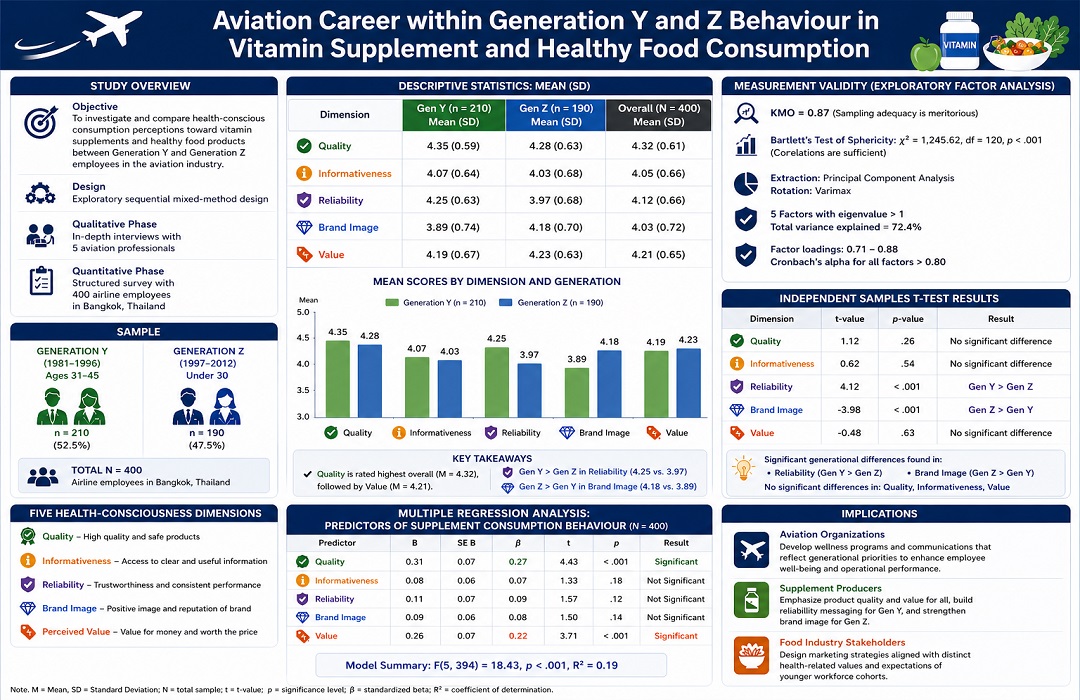
This study investigated health-conscious consumption perceptions toward vitamin supplements and healthy food products among Generation Y and Generation Z employees in the aviation industry. Using an exploratory sequential mixed-method design, qualitative data from in-depth interviews with five aviation professionals informed the development of a quantitative survey administered to 400 airline employees in Bangkok, Thailand. Five dimensions of consumer health-consciousness were examined: product quality, informativeness, reliability, brand image, and perceived value. Independent-samples t-tests revealed significant generational differences: Generation Y placed greater emphasis on reliability (t = 4.12, p < .001, d = 0.43), whereas Generation Z placed greater emphasis on brand image (t = -3.98, p < .001, d = 0.40). These findings offer practical guidance for aviation organizations, supplement producers, and food industry stakeholders in tailoring strategies to the distinct health-related preferences of younger workforce cohorts.
References
Acar, A., Büyükdağ, N., Türten, B., Diker, E., & Çalışkar, G. (2024). The role of brand identity, brand lifestyle congruence, and brand satisfaction on repurchase intention: A multi-group structural equation model. Humanities and Social Sciences Communications, 11, 1102. https://doi.org/10.1057/s41599-024-03618-w
Coman, M. M., Micioni Di Bonaventura, M. V., Cifani, C., Silvi, S., & Verdenelli, M. C. (2023). SYNBIO® probiotic and antioxidant dietary supplementation: Clinical trial evaluation of potential effects on airline flight crew members' well-being. Microorganisms, 11(4), 924. https://doi.org/10.3390/microorganisms11040924
Gauch, E. C., & Smollich, M. (2025). Misinformation and disinformation about dietary supplements in social media: Limiting the risks, seizing the opportunities, and shaping structures. Bundesgesundheitsblatt– Gesundheitsforschung–Gesundheitsschutz, 68, 112–121. https://doi.org/10.1007/s00103-025-04138-x
Guo, Z., Ning, Y., & Mustafa, M. (2024). Impact of five types of front-of-package nutrition labels on consumer behavior among young adults: A systematic review. Nutrients, 16(17), 2819. https://doi.org/10.3390/nu16172819
Halicka, E., Kaczorowska, J., Rejman, K., & Plichta, M. (2025). Investigating the consumer choices of Gen Z: A sustainable food system perspective. Nutrients, 17(3), 591. https://doi.org/10.3390/nu17030591
Jagielski, P., Łuszczki, E., Wnęk, D., Kaczmarski, M., Micek, A., Łudzik, J., Dereń, K., & Farelnik, P. (2021). Dietary supplements — For whom? The current state of knowledge about the health effects of selected supplement use. International Journal of Environmental Research and Public Health, 18(17), 8897. https://doi.org/10.3390/ijerph18178897
Liu, C., Wongsonegoro, H., Sheng, T., Fan, H., & Zhang, J. (2025). Associations between serum micronutrients and all-cause, cancer, and cardiovascular mortality in a national representative population: Mediated by inflammatory biomarkers. Redox Biology, 81, 103573. https://doi.org/10.1016/j.redox.2025.103573
Makowska, M., Boguszewski, R., & Hrehorowicz, A. (2024). Generational differences in food choices and consumer behaviors in the context of sustainable development. Foods, 13(4), 521. https://doi.org/10.3390/foods13040521
Minoretti, P., Gómez Serrano, M., Liaño Riera, M., Santiago Sáez, A., & García Martín, A. (2024). Occupational health challenges for aviation workers amid the changing climate: A narrative review. Cureus, 16(3), e55935. https://doi.org/10.7759/cureus.55935
Nguyen, T. H., Tran, V. T., & Le, Q. A. (2025). Unveiling the future of responsible, sustainable, and ethical consumption: A bibliometric study on Gen Z and young consumers. Young Consumers, 26(7), 142–165. https://doi.org/10.1108/yc-11-2024-2327
Passarelli, S., Free, C. M., Shepon, A., Beal, T., Batis, C., & Golden, C. D. (2024). Global estimation of dietary micronutrient inadequacies: A modelling analysis. The Lancet Global Health, 12(10), e1590–e1599. https://doi.org/10.1016/S2214-109X(24)00276-6
Scheibler, C., Toprani, S. M., Mordukhovich, I., Schaefer, M., Staffa, S., Nagel, Z. D., & McNeely, E. (2022). Cancer risks from cosmic radiation exposure in flight: A review. Frontiers in Public Health, 10, 947068. https://doi.org/10.3389/fpubh.2022.947068
Sizar, O., Khare, S., Goyal, A., & Givler, A. (2024). Vitamin and mineral supplementation. StatPearls Publishing. https://www.ncbi.nlm.nih.gov/books/NBK538510/
Stevens, G. A., Beal, T., Mbuya, M. N. N., Luo, H., & Neufeld, L. M. (2022). Micronutrient deficiencies among preschool-aged children and women of reproductive age worldwide: A pooled analysis of individual-level data from population-representative surveys. The Lancet Global Health, 10(11), e1590–e1599. https://doi.org/10.1016/S2214-109X(22)00367-9
Ströbele-Benschop, N., & Kamphausen, A. (2025). Sustainable food consumption behaviors of generations Y and Z: A comparison study. Cleaner and Responsible Consumption, 17, 100272. https://doi.org/10.1016/j.clrc.2025.100272
Wen, C. C. Y., Cherian, D., Schenker, M. T., & Jordan, A. S. (2023). Fatigue and sleep in airline cabin crew: A scoping review. International Journal of Environmental Research and Public Health, 20(3), 2652. https://doi.org/10.3390/ijerph20032652
World Medical Association. (2013). World Medical Association Declaration of Helsinki: Ethical principles for medical research involving human subjects. JAMA, 310(20), 2191–2194. https://doi.org/10.1001/jama.2013.281053
Downloads
Published
How to Cite
License
Copyright (c) 2026 Asian Health, Science and Technology Reports

This work is licensed under a Creative Commons Attribution-NonCommercial 4.0 International License.