AI Augmented Mascot Design Workflow for Digital Learning Media with Collaborative Intelligence
DOI:
https://doi.org/10.69650/ahstr.2026.4519Keywords:
Artificial Intelligence, Generative Image Synthesis, Collaborative Intelligence, Mascot Design, Digital Learning MediaAbstract
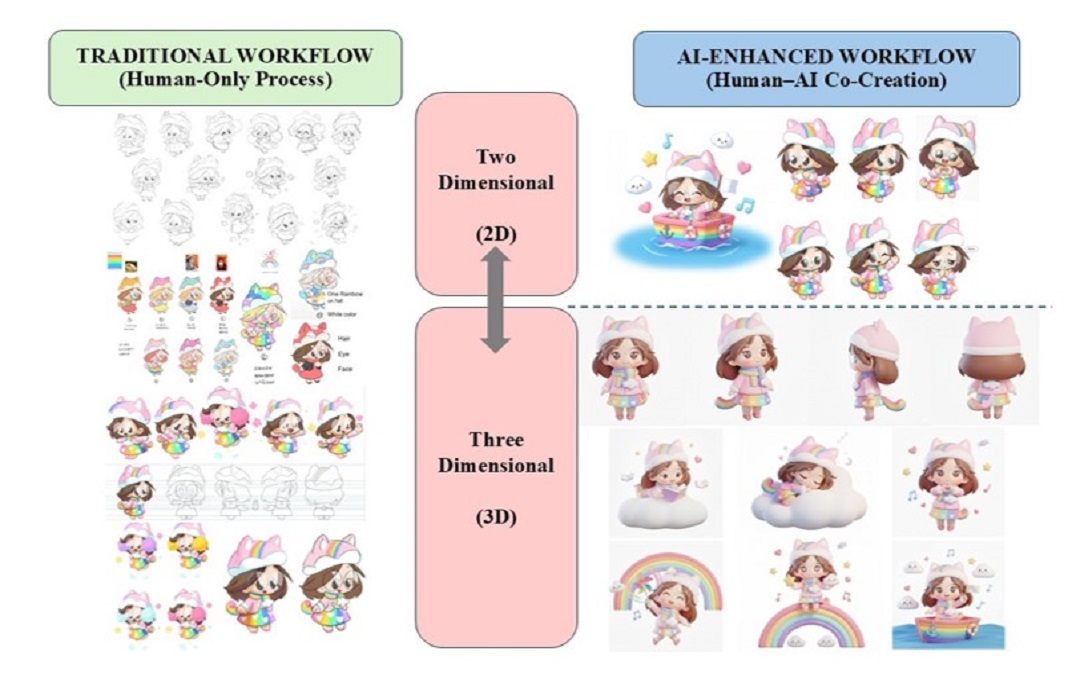
Mascot characters are increasingly central to digital communication and learning environments, yet their creation remains dominated by labor-intensive manual workflows. This study investigates whether generative AI can enhance mascot design while preserving coherent character identity. A traditional manual workflow was compared with an AI-assisted collaborative workflow that employed Gemini AI, a structured prompting protocol. This model utilized clear role separation, where AI supported ideation while humans retained identity control and final decision-making. Ten evaluators rated outputs from both workflows on identity coherence, emotional clarity, visual appeal, and variation richness. Results showed that AI assistance substantially increased exploratory breadth and stylistic diversity, yielding significantly higher scores for variation richness and near-significant gains in visual appeal, while identity coherence and emotional clarity remained comparable to the manual condition. Correlation analyses further indicated that greater variation was positively associated with visual appeal. However, it was only weakly related to identity stability, suggesting that AI-generated diversity did not fragment character meaning under human oversight. Overall, the findings support a human-centered collaborative-intelligence framework in which generative AI functions as an exploratory partner rather than a replacement for designers. The proposed workflow offers practical guidance for integrating AI into character and mascot development, with promising implications for branding and educational media.
References
Bancroft, T. (2006). Creating characters with personality. Watson-Guptill.
Bianchi, I., Branchini, E., Uricchio, T., & Bongelli, R. (2025). Creativity and aesthetic evaluation of
AI-generated artworks: Bridging problems and methods from psychology to AI. Frontiers in Psychology, 16, Article 1648480.
Brown, S., & Ponsonby-McCabe, S. (2014). Brand mascots and other marketing animals. Routledge.
Cha, E., & Wang, D. (2025). A study of the relationship between artificial intelligence generated image advertising and consumer brand awareness. Creative Business and Sustainability Journal, 47(1), 1–19. https://doi.org/10.58837/CHULA.CBSJ.47.1.1
Cohen, J. (1992). A power primer. Psychological Bulletin, 112(1), 155–159. https://doi.org/10.1037/0033-2909.112.1.155
Cross, N. (2011). Design thinking: Understanding how designers think and work. Berg Publishers.
Curedale, R. (2017). Design thinking: Process & methods (4th ed.). Design Community College Inc.
Google DeepMind. (2023). Gemini: A family of highly capable multimodal models (Technical Report). https://arxiv.org/abs/2312.11805
Jintapitak, M. (2023). Equivalent of character design for design thinking in personal character design process. In Proceedings of the Joint International Conference on Digital Arts, Media and Technology (ECTI DAMT & NCON) (pp. 16–20). https://doi.org/10.1109/ECTIDAMTNCON57770.2023.10139327
Kadenhe, N., Al Musleh, M., & Lompot, A. (2025). Human–AI co-design and co-creation: A review of emerging approaches, challenges, and future directions. Proceedings of the AAAI Symposium Series, 6(1), 265–270.
Lundy, P. (2008). Digital storytelling and self-representation in new media. Peter Lang.
Mayer, R. E. (2009). Multimedia learning (2nd ed.). Cambridge University Press. https://doi.org/10.1017/CBO9780511811678
Moreno, R., & Mayer, R. E. (2007). Interactive multimodal learning environments. Educational Psychology Review, 19(3), 309–326. https://doi.org/10.1007/s10648-007-9047-2
Morishita, M., Fukuda, H., Muraoka, K., Nakamura, T., Hayashi, M., Yoshioka, I., Ono, K., & Awano, S. (2024). Evaluating GPT-4V's performance in the Japanese national dental examination: A challenge explored. Journal of Dental Sciences, 19(3), 1595–1600. https://doi.org/10.1016/j.jds.2023.12.007
Ning, B., Liu, F., & Liu, Z. (2023). Creativity support in AI co-creative tools: Current research, challenges and opportunities. In Proceedings of the International Conference on Computer Supported Cooperative Work in Design (CSCWD) (pp. 5–10). https://doi.org/10.1109/CSCWD57460.2023.10152832
Ramesh, A., Pavlov, M., Goh, G., Gray, S., Voss, C., Radford, A., Chen, M., & Sutskever, I. (2021). Zero-shot text-to-image generation. In Proceedings of the International Conference on Machine Learning (ICML). https://arxiv.org/abs/2102.12092
Rombach, R., Blattmann, A., Lorenz, D., Esser, P., & Ommer, B. (2022). High-resolution image synthesis with latent diffusion models. In Proceedings of the IEEE/CVF Conference on Computer Vision and Pattern Recognition (CVPR). (pp. 10674–10685). https://doi.org/10.1109/CVPR52688.2022.01042
Samala, A., & Rawas, S. (2025). Bias in artificial intelligence: Smart solutions for detection, mitigation, and ethical strategies in real-world applications. IAES International Journal of Artificial Intelligence, 14(1), 32–43. https://doi.org/10.11591/ijai.v14.i1.pp32-43
Shneiderman, B. (2020). Human-centered AI: Reliable, safe & trustworthy. International Journal of Human–Computer Interaction, 36, 495–504. https://doi.org/10.1080/10447318.2020.1741118
Smith, F. W., & Rossit, S. (2018). Identifying and detecting facial expressions of emotion in peripheral vision. PLOS ONE, 13(5), e0197160. https://doi.org/10.1371/journal.pone.0197160
Tian, Y., Liu, Y., Wang, S., & Kwong, S. (2025). Quality assessment for text-to-image generation: A survey. IEEE MultiMedia, 32(2), 44–52. https://doi.org/10.1109/MMUL.2025.3538862
Veletsianos, G. (2010). Emerging technologies in distance education. AU Press.
White, T. (2006). Animation from pencils to pixels: Classical techniques for the digital animator. Routledge.
Downloads
Published
How to Cite
License
Copyright (c) 2026 Asian Health, Science and Technology Reports

This work is licensed under a Creative Commons Attribution-NonCommercial 4.0 International License.