Digital Twins in Dentistry: Technological Foundations and Clinical Applications
DOI:
https://doi.org/10.69650/ahstr.2026.4504Keywords:
Digital twins, Digital technology, Dentistry, Digital dentistry, Artificial IntelligenceAbstract
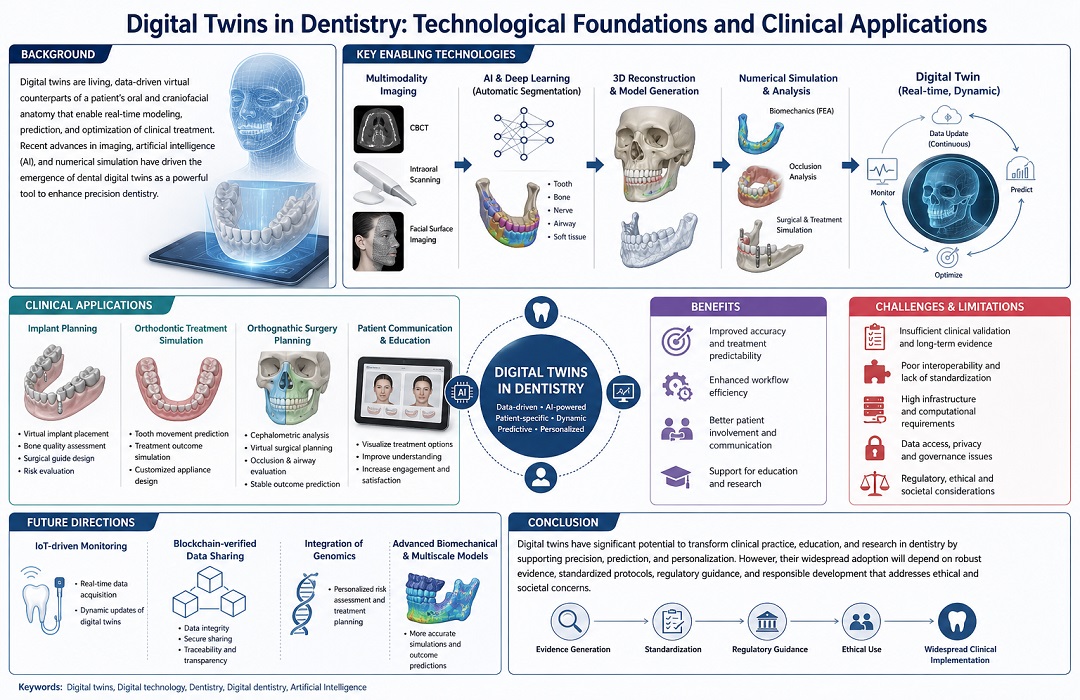
Digital twins have become a powerful new trend in dentistry, enabled by advancements in multimodality imaging, artificial intelligence (AI), and numerical simulation. Dental digital twins are living, data-driven virtual counterparts to a patient’s oral and craniofacial anatomy that allow real-time modeling, prediction, and optimization of clinical treatment. This review aimed to gather current knowledge about technical concepts, clinical fields, limitations, and future challenges of digital twins in dentistry. These key enabling technologies (including cone-beam computed tomography, intraoral scanning, facial surface imaging, and deep learning-based segmentation) contribute to accurate anatomical reconstruction and the generation of automated models. From a clinical perspective, digital twins appear particularly promising for implant planning, simulation of orthodontic treatment and orthognathic surgery, and patient communication. Research suggests that this technology may improve accuracy, workflow efficiency, and patient involvement. Many challenges, however, persist in regard to insufficient clinical validation; poor interoperability; high infrastructure requirements and authority issues in data access use cases . New modalities such as Internet of Things (IoT)-driven monitoring, blockchain-verified data sharing, and the integration of genomic information with biomechanical models may expand the range of applications for dental digital twins, enabling precision dentistry. Despite significant progress, digital twins are a developing technology. Scalability for clinical use will require robust evidence, standardized protocols, regulatory guidance, and ethical and societal considerations. Digital twins have significant potential to transform practice, education, and research in dentistry, but their benefits could be widespread only with responsible development and broad clinical evaluation.
References
Ahn, S., Kim, J., Baek, S., Kim, C., Jang, H., & Lee, S. (2024). Toward Digital Twin Development for Implant Placement Planning Using a Parametric Reduced-Order Model. Bioengineering, 11(1), 84. https://doi.org/10.3390/bioengineering11010084
Andrade, T. V. de, Silva, K. G. da, Oliveira, N. B., Polizel, A. M., Andrade, J. V. D., Fonseca, J. V., Moura, L. F. C. de, Faria, L. S., Castro, M. F. de, Martin, V. de, Oliveira, I. da S., Silva, M. A., & Silveira, A. K. G. (2024). Virtual planning in oral and maxillofacial surgery. Contribuciones a las Ciencias Sociales, 17(9), e10939. https://doi.org/10.55905/revconv.17n.9-334
Bonny, T., Al Nassan, W., Obaideen, K., Rabie, T., AlMallahi, M. N., & Gupta, S. (2024). Primary Methods and Algorithms in Artificial-Intelligence-Based Dental Image Analysis: A Systematic Review. Algorithms, 17(12), 567. https://doi.org/10.3390/a17120567
Cellina, M., Cè, M., Alì, M., Irmici, G., Ibba, S., Caloro, E., Fazzini, D., Oliva, G., & Papa, S. (2023). Digital Twins: The New Frontier for Personalized Medicine?. Applied Sciences, 13(13), 7940. https://doi.org/10.3390/app13137940
Charavet, C., Van Hede, D., Maes, N., Albert, A., & Lambert, F. (2021). Disentangling the effects of CAD/CAM customized appliances and piezocision in orthodontic treatment. The Angle Orthodontist, 91(6), 764–771. https://doi.org/10.2319/112620-962.1
Cho, R. Y., Byun, S. H., Yi, S. M., Ahn, H. J., Nam, Y. S., Park, I. Y., On, S. W., Kim, J. C., & Yang, B. E. (2023). Comparative Analysis of Three Facial Scanners for Creating Digital Twins by Focusing on the Difference in Scanning Method. Bioengineering, 10(5), 545. https://doi.org/10.3390/bioengineering10050545
DI Cosola, M., Ballini, A., Prencipe, F. A., DE Tullio, F., Fabrocini, A., Cupelli, P., Rignani, M., Cazzolla, A. P., Bizzoca, M. E., & Musella, G. (2025). Artificial intelligence in dentistry: a narrative review. Minerva Dental and Oral Science, 74(5), 337–348. https://doi.org/10.23736/S2724-6329.25.05217-9
Fuglsig, J. M. C. E. S., Reis, I. N. R. D., Yeung, A. W. K., Bornstein, M. M., & Spin-Neto, R. (2024). The current role and future potential of digital diagnostic imaging in implant dentistry: A scoping review. Clinical Oral Implants Research, 35(8), 793–809. https://doi.org/10.1111/clr.14212
Hein, J., Grunder, J., Calvet, L., Giraud, F., & Fürnstahl, P. (2024). Virtual reality for immersive education in orthopedic surgery digital twins. In 2024 IEEE International Symposium on Mixed and Augmented Reality Adjunct (ISMAR-Adjunct) (pp. 628–629). IEEE. https://doi.org/10.1109/ISMAR-Adjunct64951.2024.00183
Iliuță, M.-E., Pop, E., Cernian, A., Mantale, Ș., Sacală, I.-Ș., & Moisescu, M.-A. (2025). Dental digital twins - Advancing clinical workflows through smart diagnostics. In 2025 25th International Conference on Control Systems and Computer Science (CSCS), (pp. 136–142). https://doi.org/10.1109/CSCS66924.2025.00028
Jameil, A. K., & Al-Raweshidy, H. (2024). Enhancing offloading with cybersecurity in edge computing for digital twin-driven patient monitoring. IET Wireless Sensor Systems, 14(6), 363–380. https://doi.org/10.1049/wss2.12086
Jan, A., Anwar, S., Ullah, R., & Zhu, Y. (2025). Digital Twin in Dental Healthcare: Transforming Diagnostics, Surgery, and Patient Management. Physical Education, Health and Social Sciences, 3(2), 15–27. https://doi.org/10.63163/jpehss.v3i2.333
Joda, T., Balmer, M., Jung, R. E., & Ioannidis, A. (2024). Clinical use of digital applications for diagnostic and treatment planning in prosthodontics: A scoping review. Clinical Oral Implants Research, 35(8), 782–792. https://doi.org/10.1111/clr.14230
Kafedzhieva, A., Vlahova, A., & Chuchulska, B. (2025). Digital Technologies in Implantology: A Narrative Review. Bioengineering, 12(9), 927. https://doi.org/10.3390/bioengineering12090927
Kumar, S. S., Chacko, R., Kaur, A., Ibrahim, G., & Ye, D. (2024). A Systematic Review of Intraoral Scanning. Diagnostics, 14(5), 531. https://doi.org/10.3390/diagnostics14050531
Li, J. T. W., & Leung, Y. Y. (2025). Digital Diagnostics and Treatment Planning for Orthognathic Surgery. Australian Dental Journal, 70(Suppl 1), S82-S92. https://doi.org/10.1111/adj.70020
Maddahi, Y., & Chen, S. (2022). Applications of Digital Twins in the Healthcare Industry. Virtual Worlds, 1(1), 20–41. https://doi.org/10.3390/virtualworlds1010003
Mahmood, R. S., Hamandi, S. J., & Al-Mahdi, A. H. (2024). A Practical Guide to Virtual Planning of Orthognathic Surgery. Al-Nahrain Journal, 27(1), 9-18. https://doi.org/10.29194/NJES.27010009
Moztarzadeh, O., Jamshidi, M. B., Sargolzaei, S., Keikhaee, F., Jamshidi, A., Shadroo, S., & Hauer, L. (2023). Metaverse and Medical Diagnosis. Diagnostics, 13(8), 1485. https://doi.org/10.3390/diagnostics13081485
Papachristou, K., Katsakiori, P. F., Papadimitroulas, P., Strigari, L., & Kagadis, G. C. (2024). Digital Twins' Advancements and Applications in Healthcare. Journal of Personalized Medicine, 14(11), 1101. https://doi.org/10.3390/jpm14111101
Ringeval, M., Etindele Sosso, F. A., Cousineau, M., & Paré, G. (2025). Advancing health care with digital twins. JMIR, 27, e69544. https://doi.org/10.2196/69544
Salvi, S., Vu, G., Gurupur, V., & King, C. (2025). Digital Convergence in Dental Informatics. Electronics, 14(16), 3278. https://doi.org/10.3390/electronics14163278
Singh, P., Bornstein, M. M., Hsung, R. T., Ajmera, D. H., Leung, Y. Y., & Gu, M. (2024). Frontiers in Three-Dimensional Surface Imaging Systems. Diagnostics, 14(4), 423. https://doi.org/10.3390/diagnostics14040423
Thribhuvanan, L., Saravanakumar, M. S., Panikkar, P., & Durairaj, P. (2025). The New Era of Holistic and Precision Dentistry. IJCPD, 18(8), 1046–1050. https://doi.org/10.5005/jp-journals-10005-3234
Wang, Y., Fu, T., Xu, Y., Ma, Z., Xu, H., Du, B., Lu, Y., Gao, H., Wu, J., & Chen, J. (2024). TWIN-GPT: Digital twins for clinical trials. ACM TOMM. https://doi.org/10.1145/3674838
Xames, M. D., & Topcu, T. G. (2024). A systematic literature review of digital twin research for healthcare systems. IEEE Access, 12, 4099–4126. https://doi.org/10.1109/ACCESS.2023.3349379
Xu, P., Gholamalizadeh, T., Moshfeghifar, F., Darkner, S., & Erleben, K. (2023). Deep-learning-based segmentation. IEEE Access, 11, 102460–102470. https://doi.org/10.1109/ACCESS.2023.3317512
Zaleckas, L., Vitosyte, M., Gendviliene, I., Sun, Y., Simonaitis, T., Kaupas, S., & Rutkunas, V. (2024). Virtual planning, guided surgery, and digital prosthodontics. Journal of Prosthodontics, 33(5), 409–416. https://doi.org/10.1111/jopr.13819
Downloads
Published
How to Cite
License
Copyright (c) 2026 Asian Health, Science and Technology Reports

This work is licensed under a Creative Commons Attribution-NonCommercial 4.0 International License.