The Efficiency of the Three Data Transformation Methods for Converting Beta-Distributed Data to Normal-Distributed Data
DOI:
https://doi.org/10.69650/ahstr.2026.4410Keywords:
Beta Distribution, Data Transformation Techniques, Johnson Transformation, Box-Cox Transformation, Yeo-Johnson Transformation, Normalizing TransformationAbstract
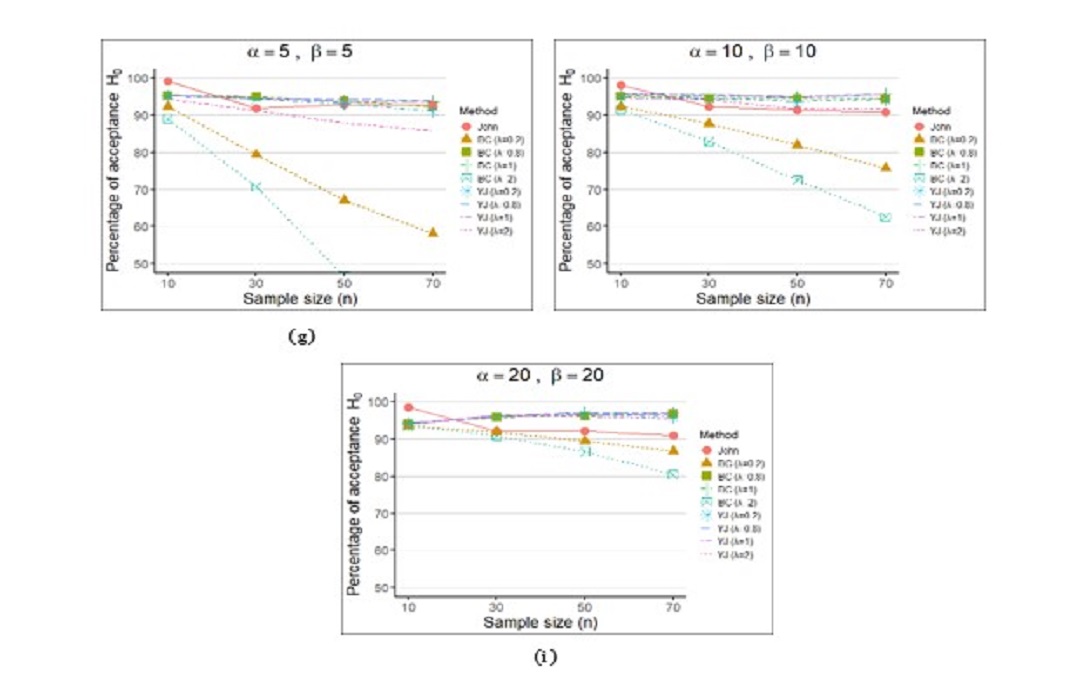
The beta distribution is widely used to model rates and proportions in fields such as epidemiology, ecology, and quality control. However, relatively few studies have systematically compared data transformation methods specifically for beta-distributed data under different shapes and sample sizes. The research aimed to study and compare the efficiency of three data transformation methods: the Johnson transformation method, the Box-Cox transformation method, and the Yeo-Johnson transformation method for transforming beta-distributed data to normally distributed data. The study was conducted using the Monte Carlo simulation technique with 1,000 replications for each situation. In each scenario, the two shape parameters and of the beta distribution were defined as 5, 10, and 20 in combinations that generated three types of distributions: right-skewed , left-skewed , and symmetric respectively; the 3 levels of sample size (n) were: small (n = 10), medium (n = 30, 50), and large (n = 70) and the power transformation were 0.2, 0.8, 1, and 2. The Anderson-Darling statistic was employed to examine the data distribution. The evaluation criterion was based on the percentage of acceptance (POA) of the null hypothesis for the transformed data to follow a normal distribution. A higher POA indicated a more effective transformation method. The results showed that, for right-skewed beta distributions, the Johnson transformation yielded the POA of normality, especially when the sample size was small. In contrast, the Box–Cox transformation became competitive for medium-sized samples. For left-skewed beta distributions, the Johnson transformation also performed best overall, with Box–Cox yielding comparable results as the sample size increased. For symmetric beta distributions, the Yeo–Johnson and Box–Cox transformations usually performed better than the Johnson transformation when the sample size was large. These findings suggest that selecting the appropriate transformation method based on the shape of the distribution and sample size is critical for improving the accuracy and validity of statistical analyses, especially when normality is a key assumption in methods such as ANOVA. Failure to apply the correct transformation may lead to mistakes or misunderstandings, which can ultimately result in inaccurate conclusions and compromise the validity of statistical tests.
References
Chortirat, T., Chomtee, B., & Sinsomboonthong, J. (2011). Comparison of four data transformation methods for weibull distributed data. Agriculture and Natural Resources, 45(2), 366-383.
D'Agostino, R. B., & Stephens, M. A. (1986). Goodness-of-fit techniques. Marcel Dekker.
Health Data Center, M. o. P. H. (2025). Morbidity Rates of Hypertension per Population. https://hdc.moph.go.th/center/public/
Phureejarurot, P. P., Worawan., Tresutumas, N., Raksakom, S., & Sinsomboonthong, J. (2020). Efficiency Comparison of Data Transformation Methodsfor the Gamma Distributed Data. Thai Science and Technology Journal, 28(8), 1321-1333.
Slifker, J. F., & Shapiro, S. S. (1980). The Johnson system: selection and parameter estimation. Technometrics, 22(2), 239-246.
Sumranhun, P., Rungcharoen, S., Damrongwatthanayothin, B., Somtobburana, P., Patsaphat, B., & Nuchpum, T. (2023). The Reducing of the Error in Forecasting Demand for Industrial Products with High Variation by Data Transformation Techniques. Journal of Management and Marketing, Rajamangala University of Technology Thanyaburi, 10(1), 36-54. https://so05.tci-thaijo.org/index.php/mmr/article/view/261443/178489
Watthanacheewakul, L. (2021, July 7-9). Transformations for left skewed data. Proceedings of the World Congress on Engineering 2010 (pp. 1-6). London, U.K.
Yeo, I.-K., & Johnson, R. A. (2000). A New Family of Power Transformations to Improve Normality or Symmetry. Biometrika, 87(4), 954-959. https://doi.org/10.1093/biomet/87.4.954
Downloads
Published
How to Cite
Issue
Section
Categories
License
Copyright (c) 2026 Asian Health, Science and Technology Reports

This work is licensed under a Creative Commons Attribution-NonCommercial 4.0 International License.