A Maturity Assessment Framework for Smart Logistics Parks: Distinctions from Traditional Models and Implications for Transformation
DOI:
https://doi.org/10.69650/ahstr.2025.4242Keywords:
Smart Logistics Parks, Maturity Assessment Framework, Traditional Logistics Parks, Digital Transformation, AHPAbstract
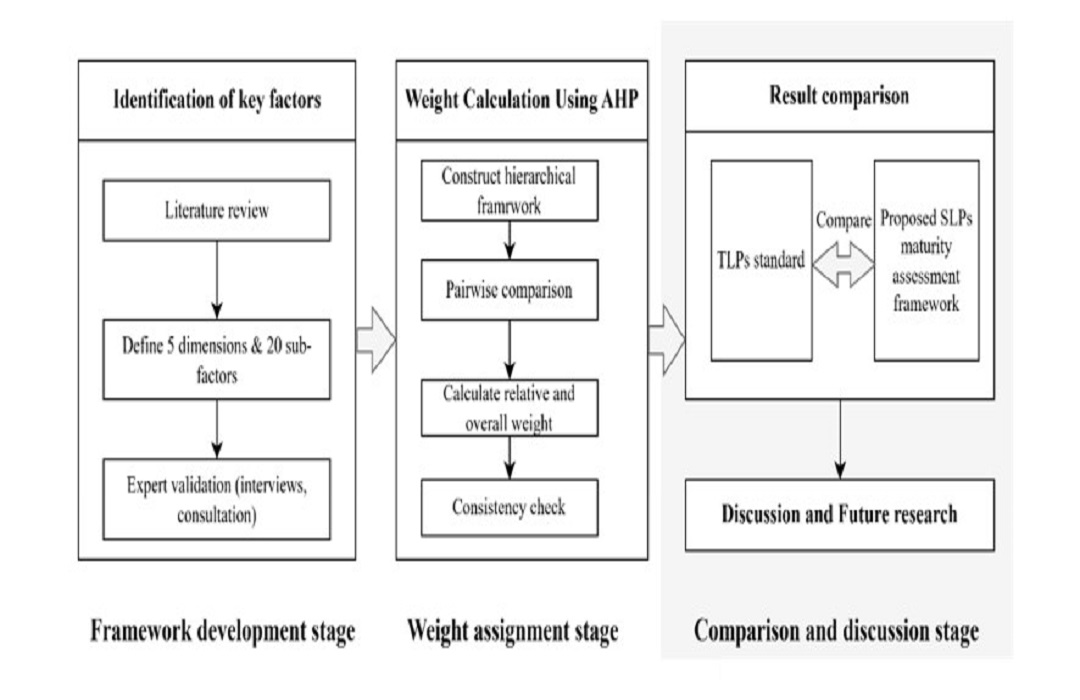
Smart logistics parks (SLPs) drive modern economies and global supply chains, making maturity assessment essential for guiding investment, improvement and strategic decision-making. Existing maturity assessment models for traditional logistics parks (TLPs) overlook the distinctive advancements of SLPs, underscoring the need for specialized frameworks. In this study, an SLP maturity evaluation model was developed that differentiates SLPs from TLPs assessments to support smart logistics transformation. The framework comprises five core dimensions with 20 sub-factors: Smart Economy, Public Services and Smart Governance, Smart Infrastructure and Intelligent Technology Application, Skilled Human Capital, and Environmental Sustainability. This structure was validated through a literature review and expert input. For comparison, the TLPs model is based on China’s national standard. Using the Analytic Hierarchy Process (AHP) to determine factor importance, results indicate that SLPs prioritize Smart Infrastructure and Intelligent Technology Application (0.3229), followed by Public Services and Smart Governance (0.2447). In contrast, TLPs place the highest emphasis on Service Capability and Operation Management (0.3317). While both models value infrastructure, operational services, and environmental considerations, SLPs place stronger emphasis on technological innovation and digital governance, whereas TLPs focus on operational efficiency and service quality. These findings confirm that although infrastructure and operations remain central to both, transitioning to SLPs demands a greater focus on intelligent technology. This study provides empirical evidence that the SLPs' transformation necessitates the integration of intelligent systems while simultaneously maintaining efficiency, service quality, and sustainability. This research offers practical guidance for investors, policymakers, and operators.
References
Agah, J., Ocheni, C., Ezugwu, I., Nnaji, A., Nnenanya, G., & Eke, J. (2024). Application Of Item Objective Congruence Index (IOC-Index) for Proper Alignment of 2020 Physics WASSCE Items with Objectives and Content. Journal of Education, 9(1), 57-63.
Agnieszka, D., Tygran, D., Lyudmyla, D., Oleg, K., & Robert, U. (2021). Smart sustainable city manufacturing and logistics: A framework for city logistics node 4.0 operations. Energies, 14(24), 8380. https://doi.org/10.3390/en14248380
Ahad, M. A., Paiva, S., Tripathi, G., & Feroz, N. (2020). Enabling technologies and sustainable smart cities. Sustainable Cities and Society, 61, 1-12. https://doi.org/10.1016/j.scs.2020.102301
Andiyappillai, N. (2021). An Analysis of the Impact of Automation on Supply Chain Performance in Logistics Companies. IOP Conference Series: Materials Science and Engineering, 1055(1), 012055. https://doi.org/10.1088/1757-899X/1055/1/012055
Ansari, A. K., & Ujjan, R. M. A. (2024). Addressing Security Issues and Challenges in Smart Logistics Using Smart Technologies. In Cybersecurity in the Transportation Industry (pp. 25-48). https://doi.org/10.1002/9781394204472.ch2
Bibri, S. E. (2020). The Leading Data-Driven Smart Cities in Europe: Their Applied Solutions and Best Practices for Sustainable Development. Advances in the Leading Paradigms of Urbanism and their Amalgamation: Compact Cities, Eco–Cities, and Data–Driven Smart Cities, 227-258. https://doi.org/10.1007/978-3-030-41746-8_9
Brunetti, M., Mes, M., & Lalla-Ruiz, E. (2024). Smart logistics nodes: concept and classification. International Journal of Logistics Research and Applications, 27(11), 1984-2020. https://doi.org/10.1080/13675567.2024.2327394
Chaopaisarn, P., & Woschank, M. (2021). Maturity model assessment of SMART logistics for SMEs. Chiang Mai University Journal of Natural Sciences, 20(2), 1-8. https://doi.org/10.12982/CMUJNS.2021.025
Chatprem, T., Puntumetakul, R., Yodchaisarn, W., Siritaratiwat, W., Boucaut, R., & Sae-Jung, S. (2020). A screening tool for patients with lumbar instability: a content validity and rater reliability of Thai version. Journal of Manipulative and Physiological Therapeutics, 43(5), 515-520. https://doi.org/10.1016/j.jmpt.2019.04.010
Chaube, S., Pant, S., Kumar, A., Uniyal, S., Singh, M. K., Kotecha, K., & Kumar, A. (2024). An overview of multi-criteria decision analysis and the applications of AHP and TOPSIS methods. International Journal of Mathematical, Engineering and Management Sciences, 9(3), 581-615. https://doi.org/10.33889/IJMEMS.2024.9.3.030
Chen, S., Li, J., Chen, Q., & Xu, F. (2021). Evaluation model of logistics park operation service capability based on entropy weight and fuzzy comprehensive evaluation. In 2021 18th International Computer Conference on Wavelet Active Media Technology and Information Processing (ICCWAMTIP) (pp. 388-394). IEEE. https://doi.org/10.1109/ICCWAMTIP53232.2021.9673709
Dintén, R., García, S., & Zorrilla, M. (2023). Fleet management systems in Logistics 4.0 era: a real time distributed and scalable architectural proposal. Procedia Computer Science, 217, 806-815. https://doi.org/10.1016/j.procs.2022.12.277
Dobers, K., Perotti, S., Wilmsmeier, G., Mauer, G., Jarmer, J.-P., Spaggiari, L., Hering, M., Romano, S., & Skalski, M. (2023). Sustainable logistics hubs: greenhouse gas emissions as one sustainability key performance indicator. Transportation Research Procedia, 72, 1153-1160. https://doi.org/10.1016/j.trpro.2023.11.572
Dzemydienė, D., Burinskienė, A., & Miliauskas, A. (2021). Integration of Multi-Criteria Decision Support with Infrastructure of Smart Services for Sustainable Multi-Modal Transportation of Freight. Sustainability, 13(9), 4675. https://www.mdpi.com/2071-1050/13/9/4675
Elhusseiny, H. M., & Crispim, J. (2023). A Review of Industry 4.0 Maturity Models: Adoption of SMEs in The Manufacturing and Logistics Sectors. Procedia Computer Science, 219, 236-243. https://doi.org/10.1016/j.procs.2023.01.286
Elpida, X., Michael, M., & Georgia, A. (2022). Developing a Smart City Logistics Assessment Framework (SCLAF): A Conceptual Tool for Identifying the Level of Smartness of a City Logistics System. Sustainability, 14(10), 6039. https://doi.org/10.3390/su14106039
Facchini, F., Oleśków-Szłapka, J., Ranieri, L., & Urbinati, A. (2020). A Maturity Model for Logistics 4.0: An Empirical Analysis and a Roadmap for Future Research. Sustainability, 12(1), 86. https://doi.org/10.3390/su12010086
Feng, B., & Ye, Q. (2021). Operations management of smart logistics: A literature review and future research. Frontiers of Engineering Management, 8(3), 344-355. https://doi.org/10.1007/s42524-021-0156-2
Ferro-Escobar, R., Vacca-González, H., & Gómez-Castillo, H. (2022). Smart and Sustainable Cities in Collaboration with IoT: The Singapore Success Case. In G. Marques, A. González-Briones, & J. M. Molina López (Eds.), Machine Learning for Smart Environments/Cities: An IoT Approach (pp. 213-243). Springer International Publishing. https://doi.org/10.1007/978-3-030-97516-6_12
Galal, A., Elawady, H., & Mostafa, N. A. (2025). An integrated framework for third party logistic evaluation by using fuzzy analytical hierarchy process and technique for order preference by similarity to ideal solution. International Journal of Logistics Systems and Management, 50(3), 361-385. https://doi.org/10.1504/IJLSM.2025.144680
Gao, Q., Liu, X., & Chang, J. (2024). Analysis of Factors for High-Quality Development of Intelligent Logistics Parks under the Internet of Things. The International Journal of Multiphysics, 18(3), 98-109. https://www.themultiphysicsjournal.com/index.php/ijm/article/view/1246
Gbahabo, P. T. A., Foluso, & Afful-Mensah, G. (2024). Trade Facilitation in Africa: A Review of Concepts and Empirical Facts. In M. K. Ocran & J. Y. Abor (Eds.), The Palgrave Handbook of International Trade and Development in Africa (pp. 463-490). Springer International Publishing. https://doi.org/10.1007/978-3-031-65715-3_24
Hanelt, A., Bohnsack, R., Marz, D., & Antunes Marante, C. (2021). A Systematic Review of the Literature on Digital Transformation: Insights and Implications for Strategy and Organizational Change. Journal of Management Studies, 58(5), 1159-1197. https://doi.org/10.1111/joms.12639
He, N., Jian, M., Liu, S., Wu, J., & Chen, X. (2023). Do publicly developed logistics parks cause carbon emission transfer? Evidence from Chengdu. Transportation Research Part D: Transport and Environment, 125, 103988. https://doi.org/10.1016/j.trd.2023.103988
Issac, A. L. (2024). Digital Technologies in Smart Sustainable Cities: Focal Cases in the UAE. In W. Leal Filho, S. Kautish, T. Wall, S. Rewhorn, & S. K. Paul (Eds.), Digital Technologies to Implement the UN Sustainable Development Goals (pp. 355-373). Springer Nature Switzerland. https://doi.org/10.1007/978-3-031-68427-2_18
Issaoui, Y., Khiat, A., Bahnasse, A., & Ouajji, H. (2021). Toward Smart Logistics: Engineering Insights and Emerging Trends. Archives of Computational Methods in Engineering, 28(4), 3183-3210. https://doi.org/10.1007/s11831-020-09494-2
Jang, S. W., & Ahn, W. C. (2021). Financial analysis effect on management performance in the Korean logistics industry. The Asian Journal of Shipping and Logistics, 37(3), 245-252. https://doi.org/10.1016/j.ajsl.2021.06.003
Janmontree, J., Shinde, A., Zadek, H., Trojahn, S., & Ransikarbum, K. (2025). A Strategic Hydrogen Supplier Assessment Using a Hybrid MCDA Framework with a Game Theory-Driven Criteria Analysis. Energies, 18, 3508. https://doi.org/10.3390/en18133508
Jović, M., Tijan, E., Vidmar, D., & Pucihar, A. (2022). Factors of Digital Transformation in the Maritime Transport Sector. Sustainability, 14,9776. https://doi.org/10.3390/su14159776
Kirimtat, A., Krejcar, O., Kertesz, A., & Tasgetiren, M. F. (2020). Future trends and current state of smart city concepts: A survey. Ieee Access, 8, 86448-86467. https://doi.org/10.1109/ACCESS.2020.2992441
Lagorio, A., Cimini, C., Pinto, R., & Cavalieri, S. (2023). 5G in Logistics 4.0: potential applications and challenges. Procedia Computer Science, 217, 650-659. https://doi.org/10.1016/j.procs.2022.12.261
Liang, H., Lin, S., & Wang, J. (2022). Impact of technological innovation on carbon emissions in China's logistics industry: Based on the rebound effect. Journal of Cleaner Production, 377, 134371. https://doi.org/10.1016/j.jclepro.2022.134371
Liu, L. (2021). Selection and evaluation of ecological logistics park mode based on ecological perspective. Fresenius Environmental Bulletin, 30(1), 809-814. WOS:000629181200089
Liu, W., Zhang, J., Hou, J., & Wang, S. (2021). Effect of intelligent logistics transformation announcements on shareholder value: Evidence from Chinese listed firms. Managerial and Decision Economics, 42(5), 1194-1219. https://doi.org/10.1002/mde.3302
Liu, Y., & Ye, M. (2022). Analysis on the Development of Smart City of Big Cities in China and Its Effect to Economic Structure Based on Entropy Method. SECURITY AND COMMUNICATION NETWORKS, 2022, 4355748. https://doi.org/10.1155/2022/4355748
Lv, Y., Xiang, S., Zhu, T., & Zhang, S. (2020). Data-Driven Design and Optimization for Smart Logistics Parks: Towards the Sustainable Development of the Steel Industry. Sustainability, 12, 7034. https://doi.org/10.3390/su12177034
Marcela, R. J., Elisabet, D. C., & Tarik, F. N. (2023). A review of Lawshe’s method for calculating content validity in the social sciences. Frontiers in Education, 8, 1271335. https://doi.org/10.3389/feduc.2023.1271335
Maretto, L., Faccio, M., & Battini, D. (2022). A Multi-Criteria Decision-Making Model Based on Fuzzy Logic and AHP for the Selection of Digital Technologies. IFAC-PapersOnLine, 55(2), 319-324. https://doi.org/10.1016/j.ifacol.2022.04.213
Mary P, M., Jacob, A. M., & Shetty, A. (2024). The validation of a multidimensional tool to test knowledge, barriers, and the challenges in screening for Tuberculosis among patients with Diabetes Mellitus. Indian Journal of Tuberculosis, 72(3), 283-289. https://doi.org/10.1016/j.ijtb.2024.04.007
Mehmood, R., Yigitcanlar, T., & Corchado, J. M. (2024). Smart Technologies for Sustainable Urban and Regional Development. Sustainability, 16(3), 1171. https://doi.org/10.3390/su16031171
Moslem, S., Saraji, M. K., Mardani, A., Alkharabsheh, A., Duleba, S., & Esztergár-Kiss, D. (2023). A Systematic Review of Analytic Hierarchy Process Applications to Solve Transportation Problems: From 2003 to 2022. Ieee Access, 11, 11973-11990. https://doi.org/10.1109/ACCESS.2023.3234298
National Standardization Administration. (2018). Performance indicator system of logistics park (GB/T 37102-2018). Beijing, China: Standardization Administration of China. http://wlbz.chinawuliu.com.cn/
Nwaogu, J. M., Yang, Y., Chan, A. P. C., & Wang, X. (2024). Enhancing Drone Operator Competency within the Construction Industry: Assessing Training Needs and Roadmap for Skill Development. Buildings, 14(4), 1153. https://doi.org/10.3390/buildings14041153
Othman, A., El-gazzar, S., & Knez, M. (2022). A Framework for Adopting a Sustainable Smart Sea Port Index. Sustainability, 14(8), 4551. https://www.mdpi.com/2071-1050/14/8/4551
Pant, S., Kumar, A., & Mazurek, J. (2025). An Overview and Comparison of Axiomatization Structures Regarding Inconsistency Indices' Properties in Pairwise Comparisons Methods. International Journal of Mathematical, Engineering and Management Sciences, 10(1), 265-284. https://doi.org/10.33889/IJMEMS.2025.10.1.015
Pereira, G. R. B., AlmeidaGuimarães, L. G. d., Cimon, Y., Barreto, L. K. D. S., & Nodari, C. H. (2023). Conceptual Model for Assessing Logistics Maturity in Smart City Dimensions. Administrative Sciences, 13(4), 114. https://doi.org/10.3390/admsci13040114
Rawat, S. S., Pant, S., Kumar, A., Ram, M., Sharma, H. K., & Kumar, A. (2022). A state-of-the-art survey on analytical hierarchy process applications in sustainable development. International Journal of Mathematical, Engineering and Management Sciences, 7(6), 883-917. https://doi.org/10.33889/IJMEMS.2022.7.6.056
Romano, G. C., & Taube, M. (2022). Knowledge and Policy Transfers Along the BRI: The Case of Duisburg. In O. Porto de Oliveira & G. C. Romano (Eds.), Brazil and China in Knowledge and Policy Transfer: Agents, Objects, Time, Structures and Power (pp. 271-303). Springer International Publishing. https://doi.org/10.1007/978-3-031-09116-2_9
Rusticus, S. (2023). Content Validity. In F. Maggino (Ed.), Encyclopedia of Quality of Life and Well-Being Research (pp. 1384-1385). Springer International Publishing. https://doi.org/10.1007/978-3-031-17299-1_553
Sarker, D., & Klungseth, N. J. (2024, November). Successful Digital Transformation: Observations on Digital Maturity, Technology and Logistics in Multiple Industries 9th International Conference on Digital Economy, Rabat, Morocco. https://doi.org/10.1007/978-3-031-76365-6_3
Shang, C., & Li, Y. (2021, Dec 3-5). Research on the Development Countermeasures of Smart Logistics Park in Central and Western Regions Based on Big Data. 2021 3rd International Conference on Machine Learning, Big Data and Business Intelligence (MLBDBI), Taiyuan,China. https://doi.org/10.1109/MLBDBI54094.2021.00089
Siems, E., Seuring, S., & Schilling, L. (2023). Stakeholder roles in sustainable supply chain management: a literature review. Journal of Business Economics, 93(4), 747-775. https://doi.org/10.1007/s11573-022-01117-5
Sishi, M., & Telukdarie, A. (2021, April 5-8). Digital Technologies and Artificial Intelligence for Optimized Key Performance Indicators. Paper presented at the International Conference on Industrial Engineering and Operations Management, Sao Paulo, Brazil.
Sun, Y., Li, Y., Jun, N., & Hang, F. (2024). Twelve pathways of carbon neutrality for industrial parks. Journal of Cleaner Production, 437, 140753. https://doi.org/10.1016/j.jclepro.2024.140753
Suresh, J., Agarwal, V., Janardhanan, M., & Saikouk, T. (2024). Unlocking sustainability: Overcoming barriers to circular economy implementation in warehouse fulfilment centers. Journal of Cleaner Production, 485, 144391. https://doi.org/10.1016/j.jclepro.2024.144391
Tao, J., Ni, S., & Ding, T. (2021). Research on Collaborative Innovation Evaluation of Intelligent Logistics Park. Ieee Transactions on Engineering Management. https://doi.org/10.1109/tem.2021.3108417
Tepic, G., Djelosevic, M., Brkljac, N., & Vukovic, M. (2025). Probabilistic ranking of Hazmat logistics subsystems under uncertainty using fuzzy AHP. Journal of Loss Prevention in the Process Industries, 94, 105563. https://doi.org/10.1016/j.jlp.2025.105563
Tian, G., Lu, W., Zhang, X., Zhan, M., & Dulebenets, M. A. (2023). A survey of multi-criteria decision-making techniques for green logistics and low-carbon transportation systems. Environmental Science and Pollution Research, 30(20), 57279-57301. https://doi.org/10.1007/s11356-023-26577-2
Tran-Dang, H. K., Jae-Woo Lee, Jae-Min Kim, Dong-Seong. (2025). Shaping the Future of Logistics: Data-driven Technology Approaches and Strategic Management. IETE Technical Review, 42(1),44-79. https://doi.org/10.1080/02564602.2024.2445513
Verma, V. K., & Rastogi, R. (2024). How Do Stakeholders Perceive Transit Service Quality Attributes? – A study through Fuzzy-AHP. Expert Systems with Applications, 238, 122043. https://doi.org/10.1016/j.eswa.2023.122043
Wang, A., Yang, Y., Sun, S., Zuo, Y., Wang, Z., & Sun, H. (2022). Developing an Evaluation Model to Measure the Intelligence Level of Smart Industrial Parks. Buildings, 12(10), 1533. Retrieved from https://www.mdpi.com/2075-5309/12/10/1533
Wei, X., & Wang, M. (2021). A New Fog Enabled Sensor Cloud Platform for Smart Logistics Park. Advances in Artificial Systems for Logistics Engineering, Cham. https://doi.org/10.1007/978-3-030-80475-6_11
Weihua Liu, Shanthikumar, J. G., Lee, P. T.-W., Li, X., & Zhou, L. (2021). Special issue editorial: Smart supply chains and intelligent logistics services. Transportation Research Part E: Logistics and Transportation Review, 147, 102256. https://doi.org/10.1016/j.tre.2021.102256
Woschank, M. R., Erwin Zsifkovits, Helmut. (2020). A Review of Further Directions for Artificial Intelligence, Machine Learning, and Deep Learning in Smart Logistics. Sustainability, 12, 3760. https://doi.org/10.3390/su12093760
Xu, S., Li, J., Gao, X., Zhao, H., Hu, J., & Yuan, S. (2024). Framework for analyzing the relationship between supply, demand, and flow of recreational services in urban park green spaces. Ecological Indicators, 166, 112403. https://doi.org/10.1016/j.ecolind.2024.112403
Yang, D., Yin, W., Liu, S., & Chan, F. T. S. (2022). Understanding the Effect of Multi-Agent Collaboration on the Performance of Logistics Park Projects: Evidence from China. Sustainability, 14(7), 4179. https://doi.org/10.3390/su14074179
Yusoff, M. S. B., Arifin, W. N., & Hadie, S. N. H. (2021). ABC of questionnaire development and validation for survey research. Education in Medicine Journal, 13(1), 97-108. https://doi.org/10.21315/eimj2021.13.1.10
Zhang, B., & Wu, R. (2023). Construction of equipment evaluation index system of emergency medical rescue based on Delphi method and analytic hierarchy process. Ain Shams Engineering Journal, 14(2), 101870. https://doi.org/10.1016/j.asej.2022.101870
Downloads
Published
How to Cite
Issue
Section
Categories
License
Copyright (c) 2025 Asian Health, Science and Technology Reports

This work is licensed under a Creative Commons Attribution-NonCommercial 4.0 International License.