Comparison of Acute Postoperative Pain Between Preemptive Ultrasound-Guided Pectoral Nerve Block and Intraoperative Pectoral Nerve Block in Patients Undergoing Mastectomy
DOI:
https://doi.org/10.69650/ahstr.2025.4118Keywords:
Pectoral nerve, Nerve block, Mastectomy, Acute postoperative painAbstract
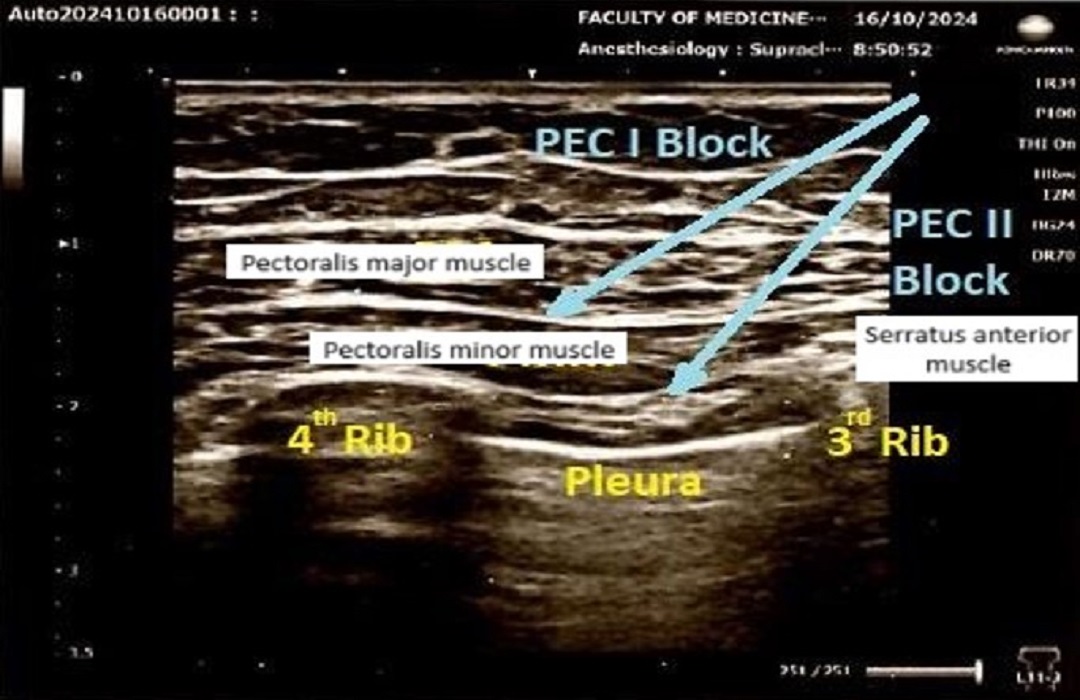
Pectoral nerve block is an effective postoperative pain control strategy for patients undergoing mastectomy. Preemptive analgesia is also recognized as a key component of multimodal pain management strategies. The purpose of this study was to compare the efficacy of preemptive ultrasound-guided pectoral nerve block (PECs block) with intraoperative PECs block. In this study, a randomized controlled trial with 44 patients undergoing mastectomy with general anesthesia was conducted, and the patients were allocated into two groups. The preemptive group received preemptive ultrasound-guided PECs block with 10 ml of 0.25% bupivacaine mixed with 1% lidocaine with epinephrine 1:200,000 for PEC I and 20 ml for PEC II, while the intraoperative group received intraoperative pectoral nerve block with 10 ml of same mixture for PEC I and 20 ml for PEC II. The primary outcome was pain intensity using a visual analogue scale (VAS). The secondary outcomes were cumulative morphine consumption over 72 hr postoperatively, total anesthetic time and complications. The study showed that at 20 hr postoperatively, the mean VAS score in the intraoperative group was 1.41 ± 1.22, which was statistically significantly lower than the 2.22 ± 1.34 observed in the preemptive group (p = 0.040). There were no complications reported in either group, and cumulative morphine consumption did not differ significantly between groups at any time point. The total anesthetic time was significantly shorter in the intraoperative group (111 ± 3.54 min) compared with the preemptive group (140 ± 2.84 min, p < 0.001). Therefore, the intraoperative PECs block resulted in significantly lower VAS scores at 20 hr postoperatively, although the clinical relevance may be limited. Additionally, the intraoperative approach may offer practical advantages in clinical settings, such as reduced anesthesia time.
References
Ali, H., Ali, M., Zanfaly, H. E., & Biomy, T. A. (2016). Pre-emptive analgesia of ultrasound-guided pectoral nerve block II with dexmedetomidine–bupivacaine for controlling chronic pain after modified radical mastectomy. Research and Opinion in Anesthesia and Intensive Care, 3(1), 6-13. https://doi.org/10.4103/2356-9115.184078
Amit, K., Mohd, S. N., Sandhya, B. K., & Jitendra, S. (2024). Efficacy of Preemptive and Preventive Analgesia in Reducing Postoperative Rescue Analgesic Requirements in Surgical Patients. Journal of Population Therapeutics and Clinical Pharmacology, 31(3), 506-514. https://doi.org/10.53555/jptcp.v31i3.4940
Bell, A., Ali, O., Robinson, A., Aggarwal, A., Blundell, M., Townend, A., & Aspinall, S. (2019). The role of pectoral nerve blocks in a day-case mastectomy service: A prospective cohort study. Annals of Medicine and surgery (2012), 48, 65–68. https://doi.org/10.1016/j.amsu.2019.10.019
Chen, S., Guo, Z., Wei, X., Chen, Z., Liu, N., Yin, W., & Lan, L. (2023). Efficacy of preemptive intercostal nerve block on recovery in patients undergoing video-assisted thoracic lobectomy. Journal Of Cardiothoracic Surgery, 18(1), 168. https://doi.org/10.1186/s13019-023-02243-z
Diéguez, P., Casas, P., López, S., & Fajardo, M. (2016). Ultrasound guided nerve block for breast surgery. Revista espanola de anestesiologia y reanimacion, 63(3), 159–167. https://doi.org/10.1016/j.redar.2015.11.003
Dsbe, M. K., Wu, J., & Sharma, R. D. (2021). The patient-Roported of Intra-operative Direct vision pectoral nerve block for post-operative analgesia for breast surgery. Surgical Science, 12, 274-285 http://doi.org/10.4236/ss.2021.128028
Elmeligy, M., Kohaf, N., Bauiomy, H., & Sakaya, A. (2024). Direct versus Ultrasound Guided PECS Block Effect on Controlling Postmastectomy Pain: A Randomized Single-Blind Trial. Benha Medical Journal, 41(5), 314-322. https://doi.org/10.21608/bmfj.2024.244677.1938
Hussain, N., Brull, R., McCartney, C. J. L., Wong, P., Kumar, N., Essandoh, M., Sawyer, T., Sullivan, T., & Abdallah, F. W. (2019). Pectoralis-II Myofascial Block and Analgesia in Breast Cancer Surgery: A Systematic Review and Meta-analysis. Anesthesiology, 131(3), 630–648. https://doi.org/10.1097/ ALN.0000000000002822
Jacobs, A., Lemoine, A., Joshi, G. P., Van de Velde, M., Bonnet, F., & PROSPECT Working Group collaborators# (2020). PROSPECT guideline for oncological breast surgery: a systematic review and procedure-specific postoperative pain management recommendations. Anaesthesia, 75(5), 664–673. https://doi.org/10.11 11/anae.14964
Jin, Z., Durrands, T., Li, R., Gan, T. J., & Lin, J. (2020). Pectoral block versus paravertebral block: a systematic review, meta-analysis and trial sequential analysis. Regional Anesthesia and Pain Medicine, 45(9), 727–732. https://doi.org/10.1136/rapm-2020-101512
Meretoja, T. J., Leidenius, M. H. K., Tasmuth, T., Sipilä, R., & Kalso, E. (2014). Pain at 12 months after surgery for breast cancer. JAMA, 311(1), 90–92. https://doi.org/10.1001/jama.2013.278795
Moon, J., Park, H. S., Kim, J. Y., Lee, H. S., Jeon, S., Lee, D., Bai, S. J., & Kim, N. Y. (2022). Analgesic Efficacies of Intraoperative Pectoralis Nerve II Block under Direct Vision in Patients Undergoing Robotic Nipple-Sparing Mastectomy with Immediate Breast Reconstruction: A Prospective, Randomized Controlled Study. Journal of Personalized Medicine, 12(8), 1309. https://doi.org/10.3390/jpm12081309
Neethu M., Pandey, R. K., Sharma, A., Darlong, V., Punj, J., Sinha, R., Singh, P. M., Hamshi, N., Garg, R., Chandralekha, C., & Srivastava, A. (2018). Pectoral nerve blocks to improve analgesia after breast cancer surgery: A prospective, randomized and controlled trial. Journal of Clinical Anesthesia, 45, 12–17. https://doi.org/10.1016/j.jclinane.2017.11.027
Ngamjarus, C., & Chongsuvivatwong, V., (2016). McNeil E. n4Studies: Sample Size Calculation for an Epidemiological Study on a Smart Device. Siriraj Medical Journal, 68(3), 160-170. https://he02.tci-thaijo.org/index.php/sirirajmedj/article/view/58342
Sherwin, A., & Buggy, D. J. (2018). Anaesthesia for breast surgery. BJA Education, 18(11), 342–348. https://doi.org/10.1016/j.bjae.2018.08.002
Steegers, M. A., Wolters, B., Evers, A. W., Strobbe, L., & Wilder-Smith, O. H. (2008). Effect of axillary lymph node dissection on prevalence and intensity of chronic and phantom pain after breast cancer surgery. The Journal of Pain, 9, 813-822. http://doi.org/10.1016/j.jpain.2008.04.001
Storm-Dickerson, T., & Sigalove, N. M. (2019). The breast surgeons' approach to mastectomy and prepectoral breast reconstruction. Gland Surgery, 8(1), 27–35. https://doi.org/10.21037/gs.2018.11.06
Thomas, M., Philip, F. A., Mathew, A. P., & Jagathnath Krishna, K. M. (2018). Intraoperative pectoral nerve block (Pec) for breast cancer surgery: A randomized controlled trial. Journal of Anaesthesiology, Clinical Pharmacology, 34(3), 318–323. https://doi.org/10.4103/joacp.JOACP_191_17
Uribe, A. A., Weaver, T. E., Echeverria-Villalobos, M., Periel, L., Pasek, J., Fiorda-Diaz, J., Palettas, M., Skoracki, R. J., Poteet, S. J., & Heard, J. A. (2022). Efficacy of PECS block in addition to multimodal analgesia for postoperative pain management in patients undergoing outpatient elective breast surgery: A retrospective study. Frontiers in Medicine, 9, 975080. http://doi: 10.3389/fmed.2022.975080
Wong, H. Y., Pilling, R. J., Young, B. W. M., Owolabi, A. A., Onwochei, D. N., & Desai, N. (2021). Corrigendum to: 'Comparison of local and regional anesthesia modalities in breast surgery: A systematic review and network meta-analysis'. Journal of Clinical Anesthesia, 75, 110491. https://doi.org/10.1016/j.jclinane.2021.110491
Xuan, C., Yan, W., Wang, D., Li, C., Ma, H., Mueller, A., Chin, V., Houle, T. T., & Wang, J. (2022). Efficacy of preemptive analgesia treatments for the management of postoperative pain: a network meta-analysis. British Journal of Anaesthesia, 129(6), 946–958. https://doi.org/10.1016/j.bja.2022.08.038
Downloads
Published
How to Cite
Issue
Section
Categories
License
Copyright (c) 2025 Asian Health, Science and Technology Reports

This work is licensed under a Creative Commons Attribution-NonCommercial 4.0 International License.