Design, Synthesis and Evaluation of Novel Coumarin-Carbamate Hybrids as Acetylcholinesterase Inhibitors for Alzheimer's Disease
DOI:
https://doi.org/10.69650/ahstr.2025.4080Keywords:
Alzheimer’s disease, Acetylcholinesterase inhibitors, Coumarin, CarbamateAbstract
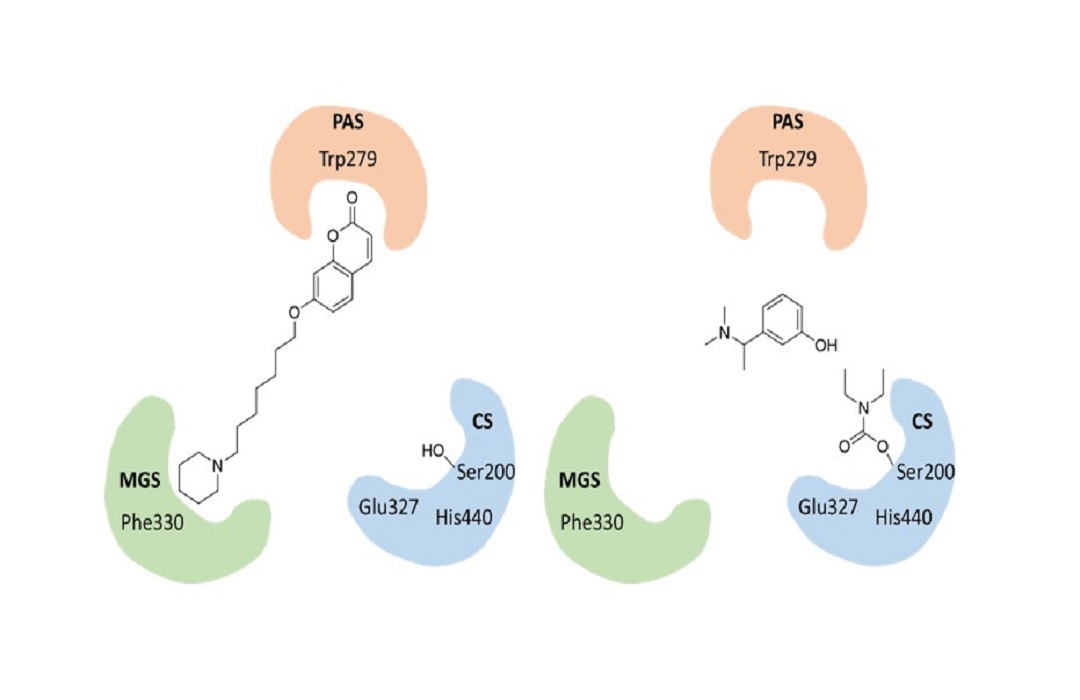
Alzheimer's disease (AD) is the most prevalent form of dementia in elderly populations and is associated with the reduction of acetylcholine (ACh) neurotransmitter levels due to neuronal degeneration and acetylcholinesterase (AChE)-catalyzed hydrolysis. Thus, AChE inhibition represents a primary therapeutic target for AD treatment. Current first-line therapies for mild to moderate AD include acetylcholinesterase inhibitors (AChEIs) such as galantamine, donepezil, and rivastigmine. Donepezil inhibits AChE activity through interactions with the peripheral anionic site (PAS), thereby impeding amyloid-beta aggregation. Conversely, rivastigmine acts as a pseudo-irreversible inhibitor through carbamylation of the serine residue at the catalytic site (CS). In this study, we designed a novel series of compounds capable of pseudo-irreversibly inhibiting AChE while simultaneously interacting with the PAS. The coumarin nucleus was selected as the core structure for PAS interaction, with an additional carbamate group incorporated as the key functionality for carbamylation reactions at the CS. Specifically, 7-hydroxycoumarin was linked to a phenyl carbamate moiety using spacers of varying methylene units (2-7). Preliminary evaluations revealed that compound RKNU153 exhibited promising AChE inhibitory activity with 63.7% inhibition, and RKNU154 exhibited AChE inhibitory activity with 73.8% inhibition, at 100 mM concentration. However, carbamylation on the serine residue at the catalytic site of our compounds was not successful, being unable to engage in this critical interaction.
References
Amin, K. M., Rahman, D. E. A., Allam, H. A., & El-Zoheiry, H. H. (2021). Design and synthesis of novel coumarin derivatives as potential acetylcholinesterase inhibitors for Alzheimer's disease. Bioorganic Chemistry, 110, 104792. https://doi.org/10.1016/j.bioorg.2021.104792
Bar-On, P., Millard, C. B., Harel, M., Dvir, H., Enz, A., Sussman, J. L., & Silman, I. (2002). Kinetic and structural studies on the interaction of cholinesterases with the anti-Alzheimer drug rivastigmine. Biochemistry, 41(11), 3555-3564. https://doi.org/10.1021/bi020016x
Bartolini, M., Cavrini, V., & Andrisano, V. (2007). Characterization of reversible and pseudo-irreversible acetylcholinesterase inhibitors by means of an immobilized enzyme reactor. Journal of Chromatography A, 1144(1), 102-110. https://doi.org/10.1016/j.chroma.2006.11.029
Bartus, R. T., Dean, R. L., Beer, B., & Lippa, A. S. (1982). The cholinergic hypothesis of geriatric memory dysfunction. Science, 217(4558), 408-414. https://doi.org/10.1126/science.7046051
Bennion, B. J., Lau, E. Y., Fattebert, J., Huang, P., Schwegler, E., Corning, W., & Lightstone, F. C. (2013). Modeling the binding of CWAs to AChE and BuChE. Military Medical Science Letters, 82(3), 102-114. https://doi.org/10.31482/mmsl.2013.015
Carvajal, F. J., & Inestrosa, N. C. (2011). Interactions of AChE with Abeta Aggregates in Alzheimer's Brain: Therapeutic Relevance of IDN 5706. Frontiers in Molecular Neuroscience, 4, 19. https://doi.org/10.3389/fnmol.2011.00019
Chaudhaery, S. S., Roy, K. K., Shakya, N., Saxena, G., Sammi, S. R., Nazir, A., Nath, C., & Saxena, A. K. (2010). Novel carbamates as orally active acetylcholinesterase inhibitors found to improve scopolamine-induced cognition impairment: pharmacophore-based virtual screening, synthesis, and pharmacology. Journal of Medicinal Chemistry, 53(17), 6490-6505. https://doi.org/10.1021/jm100573q
Chaudhary, R. K., Mateti, U. V., Khanal, P., Rawal, K. B., Jain, P., Patil, V. S., Shrivastava, A. K., & Patil, B. (2024). Alzheimer's Disease: Epidemiology, Neuropathology, and Neurochemistry. In Computational and Experimental Studies in Alzheimer's Disease (pp. 1-14). CRC Press.
Chen, H. M., Shen, K., Ji, L., McGrath, C., & Chen, H. (2025). Patterns and trends in the burden of Alzheimer’s disease and related dementias in China (1990–2021) and predictions to 2040. Journal of Alzheimer’s Disease, 105(3), 882-892. https://doi.org/10.1177/13872877251333108
Cohen, S. G., Chishti, S. B., Bell, D. A., Howard, S. I., Salih, E., & Cohen, J. B. (1991). General occurrence of binding to acetylcholinesterase-substrate complex in noncompetitive inhibition and in inhibition by substrate. Biochimica et Biophysica Acta, 1076(1), 112-122. https://doi.org/10.1016/0167-4838(91)90227-q
De Ferrari, G. V., Canales, M. A., Shin, I., Weiner, L. M., Silman, I., & Inestrosa, N. C. (2001). A structural motif of acetylcholinesterase that promotes amyloid beta-peptide fibril formation. Biochemistry, 40(35), 10447-10457. https://doi.org/10.1021/bi0101392
de Souza, G. A., da Silva, S. J., Del Cistia, C. d. N., Pitasse-Santos, P., Pires, L. d. O., Passos, Y. M., Cordeiro, Y., Cardoso, C. M., Castro, R. N., & Sant’Anna, C. M. R. (2019). Discovery of novel dual-active 3-(4-(dimethylamino) phenyl)-7-aminoalcoxy-coumarin as potent and selective acetylcholinesterase inhibitor and antioxidant. Journal of Enzyme Inhibition and Medicinal Chemistry, 34(1), 631-637. https://doi.org/10.1080/14756366.2019.1571270
De Vita, D., Pandolfi, F., Ornano, L., Feroci, M., Chiarotto, I., Sileno, I., Pepi, F., Costi, R., Di Santo, R., & Scipione, L. (2016). New N, N-dimethylcarbamate inhibitors of acetylcholinesterase: Design synthesis and biological evaluation. Journal of Enzyme Inhibition and Medicinal Chemistry, 31(sup4), 106-113. https://doi.org/10.1080/14756366.2016.1220377
Dvir, H., Silman, I., Harel, M., Rosenberry, T. L., & Sussman, J. L. (2010). Acetylcholinesterase: from 3D structure to function. Chemico-Biological Interactions, 187(1-3), 10-22. https://doi.org/10.1016/j.cbi.2010.01.042
Ellman, G. L., Courtney, K. D., Andres, V. J., & Feather-Stone, R. M. (1961). A new and rapid colorimetric determination of acetylcholinesterase activity. Biochemical Pharmacology, 7, 88-95. https://doi.org/10.1016/0006-2952(61)90145-9
Garcia-Ayllon, M. S., Small, D. H., Avila, J., & Saez-Valero, J. (2011). Revisiting the Role of Acetylcholinesterase in Alzheimer's Disease: Cross-Talk with P-tau and beta-Amyloid. Frontiers in Molecular Neuroscience, 4, 22. https://doi.org/10.3389/fnmol.2011.00022
Gupta, S., Fallarero, A., Jarvinen, P., Karlsson, D., Johnson, M. S., Vuorela, P. M., & Mohan, C. G. (2011). Discovery of dual binding site acetylcholinesterase inhibitors identified by pharmacophore modeling and sequential virtual screening techniques. Bioorganic & Medicinal Chemistry Letters, 21(4), 1105-1112. https://doi.org/10.1016/j.bmcl.2010.12.131
Hebert, L. E., Weuve, J., Scherr, P. A., & Evans, D. A. (2013). Alzheimer disease in the United States (2010-2050) estimated using the 2010 census. Neurology, 80(19), 1778–1783.
Hiranyaekaphap, T., Srimongkolpithak, N., Wongchang, T., Poowaruttanawiwat, P., Rattanamanee, K., & Kitbunnadaj, R. (2014). Discovery of novel cholinesterase inhibitor (RKNU026) with beta-amyloid aggregation inhibitory activity. The Thai Journal of Pharmaceutical Sciences, 38, 4-7. https://doi.org/10.56808/3027-7922.1992
Inestrosa, N. C., Alvarez, A., Dinamarca, M. C., Perez-Acle, T., & Colombres, M. (2005). Acetylcholinesterase-amyloid-beta-peptide interaction: effect of Congo Red and the role of the Wnt pathway. Current Alzheimer Research, 2(3), 301-306. https://doi.org/10.2174/1567205054367928
Inestrosa, N. C., Dinamarca, M. C., & Alvarez, A. (2008). Amyloid-cholinesterase interactions. Implications for Alzheimer's disease. The FEBS Journal, 275(4), 625-632. https://doi.org/10.1111/j.1742-4658.2007.06238.x
Kryger, G., Silman, I., & Sussman, J. L. (1999). Structure of acetylcholinesterase complexed with E2020 (Aricept): implications for the design of new anti-Alzheimer drugs. Structure, 7(3), 297-307. https://doi.org/10.1016/s0969-2126(99)80040-9
Lanctôt, K. L., Hahn-Pedersen, J. H., Eichinger, C., Freeman, C., Clark, A., Tarazona, L., & Cummings, J. (2024). Burden of illness in people with Alzheimer's disease: a systematic review of epidemiology, comorbidities and mortality. The journal of prevention of Alzheimer's disease, 11(1), 97-107. https://pmc.ncbi.nlm.nih.gov/articles/PMC10225771/
Liu, W., Deng, W., Gong, X., Ou, J., Yu, S., & Chen, S. (2025). Global burden of Alzheimer's disease and other dementias in adults aged 65 years and over, and health inequality related to SDI, 1990-2021: analysis of data from GBD 2021. BMC Public Health, 25(1), 1256. https://doi.org/10.1186/s12889-025-22378-z
Lomlim, L., & Nualnoi, T. (2011). New approach in development of acetylcholinesterase inhibitors for the treatment of Alzheimer's disease. Thai Pharmaceutical and Health Science Journal, 6(2), 157-173.
Morrison, A. S., & Lyketsos, c. (2005). The pathophysiology of Alzheimer’s disease and directions in treatment. Advanced Studies in Nursing, 3(8), 256-270.
Singbut, J., & Kaewket, S. (2010). Design and synthesis of novel coumarin derivatives as acetylcholinesterase inhibitors. Naresuan University.
Singh, Y. P., Kumar, N., Chauhan, B. S., & Garg, P. (2023). Carbamate as a potential anti‐Alzheimer's pharmacophore: A review. Drug Development Research, 84(8), 1624-1651. https://doi.org/10.1002/ddr.22113
Song, M.-q., Min, W., Wang, J., Si, X.-X., Wang, X.-J., Liu, Y.-W., & Shi, D.-H. (2021). Design, synthesis and biological evaluation of new carbazole-coumarin hybrids as dual binding site inhibitors of acetylcholinesterase. Journal of Molecular Structure, 1229, 129784.
Sun, Q., Peng, D.-Y., Yang, S.-G., Zhu, X.-L., Yang, W.-C., & Yang, G.-F. (2014). Syntheses of coumarin–tacrine hybrids as dual-site acetylcholinesterase inhibitors and their activity against butylcholinesterase, Aβ aggregation, and β-secretase. Bioorganic & medicinal chemistry, 22(17), 4784-4791. https://doi.org/10.1016/j.bmc.2014.06.057
Yiannopoulou, K. G., & Papageorgiou, S. G. (2020). Current and future treatments in Alzheimer disease: an update. Journal of central nervous system disease, 12, 1-12. https://doi.org/10.1177/1179573520907397
Zueva, I., Dias, J., Lushchekina, S., Semenov, V., Mukhamedyarov, M., Pashirova, T., Babaev, V., Nachon, F., Petrova, N., & Nurullin, L. (2019). New evidence for dual binding site inhibitors of acetylcholinesterase as improved drugs for treatment of Alzheimer's disease. Neuropharmacology, 155, 131-141.
Downloads
Published
How to Cite
Issue
Section
Categories
License
Copyright (c) 2025 Asian Health, Science and Technology Reports

This work is licensed under a Creative Commons Attribution-NonCommercial 4.0 International License.