Study of Factors Affecting the Efficiency of Separation Machines for the Strength of Fibers
DOI:
https://doi.org/10.69650/ahstr.2025.3949Keywords:
separation machine, fiber separation, textile industry, hemp fibers, fiber strengthAbstract
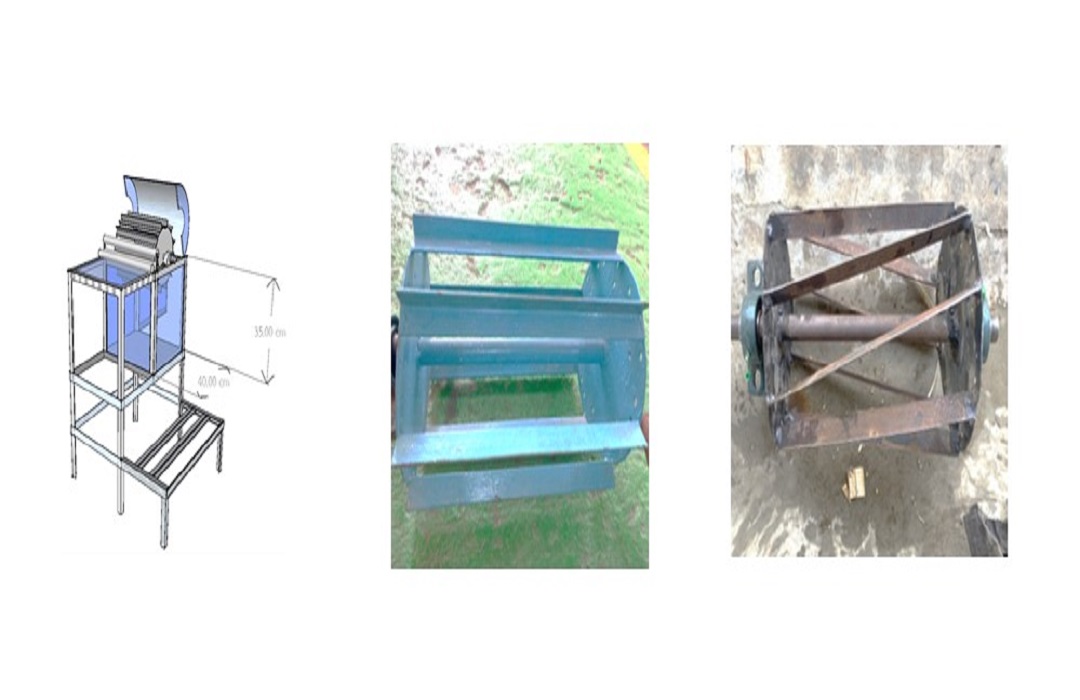
Using natural fibers helps reduce the use of fibers separated from environmentally harmful materials. Also, natural fibers reduce agricultural waste and add uniqueness to the fibers. Therefore, the objective of this research was to develop the fiber separation machine and test the efficiency of hemp fiber separation as a tool for peeling hemp fiber. The fiber separation machine consists of a beating blade assembly, a feed chute, a power transmission unit, and a waste discharge chute for the leftover material after fiber extraction. Test factors are as follows: preparation of hemp stalks (mashed stem and no mashed stem), water absorption (6, 12 hr), blade angle (0°, 15°), a set of feeds (1, 2, 3 stems), and speeds of blade (300, 400, 500 rpm). The developed hemp fiber separator effectively separates fibers from hemp stalks. Optimal performance was achieved by pre-crushing the stalks, soaking them for 6 hours, and using a blade angle of 0° at 400 rpm. With a feed rate of two stems, the machine achieved a capacity of 5.52 kg/hr, a separation efficiency of 98.20%, a post-separation loss of 0.98%, and a fiber strength of 3008.83 cN. In the operation of the machine, it consumes 0.40 kW/hr. The payback period for the hemp fiber separator is approximately 1.5 months. The fibers obtained are standardized and can provide more options for textile products, allowing communities to achieve sustainable self-reliance.
References
AOAC International. (2000). Analytical Methods: Determination of Moisture Content (AOAC, 2000) (17th ed.). Gaithersburg.
ASTM International. (2001). Standard test method for tensile properties of single textile fibers (ASTM D3822 – 01). ASTM Headquarters.
ASTM International. (2007). Standard Test Method for Linear Density of Yarn (Yarn Number) by the Skein Method (ASTM D1907 – 07). ASTM Headquarters.
Berman, H.G. (2025, Mar 24). Residual Analysis in Regression. https://stattrek.com/regression/residual-analysis
Chuan-Udom S. (2013). Grain harvesting machines. Khon Kaen University.
DITP. (2025, Mar 24). Hemp market report series for textile industry; Hemp market insight. https://www.thaitextile.org/th/insign/detail.3135.5.0.html
Elfaleh, I., Abbassi, F., Habibi, M., Ahmad, F., Guedri, M., Nasri, M., & Garnier, C. (2023). A comprehensive review of natural fibers and their composites: An eco-friendly alternative to conventional materials. Results in Engineering, 19, 101271. https://doi.org/10.1016/j.rineng.2023.101271
Fidelis, M. E. A., Pereira, T. V. C., Gomes, O. da F. M., Silva, F. de A., & Filho, R. D. T. (2013). The effect of fiber morphology on the tensile strength of natural fibers. Journal of Materials Research and Technology, 2(2), 149–157. https://doi.org/10.1016/j.jmrt.2013.02.003
Grégoire, M., Bar, M., Luycker, E. De., Musio, S., Amaducci, S., Gabrion, X., Placet, V., & Ouagne, P. (2021). Comparing flax and hemp fibres yield and mechanical properties after scutching/hackling processing. Industrial Crops & Products, 172, 114045. https://doi.org/10.1016/j.indcrop.2021.114045
Grégoire, M., Barthod-Malat, B., Labonne, L., Evon, P., Luycker, E. De., & Ouagne, P. (2020). Investigation of the potential of hemp fibre straws harvested using a combine machine for the production of technical load-bearing textiles. Industrial Crops & Products, 145, 111988. https://doi.org/10.1016/j.indcrop.2019.111988
Haug, T., Tangeland, T., Aase, T. H., & Drivdal, L. (2022). Sustainable fashion: A matter of communication and governance. Cleaner Environmental Systems, 4, 100063. https://doi.org/10.1016/j.cesys.2022.100063
Inpakdee, C. (2024). Fibers development and natural dyeing extraction from banana tree for creative communities textile product design. Naresuan University.
Karimah, A., Ridho, M. R., Munawar, S. S., Adi, D. S., Damayanti, I. R., Subiyanto, B., Fatriasari, W., & Fudholi, A. (2021). A review on natural fibers for development of eco-friendly bio-composite: characteristics, and utilizations. Journal of Materials Research and Technology, 13, 2442–2458. https://doi.org/10.1016/j.jmrt.2021.06.014
Lyu, P., Xia, L., Jiang, X., Liu, X., Xu, W., Hurren, C., & Wang, X. (2022). Efficient extraction of technical fibers from hemp in an ethanol-water mixture. Industrial Crops & Products, 178, 114620. https://doi.org/10.1016/j.indcrop.2022.114620
Mahmud, Md. A., Abir, N., Anannya, F. R., Khan, A. N., Masudur Rahman, A. N. M., & Jamine, N. (2023). Coir fiber as thermal insulator and its performance as reinforcing material in biocomposite production. Heliyon, 9, e15597. https://doi.org/10.1016/j.heliyon.2023.e15597
Manian, A. P., Cordin, M., & Pham, T. (2021). Extraction of cellulose fibers from flax and hemp: a review. Cellulose, 28, 8275–8294. https://doi.org/10.1007/s10570-021-04051-x
Musio, S., Mussig, J., & Amaducci, S. (2018). Optimizing Hemp Fiber Production for High Performance Composite Applications. Frontiers in Plant Science, 9, 1702. https://doi.org/10.3389/fpls.2018.01702
Parasakthibala, G., & Monisha, A.S. (2022). A Review on Natural Fibers; Its Properties and Application Over Synthetic Fibers. International Journal for Research in Applied Science & Engineering Technology (IJRASET), 10, 1894-1897. https://doi.org/10.22214/ijraset.2022.46530
Payom, C. (2012). The Building and Seek Efficiency of the Semi-automatic Silk-Reeling Machine. Industrial Technology Lampang Rajabhat University Journal, 5(2), 77-88.
Pigunthong, P. (2022). The development of product commercial nypa palm fibers for textiles. Naresuan University.
Rahamaththulla, S., Premnath, S., Ravi, V., Madheswaran, S., & Jayakumar, N. (2018). Design & Fabrication of Banana Fiber Extracting Machine. International Journal for Scientific Research & Development (IJSRD), 6(1), 390-393. https://doi.org/10.1016/j.matpr.2021.03.095
Rithinyo, M., Taysongnoen, K., Nithikarnjanatharn, J., Khongrit, A., & Loatong, P. (2020). The Development of Warp Yarn Adjustment of Silk Weaving Process by ECRS Technique. Journal of Engineering and Innovation, 13(1), 173-183.
Thailand Textile Institute. (2025, Mar 24). Summary Report on the Situation and Conditions of the Thai Textile and Garment Industry September 2024. https://rmuti.me/sNvV0l7QB
Thyavihalli Girijappa, Y. G., Mavinkere Rangappa, S., Parameswaranpillai, J., & Siengchin, S. (2019). Natural Fibers as Sustainable and Renewable Resource for Development of Eco-Friendly Composites: A Comprehensive Review. Frontiers in Materials, 6, 226. https://doi.org/10.3389/fmats.2019.00226
Umamageshwari, S., & Manonmani, G. (2021). Evaluation on natural fibers and its properties. Turkish Journal of Computer and Mathematics Education, 12(11), 1590-1592. https://doi.org/10.17762/turcomat.v12i11.6088
Vandepitte, K., Vasile, S., Vermeire, S., Vanderhoeven, M., Borght, W. V. der, Latre, J., Raeve, A. De, & Troch, V. (2020). Hemp (Cannabis sativa L.) for high-value textile applications: The effective long fiber yield and quality of different hemp varieties, processed using industrial flax equipment. Industrial Crops & Products, 158, 112969, https://doi.org/10.1016/j.indcrop.2020.112969
Verho, T., Turpeinen, T., Asad, F., & Immonen, K. (2025). A skeletonization-based approach for individual fiber separation in tomography images of biocomposites. Computational Materials Science, 246, 113372, https://doi.org/10.1016/j.commatsci.2024.113372
Weerachai, N. (2021). Hemp (cannabis) basics: biology and cultivation techniques. Thamsaran.
Yanaphan, R., Kuppatarat, S., & Pinmanee, S. (2023). The test of hemp varieties and their potential for fiber production. Khon Kaen Agriculture Journal (KAJ), 51(1), 140-145. https://agkb.lib.ku.ac.th/kku/search_detail/result/426918
Zhang, Q., Liu, F., Wu, D., Qu, S., Liu, W., & Chen, Z. (2023). A Comprehensive Understanding of Knife Cutting: Effects of Hardness, Blade Angle and the Micro-Geometry of Blade Edge on the Cutting Performance. Materials, 16(15), 5375. https://doi.org/10.3390/ma16155375
Downloads
Published
How to Cite
Issue
Section
Categories
License
Copyright (c) 2025 Asian Health, Science and Technology Reports

This work is licensed under a Creative Commons Attribution-NonCommercial 4.0 International License.