Heavy Metals and Microbial Loads in Freshly Made Plantain Snacks ‘Dodo-Ikire’ from Production Sites in Nigeria
DOI:
https://doi.org/10.69650/ahstr.2026.3769Keywords:
Plantain snack, Dodo-Ikire, heavy metals, microbiological analysis, production siteAbstract
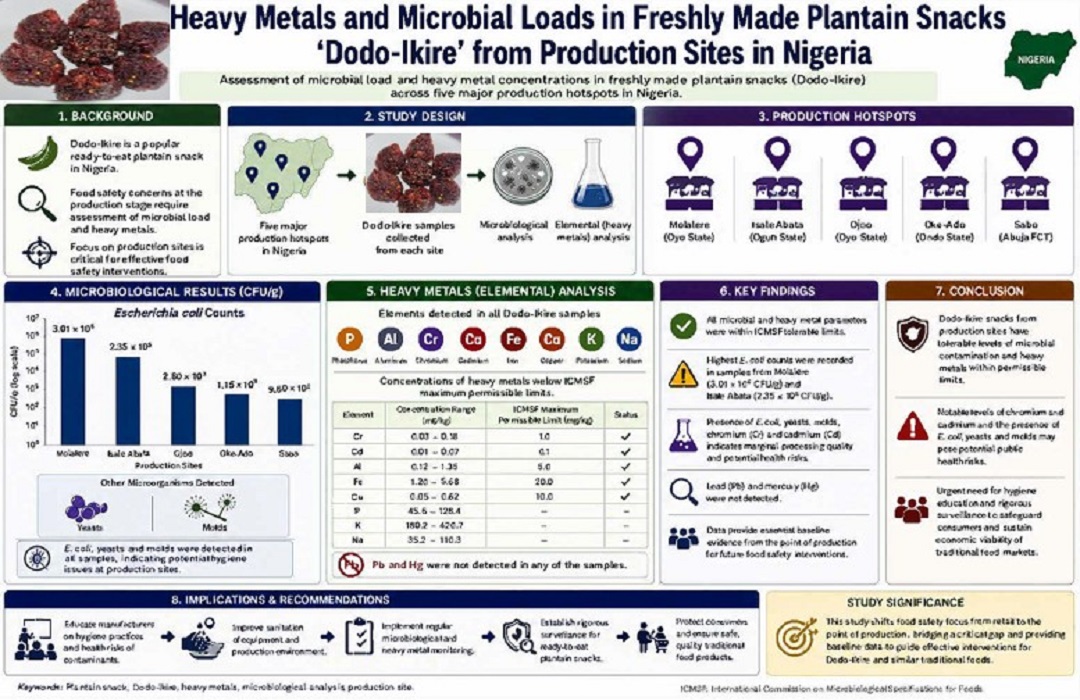
Plantain snack, locally called Dodo-Ikire, is produced from ripe plantain in Nigeria. The report on plantain snacks from the retailer’s point-of-sale calls for attention to the production centers for establishing effective food safety interventions; hence, the need to assess them for microbial load and heavy metals at that stage. This study evaluated the microbiological quality and heavy metal profiles of Dodo-Ikire across five major production hotspots in Nigeria. Microbial analysis revealed that samples from Molalere and Isale Abata exhibited the highest Escherichia coli counts (3.01 × 10⁶ CFU/g and 2.35 × 10⁵ CFU/g, respectively). phosphorus (P), aluminum (Al), chromium (Cr), cadmium (Cd), iron (Fe), copper (Cu), potassium (K), and sodium (Na) across all sites; however, concentrations did not exceed established maximum permissible limits, while lead (Pb) and mercury (Hg) remained undetected. Although the tested parameters currently fall within tolerable limits set by the International Commission on Microbiological Specifications for Foods (ICMSF), the presence of E. coli, yeasts, molds, chromium, and cadmium highlights marginal processing quality. This study bridges a critical gap by shifting the food safety focus from retail to the point of production, providing essential baseline data on heavy metal and microbial contamination. Consequently, there is an urgent need to implement targeted hygiene education regarding the health threats posed by these contaminants. Establishing rigorous surveillance for ready-to-eat plantain snacks will ultimately safeguard consumers while protecting the economic viability of traditional food markets.
References
Adewole, S. (2017). Plantain (Musa acuminata) value chain analysis in Ondo State, Nigeria. Scientific Papers Series Management, Economic Engineering in Agriculture and Rural Development, 17, 25–36.
Ajayi, K., Fabusoro, O. K., Dada, I. O., Talabi, J. Y., & Fadare, R. I. (2023). Type of pots used in cooking may influence the iron content of commonly consumed vegetables in Nigeria: A laboratory based comparative study. African Journal Reproductive Health, 27(6s), 138-142. https://doi.org/10.29063/ajrh2023/v27i6s.16
Akinyemi, S. O. S., Aiyelaagbe, I. O. O., & Akyeampong, E. (2010). Plantain (Musa spp.) cultivation in Nigeria: a review of its production, marketing and research in the last two decades. Acta Horticulturae, 879, 211–218. https://doi.org/10.17660/ActaHortic.2010.879.19
Al-Nasiry, B. S. A. N. (2020). Detection of bacterial contamination in filled and dried biscuit products of young children. Annals of Tropical Medicine & Public Health, 23(16), 84–89. https://doi.org/10.36295/ASRO.2020.231602
Alao, O. T., Alabi, D. L., & Famakinwa, F. (2020). Profitability of indigenous banana/plantain snack (dodo-ikire) among processors in Irewole Local Government Area of Osun State, Nigeria. Technoscience Journal for community development in Africa, 1(1), 63-70. https://journals.kwasu.edu.ng/index.php/technoscience/article/view/12
Amah, D., Alamu, E., & Adesokan, M. (2019). Variability of carotenoids in a Musa germplasm collection and implications for provitamin A biofortification. Food Chemistry: X, 2, 100024. https://doi.org/10.1016/j.fochx.2019.100024
Amare, A., Worku, T., Ashagirie, B., Adugna, M., Getaneh, A., & Dagnew, M. (2019). Bacteriological profile, antimicrobial susceptibility patterns of the isolates among street vended foods and hygienic practice of vendors in Gondar town, Northwest Ethiopia: A cross-sectional study. BMC Microbiology, 19(1), 120. https://doi.org/10.1186/s12866-019-1509-4
Ayanwale, A., Fatunbi, O., & Ojo, M. (2016). Innovation opportunities in plantain production in Nigeria. In: Guidebook no. 1. Forum for Agricultural Research in Africa (FARA). Accra Ghana. https://www.researchgate.net/publication/319472621_Innovation_Opportunities_in_Plantain_Production_in_Nigeria
Brown, A., Tumuhimbise, R., Amah, D., Uwimana, B., Nyine, M., Mduma, H., Talengera, D., Karamura, D., Kuriba, J., & Swennen, R. (2017). Bananas and plantains (Musa spp.). Genetic improvement of tropical crops. https://doi.org/10.1007/978-3-319-59819-2_7
Buha, A., Juddaohsingh, R., Matovic, V., Bulat, Z., Antonijevic, B., Kerns, J. G., Goodship, A., Hart, A., & Powell, J. J. (2019). Bone mineral health is sensitively related to environmental cadmium exposure-experimental and human data. Environmental Research, 176, 108538. https: doi.org/10.1016/j.envres.2019.108539
Candace, W., Stephen, M., & Imad, N. (2022). Review of regulatory reference values and background levels for heavy metals in the human diet. Regulatory Toxicology and Pharmacology, 130, 105122. https: doi.org/10.1016/j.yrtph.2022.105122
Chakraborty, N., Ghosh, R., Ghosh, S., Narula, K., Tayal, R., Datta, A., & Chakraborty, S. (2013). Reduction of oxalate levels in tomato fruit and consequent metabolic remodeling following over expression of a fungal oxalate decarboxylase. Plant Physiology, 162(1), 364-378. https://doi.org/10.1104/pp.112.209197
Eromo, T., Tassew, H., Daka, D., & Kibru, G. (2016). Bacteriological quality of street foods and antimicrobial resistance of isolates in Hawassa, Ethiopia. Ethiopian Journal of Health Sciences, 26(6), 533–542. https://doi.org/10.4314/ejhs.v26i6.5
Guo, L., Dong, X., Zhou, H., Liu, Z., & Xiong, X. (2026). Global Regulatory Mandates as Drivers for Advanced Chemical Analysis in Food Safety. Foods, 13(8), 1454. https://doi.org/10.3390/foods15081454
Hariri, S. (2022). Detection of Escherichia coli in food samples using culture and polymerase chain reaction methods. Cureus, 14(12), Article e32808. https://doi.org/10.7759/cureus.32808
Hassan, M. Z., Islam, M. S., Salauddin, M., Zafor, A. H. A., Scott, M. L., & Alam, S. (2017). Detection of enteric bacteria in the popular street food chotpoti in Dhaka, Bangladesh. Asian Journal of Medical and Biological Research, 2(4), 596–602. https://doi.org/10.3329/ajmbr.v2i4.31002
Jacobo-Estarada, T., Cardenas-Gonzalez, M., Santoyo-Sanchez, M., Thevenod, F., & Barbier, O. (2018). Intrauterine exposure to cadmium reduces HIF-1 DNA-binding ability in rat fetal kidneys. Toxics, 6(3), 53. https://doi.org/103390/toxics6030053
Jarup, L. (2003). Hazards Of Heavy Metal Contamination. British Medical Bulletin, 68, 167-182. https://doi.org/10.1093/bmb/ldg032
Jennison, A. V., & Verma, N. K. (2004). Shigella flexneri infection: Pathogenesis and vaccine development. FEMS Microbiology Reviews, 28(1), 43–58. https://doi.org/10.1016/j.femsre.2003.07.002
Jha, P., Kim, C. M., Kim, D. M., Chung, J. H., Yoon, N. R., Jha, B., Kim, S. W., Jang, S. J., Ahn, Y. J., & Chung, J. K. (2016). Transmission of Enterobacter aerogenes septicemia in healthcare workers. SpringerPlus, 5(1), 1–4. https://doi.org/10.1186/s40064-016-3011-x
Jonathan, S. G., & Olowolafe, T. B. (2001). Studies on nutrient contents and microorganisms associated with dodo Ikire a plantain snack from western Nigeria. Nigerian Society for Experimental Biology Journal (NISEB), 1(1), 27-30
Kara, M., & Soylu, S. (2022). Isolation of endophytic bacterial isolation from healthy banana trees and determination of their in vitro antagonistic activities against crown rot disease agent Fusarium verticillioides. Mustafa Kemal University Journal of Agricultural Sciences, 27(1), 36-46. https://doi.org/10.37908/mkutbd.1021349
Kaushal, M., Mahuku, G., & Swennen, R. (2020). Metagenomic insights of the root colonizing Microbiome associated with symptomatic and non-symptomatic bananas in fusarium wilt infected Fields. Plants (Basel), 9(2), 263. https://doi.org/10.3390/plants9020263
Komagbe, G. S., Sessou, P., Dossa, F., Sossa-Minou, P., Taminiau, B., Azokpota, P., Korsak, N., Daube, G., & Farougou, S. (2019). Assessment of the microbiological quality of beverages sold in collective cafes on the campuses of the University of Abomey-Calavi, Benin Republic. Journal of Food Safety and Hygiene, 5, 100–112.
Kayode, R. M. O., Ajiboye, A. T., Babayeju, A. A., Kayode, B. I., & Oladoye, C. O., Adu, K. T. (2013). Proximate, mineral composition and microbial counts of over-ripe fried plantain (Dodo-Ikire) sold by vendors in Ikire town, Nigeria. International Journal of Biotechnology, 2(4), 68–82.
Khan, A.B., Cao, Q., Zheng, Y.M., Huang, Y.Z., & Zhu, Y.G. (2008). Health risks of heavy metals in contaminated soils and food crops irrigated with wastewater in Beijing, China. Environmental Pollution, 152(3), 686-692. https://doi.org/10.1016/j.envpol.2007.06.056
Ladapo, M. (2011). Determinants of postharvest losses in plantain among farmers in some selected states in South-Western Nigeria. Journal of Agriculture, Forestry and the Social Sciences, 7(2), 64333. https://doi.org/10.4314/joafss.v7i2.64333
Makinde, O. M., Adetunji, M. C., Ezeokoli, O. T., Odumosu, B. T., Ngoma, L., Mwanza, M., & Ezekiel, C. N. (2020). Bacterial contaminants and their antibiotic susceptibility patterns in ready-to-eat foods vended in Ogun state, Nigeria. Letters in Applied Microbiology, 72(2), 187–195. https://doi.org/10.1111/lam.13407
Manhique, G. A., Hessel, C. T., Plessis, E. M. D. U., Lopes, S. M., de Oliveira Elias, S., Tondo, E. C., & Korten, L. (2020). Prevalence of enterobacteriaceae on ready-to-eat salads, drinking water and surfaces and in food markets of Maputo, Mozambique. The Journal of Food and Nutrition Research, 8(1), 63–73. https://doi.org/10.12691/jfnr-8-1-9
Mazi, I. M., Onyeaka, H., Akegbe, H., Njoagwuani, E. I., Ochulor, C. E., Oladunjoye, I. O., Omotosho, A. D., Nwaiwu, O., Tamasiga, P., & Odeyemi, O. A. (2023). Street vended foods in Nigeria: An analysis of the current state of affairs and the way forward. Cogent Food & Agriculture, 9(2), 2266194. https://doi.org/10.1080/23311932.2023.2266194
Nkwunonwo, U. C., Odika, P. O., & Onyia, N. I. (2020). A review of the health implications of heavy metals in food chain in Nigeria. Scientific World Journal, 2020, 6594109. https://doi.org/10.1155/2020/6594109
Olumba, C., & Olumba, C. (2020). Banana and plantain in West Africa: Production and marketing. African Journal of Food, Agriculture, Nutrition and Development, 20(2), 15474-15489. https://doi.org/10.18697/ajfand.90.18365
Ogidi, O. C., Oyetayo, V. O., & Akinyele, B. J. (2016). Microbial quality and antibiotic sensitivity pattern of isolated microorganisms from street foods sold in Akure Metropolis, Nigeria. Jordan Journal of Biological Sciences, 9(4), 227–234.
Ogundipe, O. T., & Oladipupo, I. C. (2018). Physico-chemical and sensory properties of fried plantain chips. Journal of food science and technology, 55(2), 532-539. https://doi.org/10.1023/A:1008186224120
Olajide, R., & Olonibua, O. (2019). Postharvest Information Needs Among Plantain Marketers in Southwestern Nigeria. Nigerian Journal of Rural Sociology, 19(1), 61-66. https://doi.org/10.22004/ag.econ.347219
Olatoye, K., & Lawal, A. (2016). Storability of " Dodo Ikire " (over -ripe plantain-basedsnack) at ambient temperature (28±2 ºC). Agricultural Engineering International: CIGR journal, 18(1), 263-268.
Oyedele, O. A., Kuzamani, K. Y., Adetunji, M. C., Osopale, B. A., Makinde, O. M., Onyebuenyi, O. E., Ogunmola, O. M., Mozea, O. C., Ayeni, K. I., & Ezeokoli, O. T. (2020). Bacteriological assessment of tropical retail fresh-cut, ready-to-eat fruits in south-western Nigeria. Scientific African, 9, 1–10. https://doi.org/10.1016/j.sciaf.2020.e00505
Oyewole, O. A. (2012). Microorganisms associated with deterioration of stored banana fruits. Frontiers in Science, 2(5), 86-91. https://doi.org/10.5923/j.fs.20120205.01
Puthiyavalappil, R., Ashwathi, V., Basheer, S. M., Jebiti, H., Santibanez, J. F., Garrote, C., Arunachalam, A. & Ramalinga, V. M. (2025). Exposure to cadmium and its impacts on human health: A Short Review. Journal of Hazardous Materials Advances, 17, 100608. https://doi.org/10.1016/j.hazadv.2025.100608
Rasin, P. V., Ashwathi, A. V., Basheer, S. M., Haribabu, J., Santibanez, J. F., Garrote, C. A., Arulraj, A. Mangalaraja, R. V. (2025). Exposure to cadmium and its impact on human health: A short review. Journal of Hazardous Materials Advances, 17, 100608. https://doi.org/10.1016/j.hazadv.2025.100608
Radwan, M. A., & Salama, A. K. (2006) Market basket survey for some heavy metals in Egyptian Fruits and vegetables. Food Chemical Toxicology, 44, 1273-1278. http://dx.doi.org/10.1016/j.fct.2006.02.004
Rai, P.K., Lee, S.S., Zhang, M., Tsang, Y.F., & Kim, K.H. (2019). Heavy metals in food crops: health risks, fate, mechanisms, and management. Environment International, 125, 365–385. https://doi.org/10.1016/j.envint.2019.01.067
Salami, M. F., Osasona, K. K., Mark, M., Falola, A., & Subair, M. B. (2023). Economic assessment of plantain marketing in Ilorin metropolis, Kwara State, Nigeria. Western Balkan Journal of Agricultural Economics and Rural Development, 5(1), 1-120. https://doi.org/10.5937/WBJAE2301001S
Snoeijs, T., Dauwe, T., Pinxten, R., Vandesande, F., & Eens, M. (2004). Heavy metal exposure affects the humoral immune response in a free-living small songbird, the great tit (Parus major). Archives of Environmental Contamination and Toxicology, 46, 399-404. https://doi.org/10.1007/s00244-003-2195-6
Wang, X., Sato, T., Xing, B., & Tao, S. (2005). Health risks of heavy metals to the public in Tianjin, China via consumption of vegetables and fish. Science of the Total Environment, 350, 28-37. https://doi.org/10.1016/j.scitotenv.2004.09.044
Xavier Pi-Sunyer, M. D. (2002). The medical risks of obesity. Obesity Surgery, 12, 65-115
Downloads
Published
How to Cite
License
Copyright (c) 2026 Asian Health, Science and Technology Reports

This work is licensed under a Creative Commons Attribution-NonCommercial 4.0 International License.